- Type
- Lesson plan
- Topics
- ScienceComputer Science
- Ages
- Ages 11-13
How can coding and 3D modeling help us accurately represent the structure, scale, and composition of molecules?
Overview
Students explore molecular structure and atomic composition by writing code to generate three-dimensional models. By manipulating color and sphere radius, learners represent individual elements and construct both simple compounds and complex chemical arrangements.
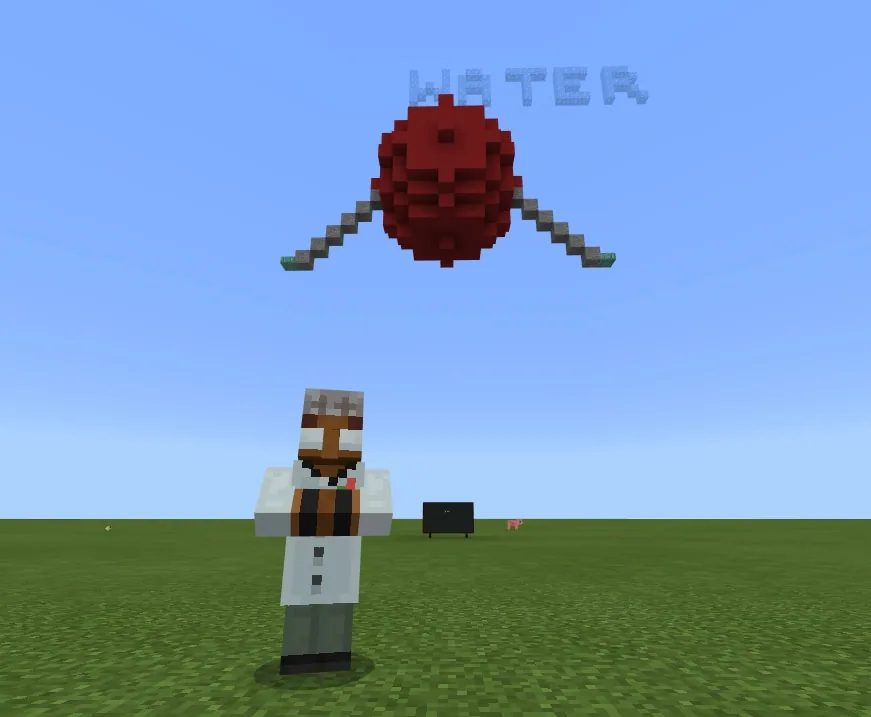
Using Minecraft Education coding commands, students spawn hollow spheres of colored concrete to build molecules such as water, ammonia, and methanol at designated build stations. They also program text labels using cardinal directions and have the option to design extended crystalline lattice networks.
Learning objectives
By the end of this lesson students will be able to:
- Construct 3D molecular models using the hollow sphere shape coding command.
- Apply appropriate color coding and relative scale to represent different atoms.
- Label molecular structures correctly using the print block command aligned to cardinal directions.
- Describe the atomic composition of simple molecules and extended crystal lattices.
Blocks and items used in this lesson


Key vocabulary
- Atom
- A basic unit of a chemical element, represented in the build by a colored concrete sphere.
- Molecule
- A group of atoms bonded together, such as water, ammonia, or methanol.
- Radius
- The distance from the center of a sphere to its edge, used in code to scale atom size.
- Extended Structure
- A repeating network or lattice of bonded atoms, such as sodium chloride or diamond.
Before class
Lesson sequence
- Introduction to Modeling Commands
Review the required chat commands for the lesson, focusing on the hollow sphere shape command and the block print command. Explain how radius controls sphere size and how player orientation to cardinal directions affects printed text placement.
- Completing Water and Ammonia
Students travel to the first two stations, standing on the prismarine brick slabs to execute their code. At the water station, they attach two smaller white hydrogen spheres to the existing red oxygen sphere. At the ammonia station, they code and attach three white hydrogen spheres to the central atom.
- Building Methanol from Scratch
Moving to the third station, students find only a prismarine brick slab. They write code to generate the entire methanol molecule from scratch, using appropriate concrete colors and radii, and then use the block print command to create a label overhead.
- Choice Molecule and Extended Lattice
In the fourth quadrant, students code a molecule of their own choice or one suggested by the teacher. Fast finishers can construct an extended lattice structure, such as sodium chloride or diamond, high above the spawn area.
Assessment: success criteria
- Student successfully generates four distinct 3D molecular models using code.
- Atoms within each molecule are appropriately scaled and color-coded.
- Molecular names are correctly oriented and displayed using the print command.
- Student can compare and contrast the structures of water, ammonia, and methanol.
Differentiation
Provide learners with exact sphere radius numbers, such as radius 3 for hydrogen and radius 5 for larger atoms, before they run commands on their prismarine slabs.
Have students code an extended crystal lattice structure such as sodium chloride or diamond high above the spawn point.
Knowledge check
5 questions to check understanding after the lesson. Tap an answer to see if it is right; the score appears at the end.
1Which coding command is used to generate the atoms for the molecular models?
Answer: A. The lesson specifies using the hollow shape sphere command to create the atoms.
2What color of concrete is recommended to represent oxygen atoms?
Answer: C. The lesson notes that red concrete is used for oxygen, blue for nitrogen, and white for hydrogen.
3Where are students instructed to stand when executing their building commands at each station?
Answer: B. Students find a prismarine brick slab at each station to stand upon when running code.
4Why must students check their cardinal direction before running the print command?
Answer: C. Students must orient themselves to cardinal directions so that printed labels place correctly.
5Which of the following is suggested as an optional extended structure challenge?
Answer: A. The lesson lists sodium chloride or diamond as optional extended lattice structures.
Resources
Part of the Code for STEM curriculum
This is lesson 11 of 20 in Code for STEM.
- 3-D Fractions
- Aquarium
- Build a Dam
- Canyon Arch Bridge
- Chicken or the Egg
- Creeper Tower Test
- Energy Transfer
- Forces
- Hour of Code: AI for Good
- Minecraft Code Town
- Molecules
- Number Line Railroad
- Plate Motions
- Road Construction Ahead
- Scale
- Slope
- Surface Area and Perimeter
- Units of Measurement
- Walled Fortress
- Wave Properties
Frequently Asked Questions
What should students do if their printed text labels face the wrong way?
Students need to check their cardinal direction and re-orient their player before running the block print command so the text generates facing the intended direction.
Why does generating larger spheres take longer in the world?
Increasing the radius creates a larger structure, which requires the game to generate significantly more blocks and increases execution time.
Adapted from Molecules by John Miller on Minecraft Education, last updated Oct 29, 2018. This classroom version, the timings and the quiz were written by 9Minecraft Education.