- Type
- Lesson plan
- Grade
- Primary (Grades 3-5)
- Ages
- Ages 8-10
- Skills
- Project Based Learning
How can we use computer code and three-dimensional block models to represent and compare fractions on a number line?
Overview
In this lesson, students explore fractions as numerical values positioned along a number line. By using physical dimensions within Minecraft, learners see fractions not just as numbers on paper, but as heights and comparative quantities made of distinct parts.
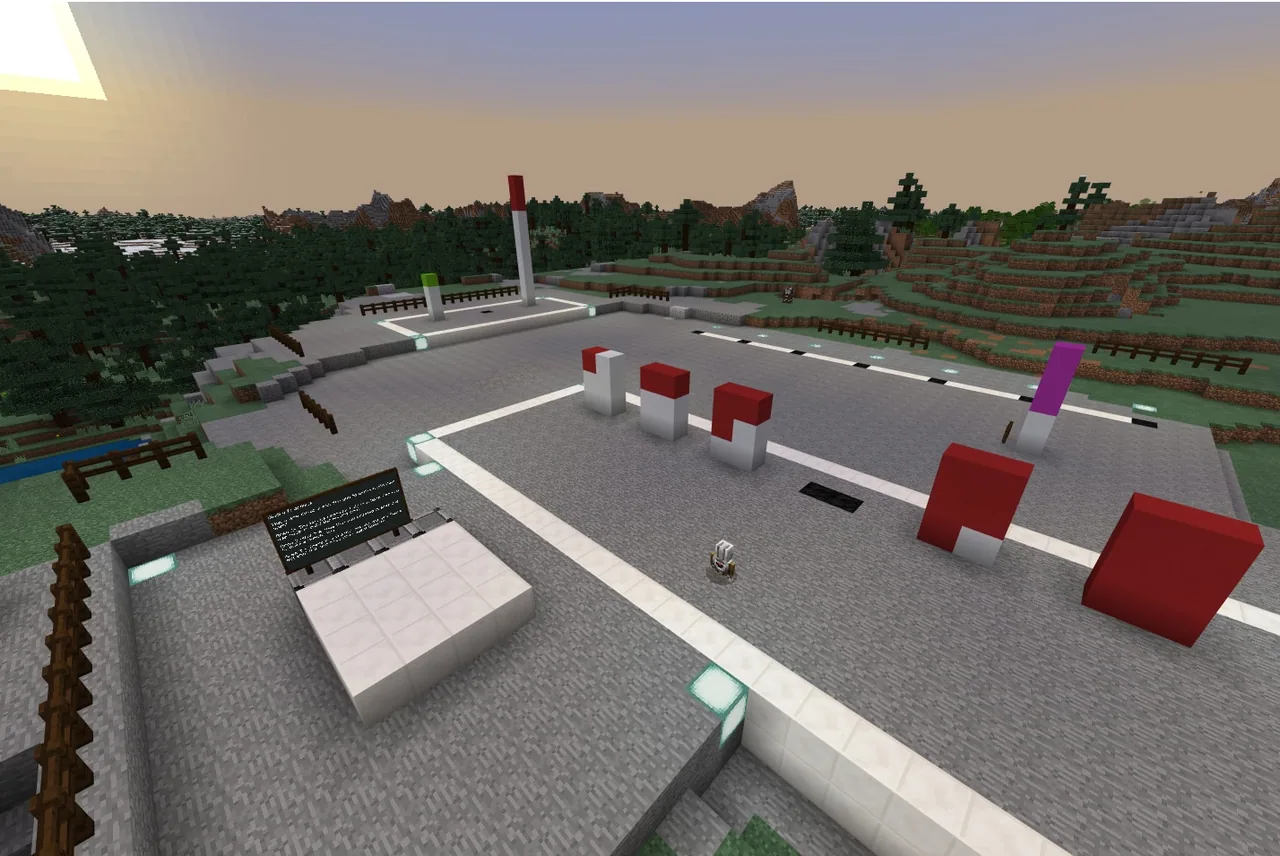
Working in pairs, students use Code Builder to program their Agent using custom chat commands. The Agent places contrasting colored concrete blocks—using darker blocks for the numerator—to build vertical columns along designated number line markers, modeling fractions such as 4/6, a full series of sevenths, and equivalent fraction relationships.
Learning objectives
By the end of this lesson students will be able to:
- Program the Agent to place vertical block columns using chat commands and inventory switching.
- Model fractions on a number line with darker blocks positioned at the top to represent the numerator.
- Construct missing fractions in sequential and equivalent fraction patterns.
- Compare fractions visually to determine equivalent values such as one-fourth, two-eighths, and three-twelfths.
Blocks and items used in this lesson


Key vocabulary
- Numerator
- The number above the fraction line, represented in this lesson by darker blocks placed at the top.
- Denominator
- The total number of equal parts that make up the whole, shown by the full height or count of blocks.
- Equivalent Fractions
- Fractions that have different numbers but represent the exact same value or size.
- Agent
- A programmable helper that moves and places blocks based on student code commands.
- Active Slot
- The specific inventory space chosen in code so the Agent knows which block to place.
Before class
Lesson sequence
- Inspect the Model
Introduce the vertical column model representing 3/5. Remind students that darker, shaded blocks represent the numerator and must sit at the top of the fraction stack for clarity and consistency across all activities.
- Activity 1: Building 4/6
In pairs, students find the sequence 1/6 to 6/6 and locate the two black blocks marking 4/6. Students load white concrete into Agent inventory slot 1 and red concrete into slot 2.
Students write chat commands using teleport, turn, place on move, and set active slot to build a 3-block-high column with 1 white and 2 red blocks, then construct the matching second column.
- Activity 2: The Sevenths Number Line
Students apply their column-building code to a new number line marking 1/7 through 7/7. Learners instruct their Agent to place ordered fraction columns directly on top of each black block marker, maintaining clear visual contrast between numerator and denominator.
- Activity 3: Finding Equivalent Fractions
Students inspect two existing fraction columns to identify their values. They determine the missing equivalent fraction between 1/4 and 3/12 and program their Agent to construct it on the black marker.
- Reflection and Discussion
Bring the class together to discuss how the Agent was used to construct fractions, identify which fraction was the most difficult to build, and predict the next fraction in the sequence 1/4, 2/8, 3/12.
Assessment: success criteria
- The Agent places a 4/6 model on the two black blocks using two columns of 1 white block and 2 red blocks.
- The Agent places the complete sequence of fraction columns from 1/7 through 7/7 along the number line.
- Students correctly identify and build the equivalent fraction between 1/4 and 3/12.
- Students explain how switching inventory slots between slot 1 (white) and slot 2 (red) creates the numerator and denominator.
Differentiation
Allow students to build the second column using a separate chat command that places blocks from the bottom up rather than coding a continuous top-down sequence.
Have advanced students code their Agent to automatically build multiple columns in sequence or construct the second column from the top down.
Knowledge check
5 questions to check understanding after the lesson. Tap an answer to see if it is right; the score appears at the end.
1Which blocks represent the numerator in the 3-D models built during this lesson?
Answer: B. The lesson specifies that darker, shaded blocks represent the numerator and should be placed at the top of the fraction.
2Why must students program the Agent to change its active inventory slot?
Answer: D. Slot 1 holds white concrete and slot 2 holds red concrete, requiring an active slot change to place different colors.
3What missing equivalent fraction are students asked to identify and build between 1/4 and 3/12?
Answer: A. The equivalent fraction sequence given in the lesson is 1/4, 2/8, 3/12.
4What indicates the exact locations on the number line where fraction columns should be placed?
Answer: C. Black blocks on the number line mark where students must instruct their Agent to place the fraction columns.
5In Activity 1, what is the block composition of each 3-block-tall column used to build 4/6?
Answer: B. The builder instructions specify that the single column is 3 blocks high with 1 white and 2 red blocks.
Resources
- World FileWorld file for student use
- Lesson worldOpens the world page in Minecraft Education (sign-in with a school account may be needed).
Part of the Code for STEM curriculum
This is lesson 1 of 20 in Code for STEM.
- 3-D Fractions
- Aquarium
- Build a Dam
- Canyon Arch Bridge
- Chicken or the Egg
- Creeper Tower Test
- Energy Transfer
- Forces
- Hour of Code: AI for Good
- Minecraft Code Town
- Molecules
- Number Line Railroad
- Plate Motions
- Road Construction Ahead
- Scale
- Slope
- Surface Area and Perimeter
- Units of Measurement
- Walled Fortress
- Wave Properties
Frequently Asked Questions
What materials need to be placed in the Agent's inventory?
Students should place white concrete blocks into slot 1 and red concrete blocks into slot 2 so the Agent can alternate between them when building fraction components.
Why are students encouraged to work in pairs?
Pair work allows students to collaborate on troubleshooting Agent orientation, writing chat commands, and reasoning through equivalent fractions together.
What model should students look at before starting their number line builds?
Students should inspect a vertically stacked block model in the world that represents the fraction 3/5 to understand how numerators and denominators are visually separated.
Adapted from 3-D Fractions by John Miller on Minecraft Education, last updated Jul 16, 2025. This classroom version, the timings and the quiz were written by 9Minecraft Education.