- Type
- Lesson plan
- Ages
- Ages 8-13
- Duration
- about 1.5 hours (suggested)
How can we harness natural renewable energy sources in different environments to power our homes sustainably?
Overview
Modern society relies heavily on fossil fuels to meet its energy demands, yet these resources are finite and contribute to environmental harm through carbon dioxide emissions. Renewable energy technologies harness ongoing natural processes such as sunlight, wind, and flowing water, providing sustainable alternatives with stable operational costs despite construction expenses and geographic limitations.
In this lesson, students work in groups to examine different renewable energy categories and their real-world practicalities. They translate this knowledge into Minecraft by locating an appropriate biome, constructing a modeled energy facility, building a home powered by that facility, and documenting their design using in-game photography.
Learning objectives
By the end of this lesson students will be able to:
- Explain the essential differences between finite fossil fuels and naturally replenished renewable energy sources.
- Identify key benefits and trade-offs associated with different renewable power technologies.
- Match specific renewable energy types to their optimal Minecraft biomes and environmental conditions.
- Construct a renewable energy installation and an accompanying functional home within Minecraft.
- Document and present the energy conversion process and viable real-world locations using in-game photos.
Blocks and items used in this lesson


Key vocabulary
- Fossil fuels
- Energy sources that are limited in quantity and emit carbon dioxide when burned.
- Renewable energy
- Energy gathered from sources that naturally replenish themselves, such as wind, water, and sunlight.
- Hydroelectric power
- Electricity generated by using the natural movement and flow of water.
- Geothermal energy
- Thermal energy derived and harnessed from the internal heat of the earth.
- Biomass
- Renewable organic material that can be converted into usable energy.
Before class
Lesson sequence
Suggested timing: about 90 minutes in total.
- Introduction: Energy Sources and Trade-offs15 min
Introduce the distinction between fossil fuels and renewable energy, noting that fossil fuels currently supply roughly 80 percent of energy needs in the United States. Discuss hydroelectric power using the Hoover Dam as a concrete example.
Review the advantages of renewables, including pollution reduction and long-term price stability, alongside challenges like weather dependence, high initial construction costs, and localized availability.
- Group Selection and Biome Matching15 min
Organize students into small teams and assign or let them choose a renewable energy type: wind, solar, hydro, geothermal, tidal, or biomass.
Have teams select an appropriate Minecraft biome that reflects the natural conditions needed for their energy type, such as deserts or savannas for solar, oceans or beaches for tidal, or rivers and hills for hydro.
- In-Game Construction35 min
Students enter their world, locate their chosen biome, and construct a working model of their renewable power generator.
Alongside the power facility, students design and build a home that demonstrates the practical use of that generated clean energy.
- Documentation and Group Presentations25 min
Students use the in-game camera to take detailed photos of their clean energy facility and home build.
Teams present their images and answer core questions: how their resource converts into usable power, its key pros and cons, and where in their country or the world this energy source works best.
Assessment: success criteria
- Student accurately distinguishes between fossil fuels and renewable resources in discussion and presentations.
- Student correctly pairs their chosen energy system with an environmentally suitable Minecraft biome.
- Student constructs a model power generator and a home that makes use of the generated energy.
- Student delivers a presentation using in-game photos that explains the conversion process, pros, cons, and real-world placement.
Differentiation
Provide students with a visual biome-to-energy cheat sheet listing the source suggestions to guide their building location.
Ask advanced students to investigate and present specific geographic regions within their own country that are best suited for their chosen renewable source.
Knowledge check
5 questions to check understanding after the lesson. Tap an answer to see if it is right; the score appears at the end.
1What proportion of energy needs in the United States is currently supplied by fossil fuels?
Answer: C. According to the lesson facts, fossil fuels currently account for 80 percent of the energy needs in the United States.
2Which of the following is considered a primary advantage of renewable energy sources?
Answer: A. Renewable energy helps combat climate change and reduces pollution, and sources like wind and solar do not run out.
3Which pair of Minecraft biomes is recommended for a solar energy build?
Answer: B. The lesson lists Savanna, Desert, Mesa, and Plains as ideal biomes for modeling solar energy.
4What is one limitation of wind and solar energy highlighted in the lesson?
Answer: B. Wind and solar energy output is variable because it depends directly on weather patterns, seasons, and daylight.
5Which in-game tool are students expected to use to capture visuals of their completed energy builds?
Answer: D. The lesson requires students to use the in-game camera to take photos of their build to illustrate their presentations.
Resources
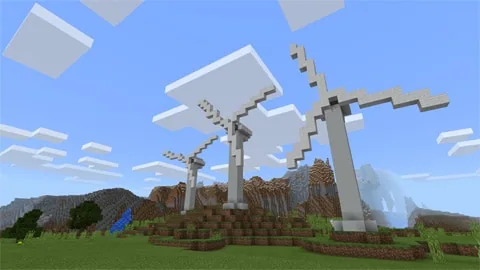
- Minecraft World FilesBiomes and wind power example.
- Lesson worldOpens the world page in Minecraft Education (sign-in with a school account may be needed).
Frequently Asked Questions
What types of worlds can students use to build their projects?
Teachers can use the provided starter worlds, have students generate a new world to explore, or look up seed worlds that contain the specific biomes required for the assignment.
What real-world engineering project is cited to illustrate hydroelectric energy?
The Hoover Dam is specifically highlighted as a real-world example when introducing students to hydroelectric power generation.
Adapted from Renewable Energy by Minecraft Education on Minecraft Education, last updated Aug 26, 2026. This classroom version, the timings and the quiz were written by 9Minecraft Education.