
- Type
- Lesson plan
- Subject
- Science
- Topics
- Science
- Ages
- Ages 8-18
- Duration
- about 1.5 hours (suggested)
How do the structures of the circulatory system work together to transport blood and sustain life?
Overview
The circulatory system transports blood throughout the human body, relying on interconnected structures to deliver oxygen, exchange gases, and sustain life. In this lesson, students investigate key components such as the heart chambers, alveoli, and capillary beds to understand how blood flows through pulmonary and systemic pathways.
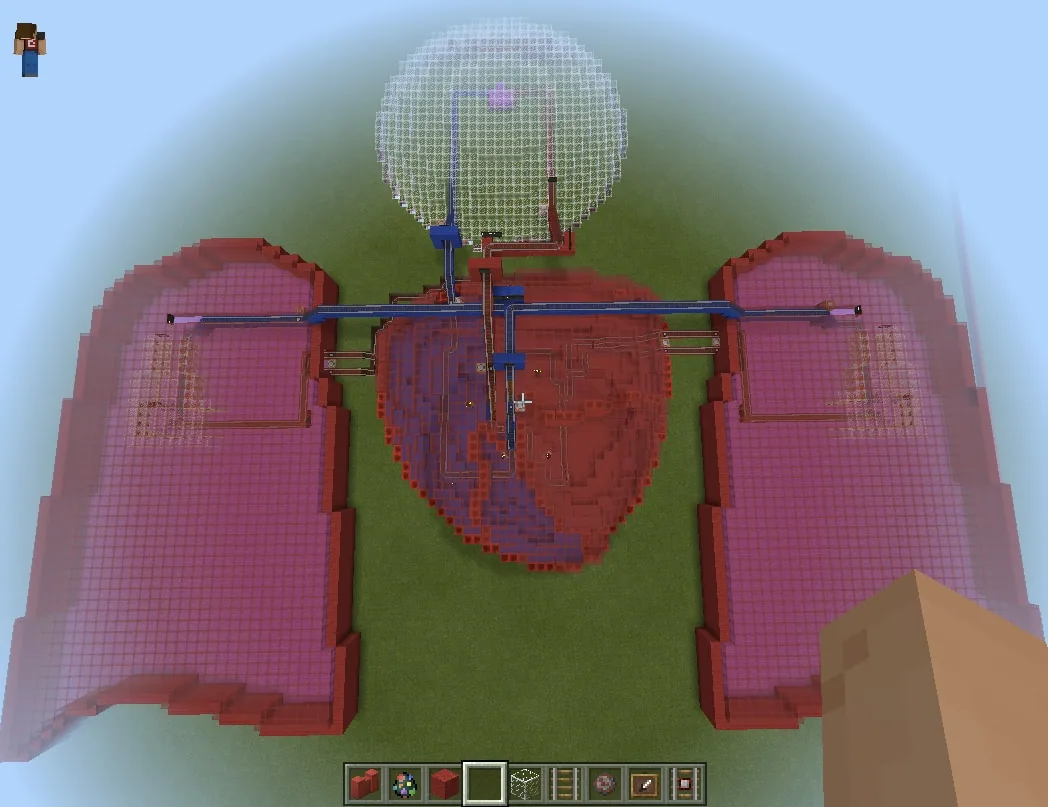
Students enter a dedicated Minecraft world modeled after the circulatory system. Working in cooperative teams, individual learners explore assigned anatomical structures within the virtual environment before collaborating to construct and present a physical product, such as a poster or sculpture, that illustrates their combined understanding.
Learning objectives
By the end of this lesson students will be able to:
- Identify the major anatomical structures of the human circulatory system.
- Explain the roles of the heart, alveoli, and capillaries in moving blood through the body.
- Collaborate with peers to construct a physical model illustrating blood circulation.
- Present findings clearly by describing how individual body structures contribute to the whole system.
Blocks and items used in this lesson


Key vocabulary
- Circulatory System
- The body system responsible for pumping and moving blood, oxygen, and nutrients throughout the body.
- Alveoli
- Tiny air sacs in the lungs where gas exchange occurs with the blood.
- Capillary Exchange
- The transfer of oxygen, nutrients, and waste products between blood in tiny vessels and surrounding tissues.
- Heart
- The central muscular organ divided into halves that pumps blood through the lungs and the body.
Before class
Lesson sequence
Suggested timing: about 90 minutes in total.
- Introduction & Role Assignment10 min
Introduce the lesson by presenting the guiding questions about the circulatory system. Divide students into small teams and assign each student an individual focus area to research: the right half of the heart, the left half of the heart, the alveoli, or capillary exchange.
- In-World Exploration & Research25 min
Students load into the Circulatory System Minecraft world. Each learner navigates to and explores their assigned structure, gathering observations on its design, function, and how blood passes through it.
- Team Synthesis & Product Construction35 min
Students regroup with their teammates to teach one another about their assigned structures. Using physical classroom supplies, each team works collaboratively to design and build a representative product, such as a labeled poster or three-dimensional sculpture, that demonstrates the complete pathway of blood flow.
- Group Presentations & Assessment20 min
Each team presents their finished model to the class. Every member must speak to explain their designated structure and its role in blood flow, while the team collectively answers the driving questions to show how these organs work together to sustain life.
Assessment: success criteria
- The physical product accurately represents the major structures of the circulatory system.
- The project clearly diagrams or models the pathway of blood flow through the heart, lungs, and body.
- The team presentation addresses all guiding questions regarding the function and purpose of the circulatory system.
- Every team member actively explains their assigned anatomical component during the presentation.
Differentiation
Provide a labeled flow diagram for students to reference while locating their assigned structure inside the Minecraft world.
Ask advanced learners to explain the specific gas and nutrient exchanges taking place at both the lung and tissue levels during their presentation.
Knowledge check
5 questions to check understanding after the lesson. Tap an answer to see if it is right; the score appears at the end.
1Which organ acts as the primary pump moving blood through the circulatory system?
Answer: B. The heart pumps blood continuously through the circulatory system.
2Where in the lungs does gas exchange take place with the bloodstream?
Answer: A. Alveoli are microscopic air sacs in the lungs where oxygen enters and carbon dioxide exits the blood.
3What happens during capillary exchange?
Answer: C. Capillary exchange allows vital nutrients and gases to move between the bloodstream and surrounding body tissues.
4Why is the heart divided into a right half and a left half?
Answer: B. The two halves of the heart work together to direct deoxygenated blood to the lungs and oxygenated blood out to the body.
5What is the primary function of the circulatory system?
Answer: D. The circulatory system exists to transport blood, delivering necessary nutrients and oxygen throughout the body.
Resources
- Lesson package (.zip)Everything the author attached to this lesson in one download.
- Circulatory SystemThis is the Minecraft EE world that accompanies this lesson.
- Lesson worldOpens the world page in Minecraft Education (sign-in with a school account may be needed).
Frequently Asked Questions
What materials are recommended for the final student product?
Teams can use whatever creative mediums you have available, including poster board, construction paper, recycled cardboard, or modeling clay, to construct their model of blood flow.
How can I ensure all students contribute during group presentations?
Because each member was responsible for researching a distinct anatomical feature in the Minecraft world, require each student to speak individually about their assigned structure during the presentation.
Adapted from Circulatory System by Randy Otaka on Minecraft Education, last updated Aug 19, 2021. This classroom version, the timings and the quiz were written by 9Minecraft Education.






































