- Type
- Lesson plan
- Subject
- Math
- Topics
- Math & Economics
- Ages
- Ages 8-13
How can unit cubes and mathematical formulas help us measure and understand two-dimensional and three-dimensional space?
Overview
This lesson introduces students to spatial measurement by examining two-dimensional area and three-dimensional volume. Learners discover that volume represents the total quantity of identical unit cubes required to fill a three-dimensional space without leaving gaps or overlapping shapes, reinforcing foundational geometry and algebraic thinking.Learning objectives
By the end of this lesson students will be able to:
- Identify volume as an attribute of three-dimensional space.
- Calculate volume by finding the total number of same-size unit cubes needed to pack a space without gaps or overlaps.
- Write and interpret numerical expressions using area and volume formulas.
- Construct original block-based puzzles for a peer to analyze and solve.
Blocks and items used in this lesson


Key vocabulary
- Area
- The measurement of the surface space enclosed within a two-dimensional shape.
- Volume
- The amount of three-dimensional space enclosed or occupied by an object.
- Unit Cube
- A cube with equal dimensions used as a standard unit to measure volume without gaps or overlaps.
- Numerical Expression
- A mathematical phrase that combines numbers and operational signs to show a calculation.
Before class
Lesson sequence
- Concept Introduction
Introduce the concepts of area and volume to the whole class. Explain that three-dimensional volume is measured by counting the total number of identical unit cubes required to fill a space completely, ensuring there are no gaps or overlapping blocks.
- World Exploration and Puzzle Solving
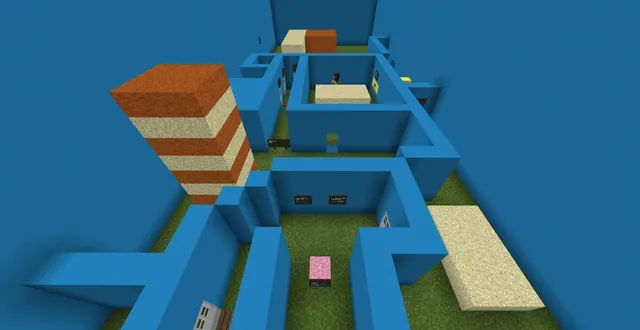
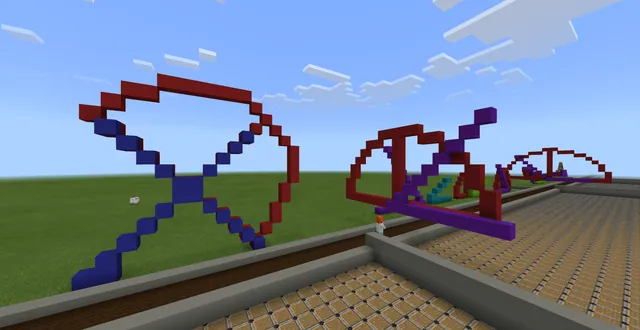
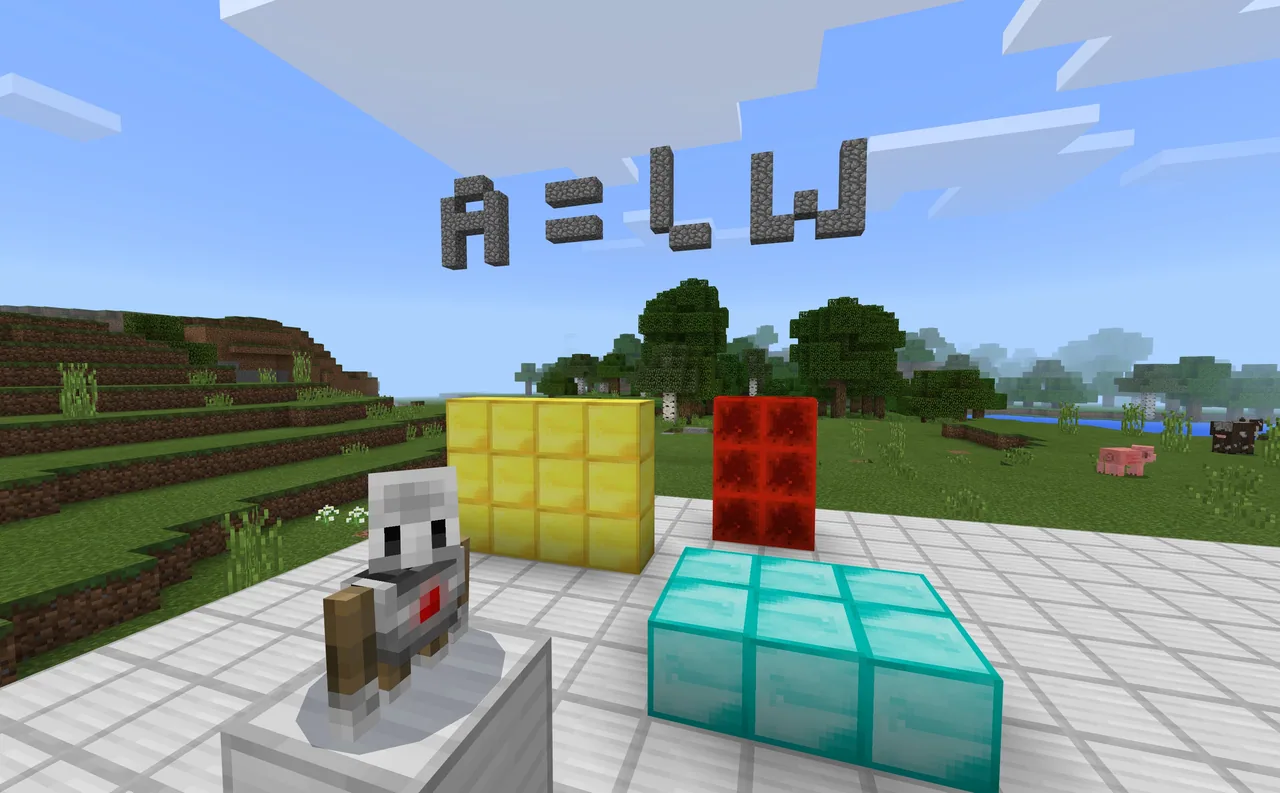
Students enter the supplied Minecraft world and use the visual block structures to inspect geometric dimensions. Working individually, they apply area and volume formulas to calculate solutions for each puzzle presented in the environment.
- Documentation of Solutions
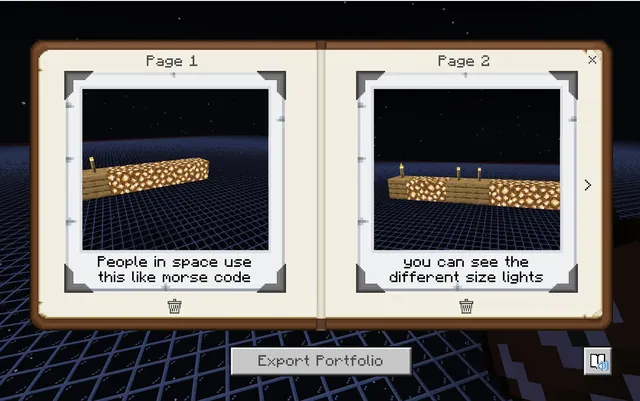
Learners record their calculated answers directly onto the chalkboards located near each puzzle and capture their work with the in-game camera or a screenshot. Alternatively, students can number the puzzles and record their numerical expressions and answers on paper.
- Peer Challenge Creation
Students pair up to extend their learning. Each learner designs and builds an original area or volume puzzle out of blocks inside Minecraft, then challenges their partner to calculate the dimensions and solve it.
Assessment: success criteria
- The student correctly writes and evaluates numerical expressions for area and volume puzzles.
- The student explains volume as a three-dimensional measurement based on unit cubes packed without overlaps or gaps.
- The student creates a clear, solvable block puzzle that allows a partner to test their measurement skills.
Differentiation
Allow students to number puzzles on paper and directly count physical blocks in the world before applying multiplication formulas.
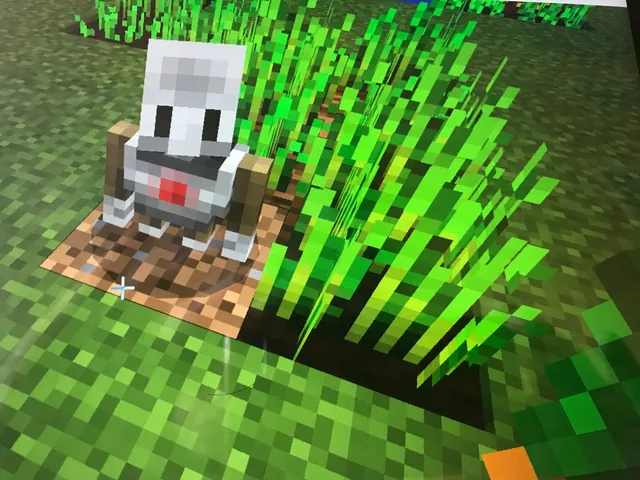
Have students open Code Connection and program the Agent to automatically construct their custom three-dimensional puzzles.
Knowledge check
5 questions to check understanding after the lesson. Tap an answer to see if it is right; the score appears at the end.
1How is volume measured according to this lesson?
Answer: C. Volume is defined as the total number of identical units needed to pack a three-dimensional space completely without gaps or overlaps.
2What attribute does volume describe?
Answer: A. The learning objectives specify that students will recognize volume as an attribute of three-dimensional space.
3How do students record their answers within the Minecraft world?
Answer: B. The activity instructions direct students to write answers on nearby chalkboards and record them using screenshots or the camera tool.
4What task do students complete in pairs after finishing the supplied puzzles?
Answer: C. After solving the built-in puzzles, each student builds their own block puzzle for a partner to solve.
5Which tool can students use to code and build their extension shapes?
Answer: B. The lesson suggests using Code Connection and the Agent as an extension to construct geometric shapes.
Resources
Part of the Area and Perimeter curriculum
This is lesson 1 of 5 in Area and Perimeter.
Frequently Asked Questions
What should I do if students struggle with in-game photography tools?
Students can simply number each puzzle and write down their calculations and numerical expressions on a sheet of paper instead of using in-game chalkboards and cameras.
How does this lesson integrate computer science?
Students who finish early can take on an extension challenge using Code Connection to program the Agent to automatically construct their three-dimensional shapes.
Adapted from Area and Volume by Minecraft Education on Minecraft Education, last updated Feb 28, 2025. This classroom version, the timings and the quiz were written by 9Minecraft Education.