- Type
- Lesson plan
- Subject
- Math
- Topics
- Math & Economics
- Grade
- Primary (Grades 3-5)
- Ages
- Ages 8-10
How can our understanding of area help us derive and calculate the volume of rectangular prisms and irregular shapes?
Overview
Students investigate volume as an attribute of solid figures, connecting what they already know about unit measurements and two-dimensional area to three-dimensional space. By working through block-based models, learners observe how individual unit cubes accumulate to fill rectangular prisms and irregular geometric figures.Learning objectives
By the end of this lesson students will be able to:
- Describe volume as the measurement of unit cubes that fill a solid figure.
- Derive the formula for finding the volume of a rectangular prism using base area.
- Calculate the total volume of rectangular prisms and irregular shapes.
Blocks and items used in this lesson


Key vocabulary
- Unit measurement
- A fixed standard quantity used to measure length, area, or volume.
- Area
- The total amount of flat two-dimensional surface within a boundary.
- Rectangular prism
- A solid three-dimensional object with six rectangular faces.
- Volume
- The amount of three-dimensional space enclosed inside a solid boundary.
- Irregular shape
- A three-dimensional structure that does not have uniform or standard rectangular dimensions.
Before class
Lesson sequence
- Level 1: Sandboxes
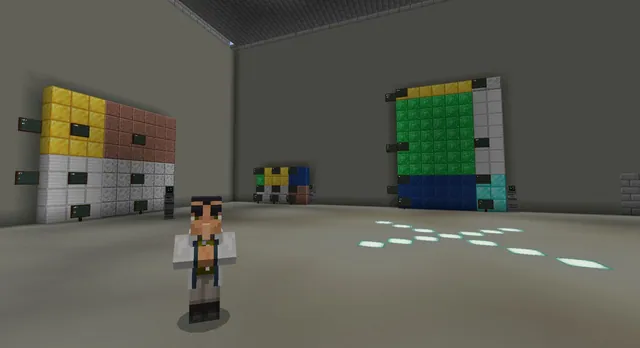
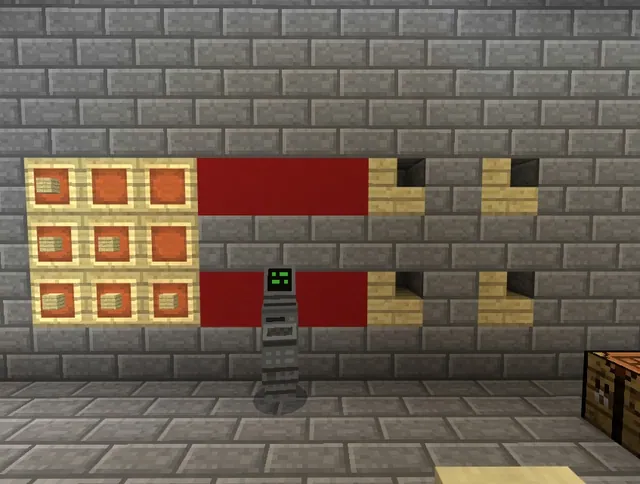
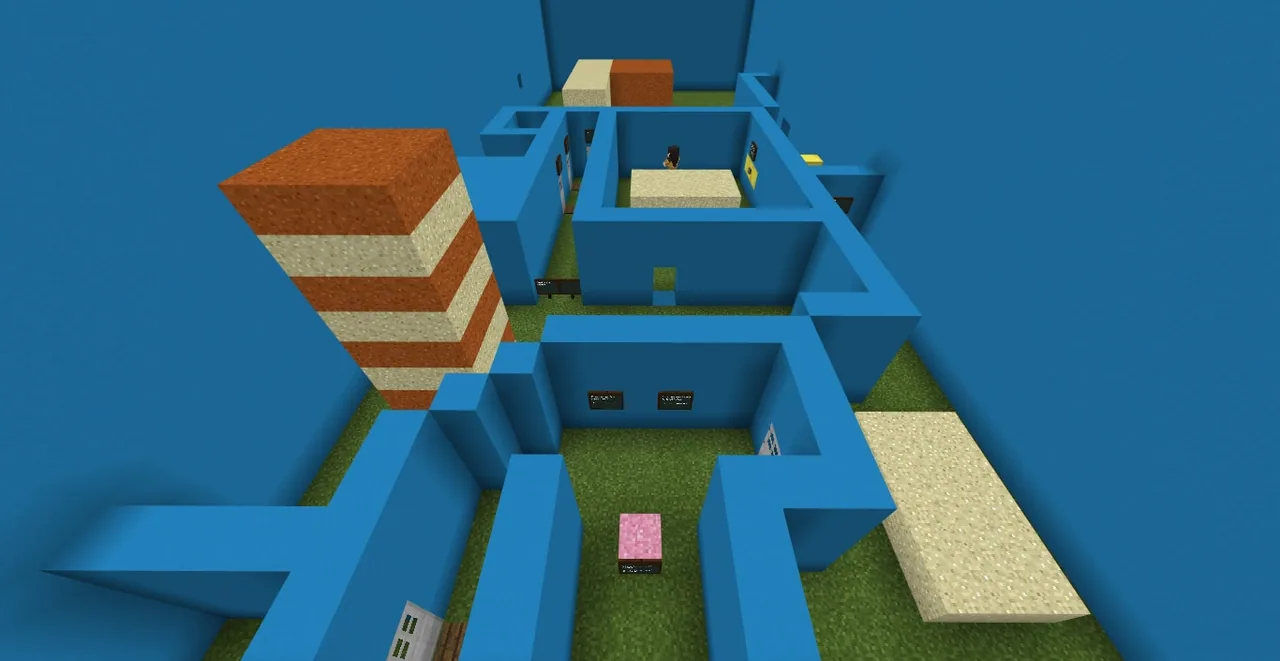
Students load the single-player world and encounter three sandboxes alongside three piles of sand blocks. Students measure the area of each sandbox, determine which sand pile corresponds to each area, and fill the sandboxes completely to open the exit door.
- Level 2: Volume Maze
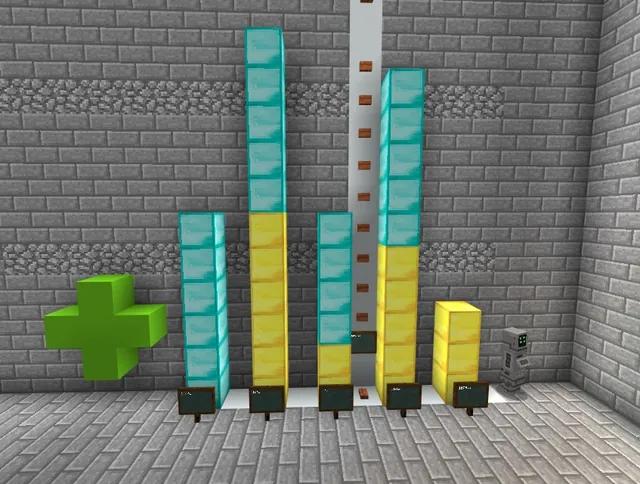
Learners enter a maze where they collect clues that demonstrate how to derive the volume formula. Along the paths, they determine the volume of standard rectangular prisms before finding the volume of an irregular shape.
- Level 3: Boss Fight Dropper
Students complete a dropper challenge where they fall from a height, avoid obstacles during descent, and land safely in water. At the bottom, students examine a final irregular shape and determine its total volume to complete the stage.
- Score Room & Reflection
Students step into the Score Room to view three scores corresponding to measurement and data standards. Facilitate a short group discussion about how base area links directly to 3D volume calculations.
Assessment: success criteria
- The student correctly matches sand quantities to sandbox areas to unlock Level 2.
- The student explains how to derive the volume formula using the concept of area.
- The student determines the correct volume for rectangular prisms encountered in the maze.
- The student calculates the volume of irregular block figures in Level 2 and Level 3.
Differentiation
Allow students who struggle with mental multiplication to watch the provided help videos and count individual unit blocks before setting up equations.
Have students sketch their own irregular block figures and write equations showing how to split them into separate rectangular prisms.
Knowledge check
5 questions to check understanding after the lesson. Tap an answer to see if it is right; the score appears at the end.
1In Level 1, what must students do to unlock the door to Level 2?
Answer: B. Students open the door by matching the amount of sand in each pile to the area of the three sandboxes and filling them.
2What math concept do students uncover clues about while navigating the Level 2 maze?
Answer: A. Clues scattered inside the Level 2 maze guide students to derive the volume formula.
3What physical challenge must players survive at the beginning of Level 3?
Answer: C. In Level 3, students fall through a dropper game where they must avoid touching anything on the way down and land safely in water.
4What final task must students complete at the bottom of the Level 3 drop?
Answer: D. After landing safely in the water, students examine an irregular shape and calculate its volume to complete the lesson.
5Which earlier geometric concept directly helps students derive the formula for 3D volume?
Answer: C. The lesson uses the area of a base to help learners derive and understand the formula for volume.
Resources
Part of the Grade 5 Math curriculum
This is lesson 13 of 13 in Grade 5 Math.
- The Decimal Dungeon - Part 1
- The Decimal Dungeon - Part 2
- The Decimal Dungeon - Part 3
- The Decimal Dungeon - Part 4
- The Decimal Dungeon - Part 5
- City Planning - Survival Roads
- Classifying Quadrilaterals
- Coordinate Planes in Minecraft
- Crafting Fractions
- Fraction World
- Fractions and Multiplication
- Javelin Line Plots
- Volume World
Frequently Asked Questions
What should students do if they fail the dropper challenge in Level 3?
Students can retry the fall until they maneuver past the obstacles and land safely in the water at the bottom, where the final math task awaits.
How does the world provide assessment feedback to the teacher?
At the end of Level 3, players enter the Score Room, which displays three separate scores aligned with the measurement and data standards taught in the lesson.
Adapted from Volume World by Minecraft Education on Minecraft Education, last updated Jul 14, 2025. This classroom version, the timings and the quiz were written by 9Minecraft Education.