- Type
- Lesson plan
- Subject
- Math
- Topics
- Math & Economics
- Grade
- Primary (Grades 3-5)
- Ages
- Ages 8-10
- Duration
- about 1.5 hours (suggested)
How can we use unit conversions and algebraic equations to plan and gather the exact materials needed to construct a road?
Overview
In this lesson, students combine measurement conversion and algebraic thinking to plan a civic construction project. By converting 0.2 kilometers into meters, learners examine how mathematical equations help builders estimate material quantities accurately before starting manual work.
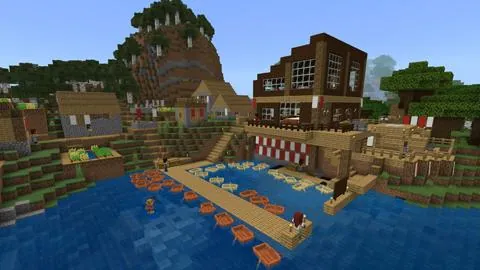
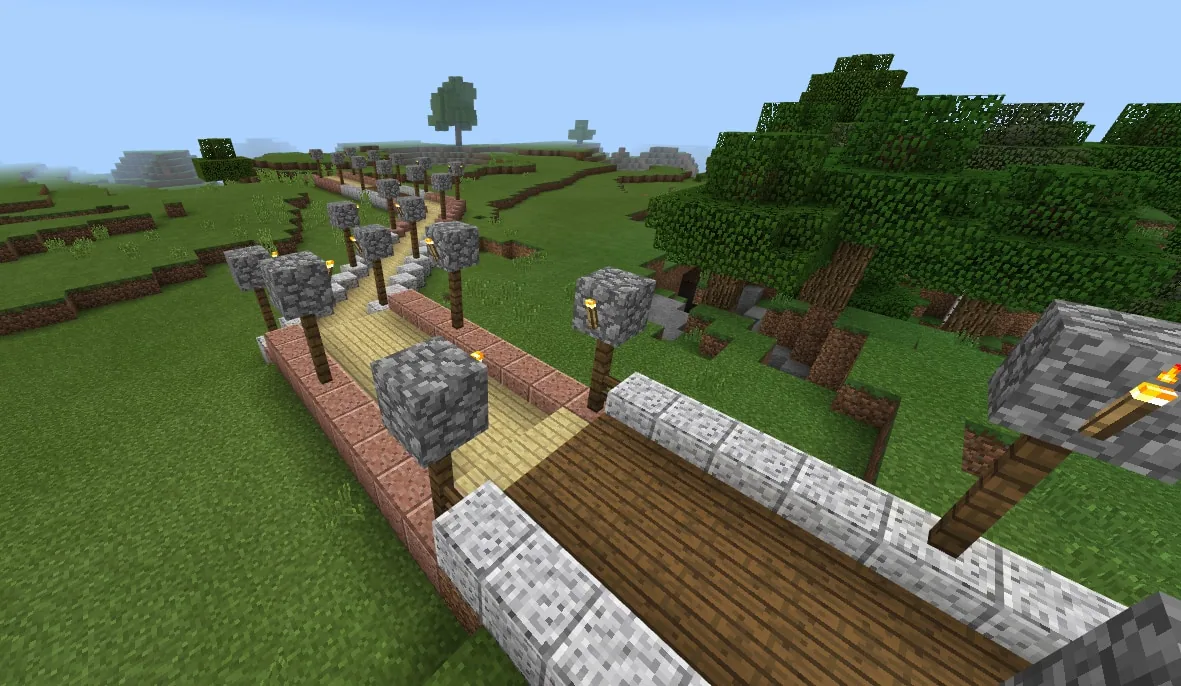
Working collaboratively inside the Survival City Roads Minecraft world, students take on resource-gathering and construction jobs. From surveying terrain and leveling ground to laying curb blocks and paving slabs, students directly apply their mathematical calculations to practical engineering in-game.
Learning objectives
By the end of this lesson students will be able to:
- Convert distance measurements between kilometers and meters.
- Write and evaluate algebraic equations using parentheses to calculate total building materials.
- Collaborate in assigned roles to gather resources and construct a 0.2-kilometer road.
- Survey Minecraft terrain and level ground to a width of at least five blocks.
Blocks and items used in this lesson


Key vocabulary
- Kilometer
- A metric unit of length equal to 1,000 meters.
- Slab
- A half-height building block in Minecraft crafted such that one whole block yields two slabs.
- Equation
- A mathematical statement showing that two expressions are equal, used here to calculate needed blocks.
- Survey
- To examine and record the features of an area of land before building.
Before class
Lesson sequence
Suggested timing: about 90 minutes in total.
- Survey the Land15 min
Load students into the Survival City Roads world in small teams of 3 to 5. Instruct groups to explore the environment, observe biomes and land structures, and select where their road will be placed.
- The Worksheet and Equation Modeling20 min
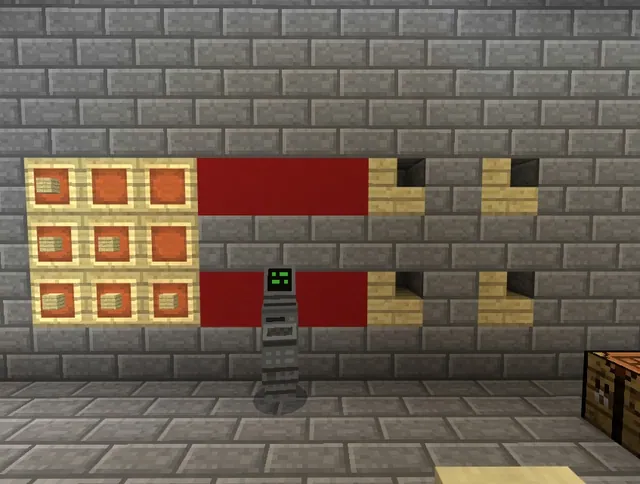
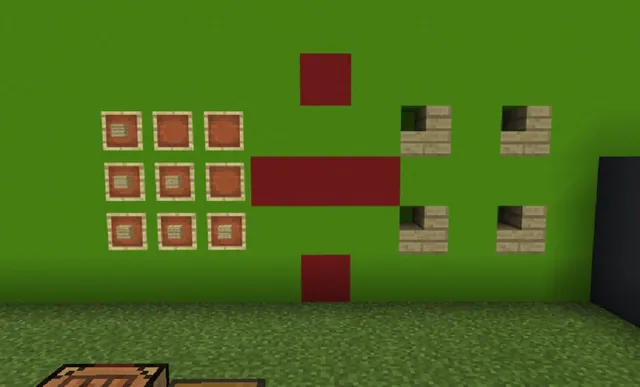
Distribute the Building Roads Worksheet. Guide students through calculating the materials for a 0.2-kilometer (200-meter) road where each meter requires 2 whole blocks and 3 slabs.
Explain that because 1 whole block yields 2 slabs, each slab counts as half a block. Guide students to write and evaluate the formula R = (2 × M) + (3 × M) / 2, arriving at 700 total blocks, and compare their work to the fictional character's equation on the worksheet.
- Gathering Resources25 min
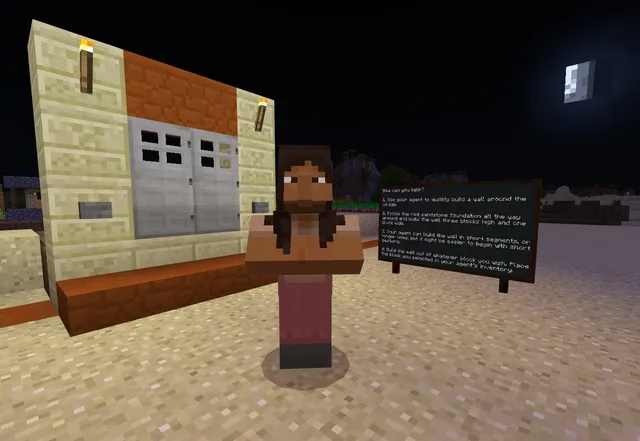
Organize students into groups of four and direct them to the NPC named Jude Washington to collect gear via interactive buttons. Students select specialized gathering roles:
- Lumberjacks: Gather wood, flower dye, and dirt.
- Miners: Collect various types of stone, ores, and gravel.
- Concrete Workers: Gather sand, gravel, sandstone, dirt, and flowers.
- Road Construction30 min
Call teams to their village sites to begin paving their 0.2-kilometer road using specific construction assignments:
- Land Levelers: Clear bumps with shovels, fill dips with dirt, and ensure a flat path at least 5 blocks wide.
- Block Placers: Place outer curb blocks leaving an open corridor exactly 3 blocks wide.
- Slab Pavers: Fill the 3-block corridor with slabs between the curbs.
Assessment: success criteria
- Successfully converted 0.2 kilometers to 200 meters.
- Wrote and correctly solved the algebraic equation showing that 700 whole blocks are required.
- Prepared a flat roadbed that is at least 5 blocks wide.
- Completed a 0.2-kilometer road featuring outer curb blocks separated by three rows of slabs.
Differentiation
Walk through the fraction conversion step by step, demonstrating physically or visually how two slabs combine to equal one whole block.
Have students adapt the equation to calculate resource requirements for roads of different lengths or alternative curb-to-slab width proportions.
Knowledge check
5 questions to check understanding after the lesson. Tap an answer to see if it is right; the score appears at the end.
1How long is the road that students are tasked with planning and constructing?
Answer: A. The lesson specifically tasks students with building a road that is 0.2 kilometers (200 meters) in length.
2How many slabs can be crafted from one whole Minecraft block?
Answer: C. One whole block can be crafted into two slabs, meaning each slab is equivalent to half a block.
3Which NPC do students visit to press buttons and receive their gathering tools?
Answer: C. The source identifies Jude Washington as the NPC who gives out gear when buttons are clicked.
4What minimum width must the Land Levelers prepare so the road fits the terrain?
Answer: D. Land levelers are instructed to ensure the cleared ground is flat and at least 5 blocks wide.
5Based on the equation R = (2 × M) + (3 × M) / 2, how many whole blocks must be gathered for a 200-meter road?
Answer: B. Plugging 200 into the equation gives (2 × 200) + (3 × 200) / 2 = 400 + 300 = 700 blocks.
Resources
- Building Roads WorksheetStudent worksheet to support lesson.
- Lesson worldOpens the world page in Minecraft Education (sign-in with a school account may be needed).
Part of the Grade 5 Math curriculum
This is lesson 6 of 13 in Grade 5 Math.
- The Decimal Dungeon - Part 1
- The Decimal Dungeon - Part 2
- The Decimal Dungeon - Part 3
- The Decimal Dungeon - Part 4
- The Decimal Dungeon - Part 5
- City Planning - Survival Roads
- Classifying Quadrilaterals
- Coordinate Planes in Minecraft
- Crafting Fractions
- Fraction World
- Fractions and Multiplication
- Javelin Line Plots
- Volume World
Frequently Asked Questions
How many meters are in the 0.2-kilometer road?
A full kilometer is 1,000 meters, so 0.2 kilometers equals exactly 200 meters (or 200 blocks in length inside Minecraft).
What roles are assigned during the construction phase?
During construction, students divide into Land Levelers (clearing and flattening ground), Block Placers (laying outer curb blocks), and Slab Pavers (placing slabs between curbs).
Adapted from City Planning - Survival Roads by Minecraft Education on Minecraft Education, last updated Sep 16, 2023. This classroom version, the timings and the quiz were written by 9Minecraft Education.