How do daily decisions regarding earning, budgeting, saving, and investing impact personal financial independence and community services?
Overview
Financial literacy equips learners with essential life habits, such as managing career earnings, balancing budgets between needs and wants, contributing to community services through taxes, and navigating debt responsibly. This unit introduces fundamental economic concepts through practical decision-making scenarios.
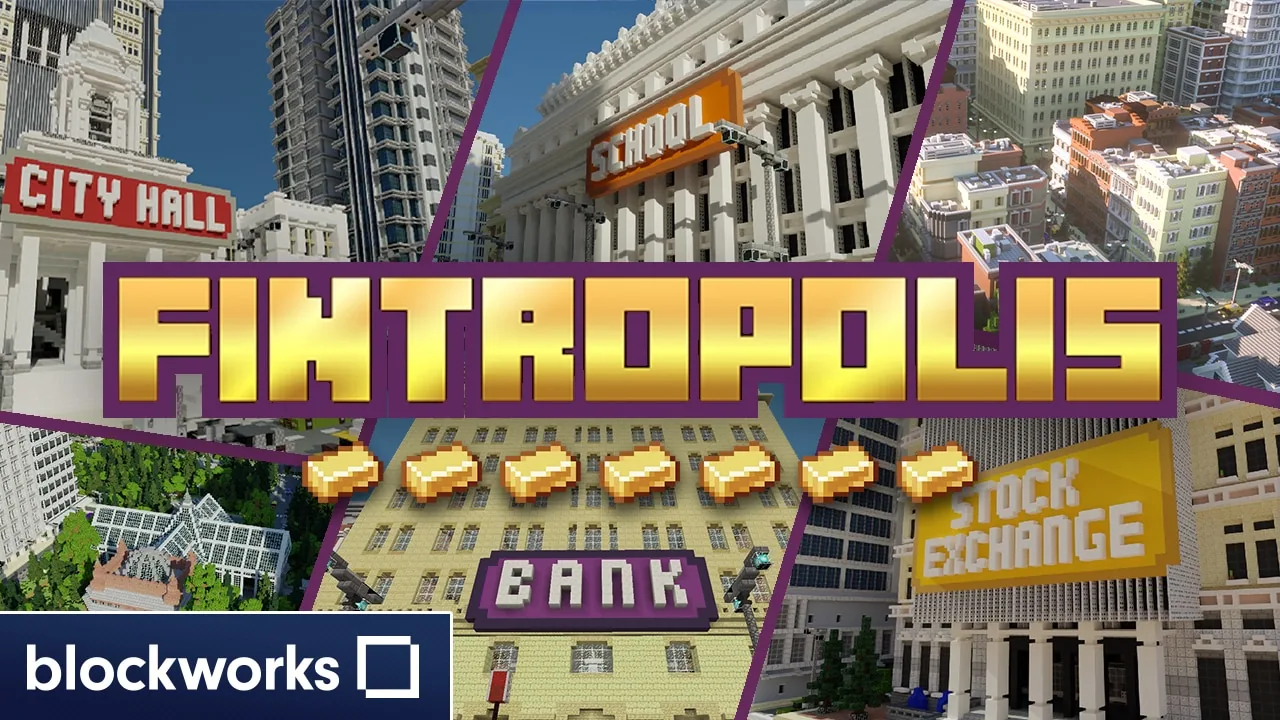
Students navigate the city of Fintropolis at their own pace, interacting with non-player characters who guide them through core economic institutions. By completing tasks at the career fair, City Hall, the bank, the retail mall, and the stock exchange, learners earn currency to purchase and furnish a home while learning the value of delayed gratification and risk management.
Learning objectives
By the end of this lesson students will be able to:
- Identify educational requirements and practical skills associated with various career paths.
- Explain how income determines tax obligations and categorize public services funded by city taxes.
- Distinguish between needs, wants, and charitable giving within a structured spending budget.
- Demonstrate how prompt credit repayments build a healthy credit score while managing mortgage debt.
- Assess financial risk and potential growth by analyzing clues and trading on a simulated stock exchange.
Blocks and items used in this lesson


Key vocabulary
- Budget
- A spending plan that balances earned income across expenses, savings goals, and donations.
- Taxes
- Mandatory fees collected based on salary or purchases to pay for shared public services like road repairs.
- Mortgage
- A specific type of loan used to finance the purchase of real estate, such as a house.
- Credit
- Borrowed purchasing power that allows you to buy items now with the agreement to pay the money back later.
- Delayed Gratification
- The choice to resist an immediate impulse purchase so that savings can build toward a larger future goal.
- Identity Theft
- The unauthorized acquisition and misuse of someone else's personal information, requiring immediate reporting.
Before class
Lesson sequence
Suggested timing: about 45 minutes in total.
- Careers, Earning, and Taxation15 min
Students visit the school career fair to learn about job requirements from non-player characters. After choosing a path, they ride a minecart rail, answer career-related questions, and collect their initial paycheck.
Next, students report to City Hall to meet the mayor. They receive a reference book detailing municipal tax allocations, calculate taxes based on their salary, and categorize public items funded by tax dollars, such as road repairs.
- Budgeting, Spending, and Savings15 min
Learners proceed to the bank to open an account and study basic cash flow concepts. At the mall, they practice budgeting by spending dedicated currencies sorted into three specific categories: needs, wants, and charity donations.
Students then engage in a savings challenge where they earn gold while resisting tempting impulse buys. Practicing delayed gratification yields bonus rewards, followed by a self-assessment identifying whether they act as spenders, savers, or givers.
- Credit, Security, and Stock Trading15 min
Players secure a mortgage to purchase a house and receive a shopping list to complete with a credit card, which they must repay promptly to secure a favorable credit score. After an in-game alert that their identity has been compromised, they visit the bank and police station to file a report and complete a protection quiz.
Finally, students enter the Stock Exchange to review market clues, purchase one of three available stocks, track value growth or loss over time, and cash out their investments to furnish their homes.
Assessment: success criteria
- Correctly categorizes civic spending items into corresponding city tax allocations.
- Applies the proper currency types for needs, wants, and giving during the mall shopping simulation.
- Maintains a high credit score by promptly paying off balances incurred on the credit card shopping list.
- Completes the identity theft protection quiz and demonstrates an understanding of investment risk at the Stock Exchange.
Differentiation
Review the definitions of needs versus wants before mall shopping and assist students with the career minecart rail questions.
Have students revisit the Stock Exchange regularly across multiple sessions to actively track portfolio performance, calculate profit or loss, and furnish higher-tier homes.
Knowledge check
5 questions to check understanding after the lesson. Tap an answer to see if it is right; the score appears at the end.
1What must students do immediately after choosing a profession at the school career fair?
Answer: B. After selecting a career, students receive a key to a minecart rail where they answer questions to earn their first paycheck.
2How is the amount of income tax a player pays at City Hall determined?
Answer: A. City Hall teaches players that their tax obligation is directly determined by their earned salary.
3What rule must students follow when spending money at the retail mall?
Answer: D. Students are given designated currencies that must match whether the item being bought is a need, a want, or charitable giving.
4What steps should players take after receiving the notification that their identity was stolen?
Answer: C. When identity theft occurs, students must visit both the bank and the police station to report the crime and complete a safety quiz.
5How does the savings activity reward players for showing delayed gratification?
Answer: A. The savings challenge teaches delayed gratification by rewarding players who resist impulse buys and save their gold.
Resources
- Lesson package (.zip)Everything the author attached to this lesson in one download.
- Lesson PlansFinancial Education Lesson Plans
- Lesson worldOpens the world page in Minecraft Education (sign-in with a school account may be needed).
Frequently Asked Questions
Is previous financial or Minecraft experience required for students to participate?
No prior experience is necessary. In-game non-player characters guide students directly through each location and explain the mechanics step-by-step.
Can these economic concepts be taught without using the Minecraft game?
Yes. The accompanying files include stand-alone lesson plans, student worksheets, and classroom activities that can be taught entirely offline or as preparation before entering the digital world.
What long-term objective drives student spending and saving throughout the city?
As students earn and manage money across the various city challenges, their ultimate goal is to purchase and furnish increasingly advanced tiers of housing.
Adapted from Fintropolis by BlockWorks on Minecraft Education, last updated Apr 23, 2025. This classroom version, the timings and the quiz were written by 9Minecraft Education.