- Type
- Lesson plan
- Subject
- MathArt, Music & Design
- Grade
- Primary (Grades 3-5)
- Ages
- Ages 8-10
How does rearranging a rectangular array into equal groups help us understand and prove division?
Overview
Students investigate the inverse connection between multiplication and division by examining physical arrangements of units. Building on the understanding that rectangular arrays represent multiplication, learners discover that separating those same structures into equal sets forms the foundation of division.
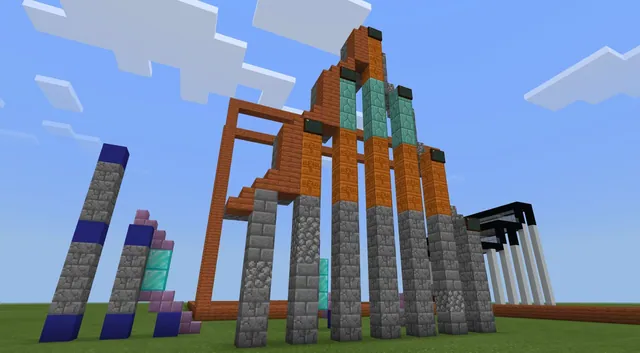
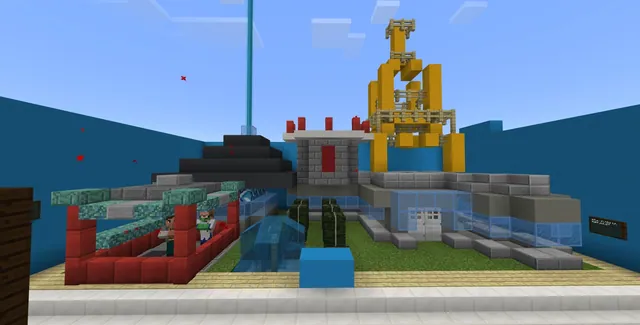
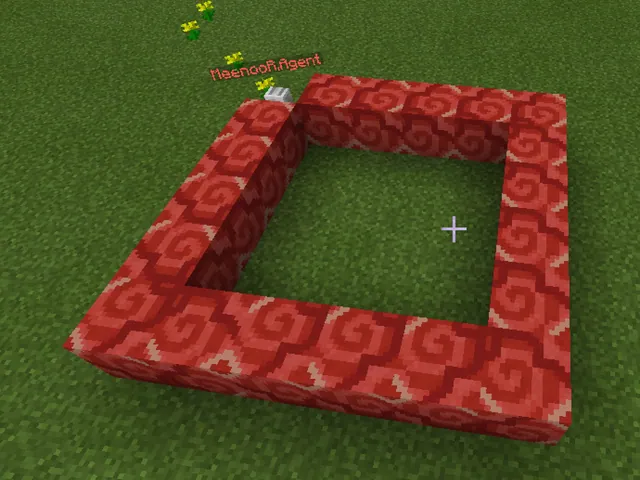
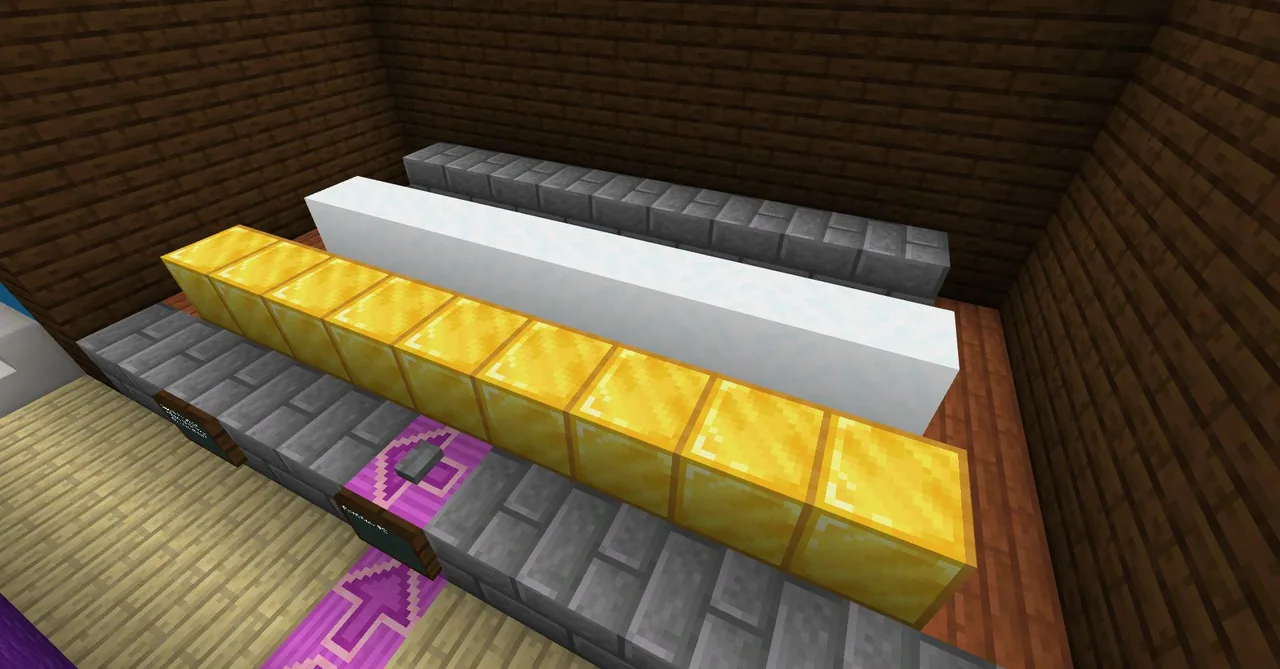
Inside the Minecraft world, learners use tools to dismantle pre-built block arrays and rearrange the units into equal groupings. They document both multiplication and division number sentences, construct 3D models to verify or disprove given equations, and record their mathematical reasoning on slates and in notebooks.
Learning objectives
By the end of this lesson students will be able to:
- Dismantle a block array and reorganize its units into sets of equal size.
- Formulate matching multiplication and division equations for a single group of blocks.
- Construct a three-dimensional block model to verify whether a division equation is true or false.
- Define division in writing and speech as the process of separating quantities into equal groups.
Blocks and items used in this lesson


Key vocabulary
- Array
- An orderly arrangement of objects or blocks placed into equal rows and columns.
- Division
- The mathematical operation of separating a total number into equal groups or shares.
- Inverse Operation
- Opposite operations that undo each other, such as multiplication and division.
- Factor
- A number multiplied by another number to produce a product.
Before class
Lesson sequence
- Brainstorm and Big Idea Discussion
Present the slideshow images to the class and ask students to share observations about shapes, patterns, and structures. Guide the discussion back to the concept that rectangles represent multiplication, then reveal the lesson's core idea: separating numbers into equal groups is division. Students record this concept and related equations in their math notebooks.
- Worksheet Check-In and Setup
Distribute page 76 of the worksheet file. Students work through four practice questions independently before swapping papers with a peer to compare results. While students finish, write the instructions for the Minecraft tasks on the board. After the teacher confirms worksheet accuracy, students log into the Division world.
- Challenge 1: Tear Down and Rebuild
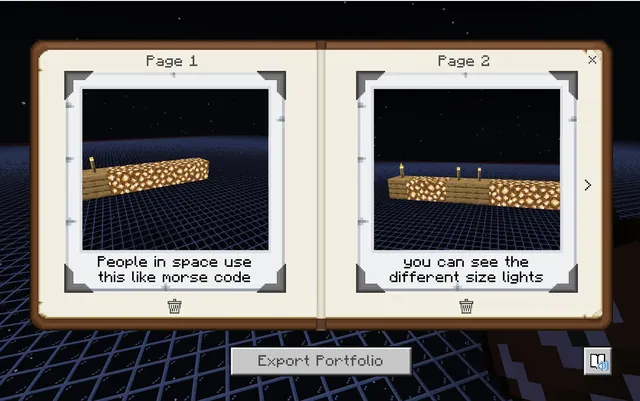
Equipped with a pickaxe, each student mines an existing array to collect its individual blocks. They reconstruct the blocks into equal groups, write corresponding multiplication and division equations, take an in-game photo, and describe the inverse connection between both operations in their notebooks.
- Challenge 2: Prove Me Wrong
Students visit an in-game problem station to collect a division equation. Using blocks, they build a physical model to prove whether the statement is correct or incorrect, logging their factors on slates as they organize their equal groups.
- Group Reflection and Debrief5 min
Gather students into groups of four. Each group spends time agreeing on a shared definition of division and determining how someone can prove a division problem. The teacher then invites each group to share their ideas during a whole-class conversation.
Assessment: success criteria
- Student accurately deconstructs an array and reassembles the blocks into equal groupings.
- Student writes correct matching multiplication and division number sentences for their block models.
- Student builds a block structure that successfully proves or disproves an assigned division equation.
- Student correctly solves all four problems on the introductory worksheet and provides feedback to a partner.
Differentiation
Have students sketch their block groupings on graph paper before breaking and placing blocks in the game.
Challenge early finishers to construct a four-problem parkour course or program the Agent with Code Builder to generate arrays and grouped numbers.
Knowledge check
5 questions to check understanding after the lesson. Tap an answer to see if it is right; the score appears at the end.
1What core mathematical concept does the lesson introduce during the opening brainstorm?
Answer: B. The opening discussion introduces the core idea that breaking numbers into equal groups is division.
2What tool are students given in the 'Tear down and rebuild' challenge to take apart the array?
Answer: A. The activity instructions specify that students receive a pickaxe to dismantle the array.
3What must students do before logging into the Minecraft world?
Answer: C. Students work through page 76 of the worksheet, review answers with a peer, and receive teacher approval before logging in.
4In the 'Prove Me Wrong!' challenge, how do students track their factors while grouping blocks?
Answer: B. Students are instructed to keep track of their factors by writing them on slates as they build equal groups.
5What is one of the optional extension activities available in this lesson?
Answer: C. The source includes an extension activity where students build a parkour course out of four division problems.
Resources
- Lesson package (.zip)Everything the author attached to this lesson in one download.
- Opening Slideshow
- Rubric
- Worksheet and Homework
- Lesson worldOpens the world page in Minecraft Education (sign-in with a school account may be needed).
Part of the Grade 3 Math curriculum
This is lesson 3 of 15 in Grade 3 Math.
- Algebra Architecture
- Building Word Problems
- Division Into Equal Numbers
- Finding the Unknown
- Fractions Pixel Art
- Fractions Steeplechase
- Liquid Measurements
- Make a Regrouping Video
- Measuring Landforms
- Repeated Addition with Parkour
- Round Numbers Video
- Shapes From Shapes
- Survival City Making Roads
- Survival Olympics Bar Graphs
- Two Step Word Problems
Frequently Asked Questions
What should students do with the back page of the worksheet?
According to the lesson plan, page 76 is completed during class as a quick check-in, while the back page is assigned to students as homework.
How do students verify equations during the second in-game activity?
Learners visit a problem station inside the world to pick up an equation, construct a block model showing equal groups to test the numbers, and explain whether the equation is correct or false.
Adapted from Division Into Equal Numbers by Minecraft Education on Minecraft Education, last updated Dec 19, 2022. This classroom version, the timings and the quiz were written by 9Minecraft Education.