- Type
- Lesson plan
- Subject
- Math
- Topics
- Math & Economics
- Grade
- Primary (Grades 3-5)
- Ages
- Ages 8-10
- Duration
- about 3.3 hours (suggested)
How can strategies for multiplying by multiples of ten help us plan and build city infrastructure efficiently?
Overview
In this lesson, students explore the mathematical concept of multiplying single-digit numbers by multiples of ten through urban planning. By designing a ten-meter road section first, learners calculate how material requirements scale as their infrastructure extends across the terrain.
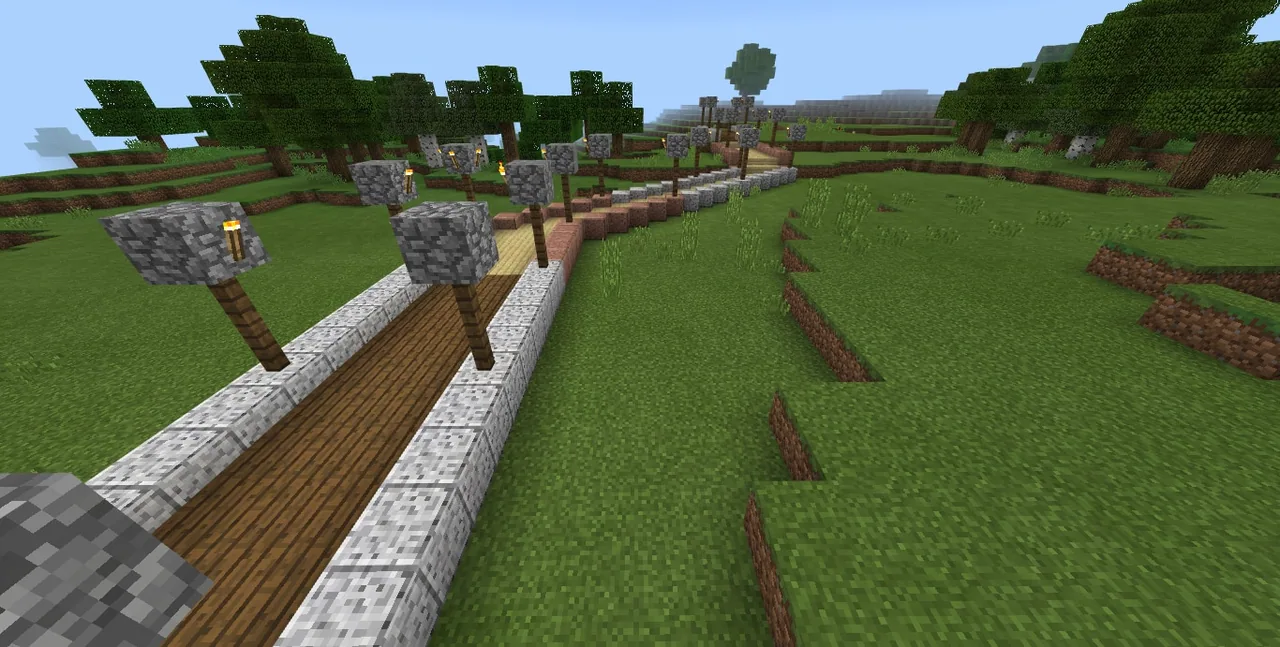
Using Minecraft Survival mode, students collaborate in defined roles to survey land, gather raw materials, refine construction blocks, and lay paved roadways. Connecting mathematical calculations to real-world infrastructure illustrates why city planners establish roads before constructing buildings.
Learning objectives
By the end of this lesson students will be able to:
- Multiply single-digit whole numbers by multiples of ten to calculate construction materials.
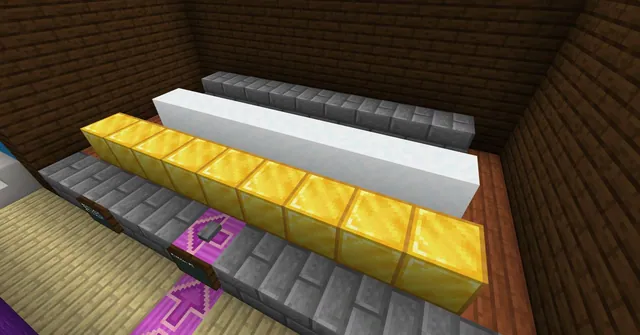
- Design a ten-block road prototype and inventory the materials required to build it.
- Collaborate in specialized roles to survey terrain, collect survival resources, and construct roads.
- Explain why infrastructure must be planned and built before city buildings are erected.
Blocks and items used in this lesson


Key vocabulary
- Prototype
- A sample model built to test a design and measure its parts before creating a full-size version.
- Multiple of Ten
- A number produced by multiplying a whole number by ten, such as 10, 20, 30, or 40.
- Infrastructure
- The basic physical systems of a community, such as roads, water lines, and bridges.
- Survey
- To inspect and measure a piece of land to prepare it for construction.
Before class
Lesson sequence
Suggested timing: about 200 minutes in total.
- Math Models and Prototyping45 min
Present the math slideshow to help students discover patterns when multiplying by multiples of ten. Next, direct students to form groups of four and design individual ten-block road prototypes using readily available survival materials like stone, wood, sand, and gravel. Each team votes on one design to construct.
- Material Calculations and City Planning40 min
Teams complete their worksheets to compute how many blocks they need for every ten meters of road. Present city maps of Paris, New York, and California City so students can discuss why civil planners build transit infrastructure before erecting buildings.
- Resource Gathering and Crafting45 min
Organize students into three gathering teams: Miners for stone, coal, and iron; Lumberjacks for wood and flowers; and Mudders for sand, gravel, and clay. Teams deposit all resources into labeled community chests and smelt or craft required blocks like stone bricks, slabs, or concrete.
- Road Construction50 min
Groups assemble their roads by assigning specific roles: the Bulldozer levels the ground, the Curb Maker places boundary blocks, and the Paver lays slabs between curbs. Teams create intersections when paths cross or curve roads around immovable obstacles.
- Debrief and Reflection20 min
Gather the class to measure total road distance completed. Discuss effective mental math strategies for multiplying by multiples of ten and reinforce why infrastructure planning is essential before building homes and shops.
Assessment: success criteria
- Student accurately completes worksheet calculations multiplying single-digit prototype items by multiples of ten.
- Student creates and documents a ten-block prototype using accessible survival resources.
- Student fulfills an assigned construction or gathering role collaboratively within their team.
- Student articulates a clear strategy for multiplying by multiples of ten during class debriefs.
Differentiation
Provide a multiplication chart and base-ten blocks to help students visualize place value shifts when scaling up prototype material counts.
Fast finishers can extend their roadway further, add street lamps, or design custom intersections where multiple roads connect.
Knowledge check
5 questions to check understanding after the lesson. Tap an answer to see if it is right; the score appears at the end.
1How long is the initial road prototype each student builds?
Answer: B. Students begin by designing a sample road section that is ten blocks (ten meters) in length.
2Which team of gatherers is responsible for collecting sand, gravel, and clay?
Answer: C. Mudders receive shovels and visit riverbanks to dig sand, gravel, and clay for concrete and glass.
3What is the primary duty of the Bulldozer on a road-building crew?
Answer: D. The Bulldozer surveys the route, digging out excess dirt and filling dips to create a flat, even path.
4Why do students review maps of Paris, New York, and California City?
Answer: A. Comparing these city maps illustrates the importance of establishing transit networks prior to building structures.
5What should a construction crew do if two roads meet during building?
Answer: B. When two roadways meet on the map, teams are instructed to construct an intersection.
Resources
- Lesson package (.zip)Everything the author attached to this lesson in one download.
- Slideshow Day 1
- Slideshow Day 2
- Worksheet
- Curb MakerVisual
- PaverVisual
- Lesson worldOpens the world page in Minecraft Education (sign-in with a school account may be needed).
Part of the Grade 3 Math curriculum
This is lesson 13 of 15 in Grade 3 Math.
- Algebra Architecture
- Building Word Problems
- Division Into Equal Numbers
- Finding the Unknown
- Fractions Pixel Art
- Fractions Steeplechase
- Liquid Measurements
- Make a Regrouping Video
- Measuring Landforms
- Repeated Addition with Parkour
- Round Numbers Video
- Shapes From Shapes
- Survival City Making Roads
- Survival Olympics Bar Graphs
- Two Step Word Problems
Frequently Asked Questions
What tools should I supply to students during the resource gathering phase?
Supply pickaxes to the Miners collecting stone and ores, axes to the Lumberjacks harvesting timber in the forest, and shovels to the Mudders digging along the river.
How does this lesson connect directly to math standards?
Students apply standard CCSS.Math.Content.3.NBT.A.3 by counting the units of each block in a 10-block prototype and multiplying those counts by multiples of ten to determine totals for larger road sections.
Adapted from Survival City Making Roads by Minecraft Education on Minecraft Education, last updated Sep 15, 2023. This classroom version, the timings and the quiz were written by 9Minecraft Education.