- Type
- Lesson plan
- Subject
- MathArt, Music & Design
- Grade
- Primary (Grades 3-5)
- Ages
- Ages 8-10
- Duration
- about 60 min (suggested)
How can we visually represent a multiplication or division story in a 3D world?
Overview
Multiplication and division help unpack real-world scenarios involving equal groups, arrays, and measurement. By turning abstract word problems into concrete stories, students learn how these operations describe interactions between quantities and understand the relationships between factors and products.Learning objectives
By the end of this lesson students will be able to:
- Solve multiplication and division word problems within 100.
- Plan a narrative scene by identifying the setting, characters, and mathematical quantities.
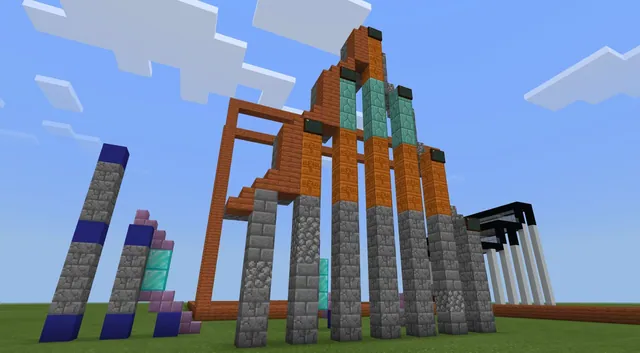
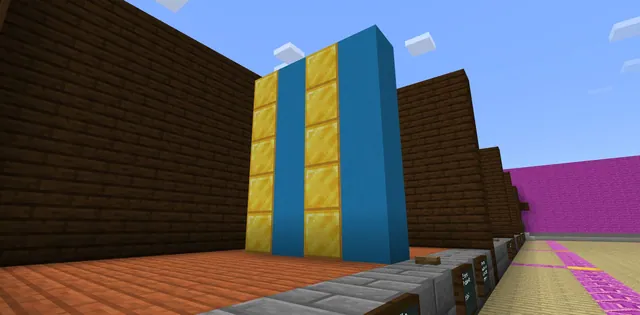
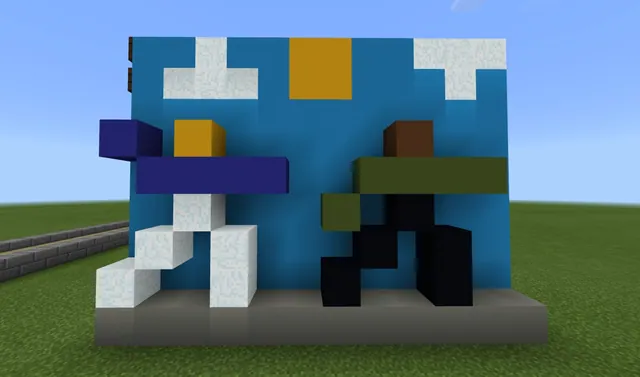
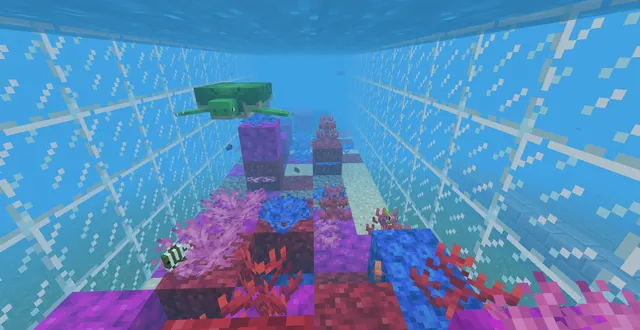
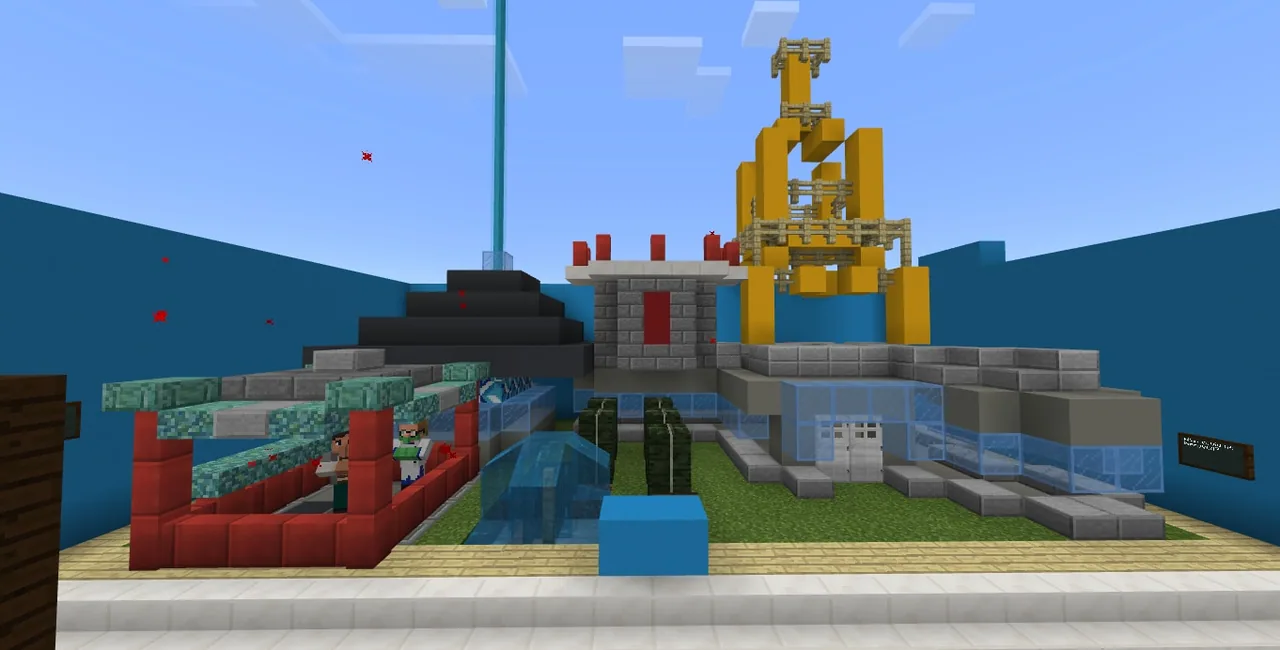
- Build a 3D Minecraft stage featuring a visual math model, problem slates, and NPC characters.
- Evaluate peer builds using guiding questions about mathematical accuracy and set design.
Blocks and items used in this lesson

Key vocabulary
- Multiplication
- An operation that combines equal groups to find a total amount.
- Division
- An operation that splits a total into equal groups or finds the number of items in each group.
- Math Model
- A visual representation, such as an array or grouped blocks, that demonstrates how numbers interact.
- Slate
- A small writing board in Minecraft used to present text, clues, or mathematical equations.
- NPC
- A non-player character placed in the world to portray story figures and deliver dialogue.
Before class
Lesson sequence
Suggested timing: about 60 minutes in total.
- Warm-up and Introduction10 min
Distribute the Word Problem Design Sheet Packet. Lead the class through the word problem Mad Lib on page 1 to demonstrate how stories carry mathematical meaning, then introduce the core theme: multiplication and division can be used to solve everyday challenges.
- Problem Selection and Planning15 min
Have students turn to page 2 and pick one of the four word problems (two multiplication and two division). Students solve their chosen problem independently and check their answer with a peer who selected the same problem.
Once matched, partners collaborate on their build plan by sketching a math model, choosing a setting, and optionally altering character names or numbers.
- Minecraft World Build25 min
Students launch the Build Word Problems world, review the practice problems, and move to their building stage. Start a 20-minute timer for pairs to construct their scene.
- Write the problem description and mathematical equation on slates.
- Build a clear math model illustrating the groups or array.
- Create an environment that matches the story setting and place NPCs as characters.
- Add conversation to NPCs if time permits.
- Peer Review and Debrief10 min
Pairs rotate to another team's build to evaluate the accuracy of the math model, confirm the story makes sense, and suggest improvements. Conclude with a whole-class debrief discussing what students discovered about modeling operations.
Assessment: success criteria
- Identifies whether a scenario requires multiplication or division.
- Accurately solves division and multiplication word problems within 100.
- Builds a Minecraft stage containing problem slates, an accurate math model, and NPC characters.
- Provides constructive, mathematically sound feedback during peer review.
Differentiation
Help students identify the number family and group sizes before building, or keep the original problem numbers without modifications.
Challenge students to author their own original word problems, explain inverse relationships, or program multi-line dialogue into their NPCs.
Knowledge check
5 questions to check understanding after the lesson. Tap an answer to see if it is right; the score appears at the end.
1What is the primary function of the math model built on the Minecraft stage?
Answer: B. The math model serves as a concrete visual representation of the problem's mathematical relationships.
2Which two items must be displayed on slates in the completed build?
Answer: A. The build criteria require students to write both the word problem text and the equation on slates.
3How do students select their building partners during the planning phase?
Answer: C. Students verify their work with a classmate who completed the same problem, and that peer becomes their building partner.
4How long is the active building timer once all student pairs finish planning?
Answer: D. The lesson directs the teacher to start a 20-minute timer for the partner construction phase.
5What additional feature are students encouraged to add if they complete their build early?
Answer: C. Fast finishers are prompted to add conversation lines to their NPCs and include more environmental detail.
Resources
- Lesson package (.zip)Everything the author attached to this lesson in one download.
- Rubric
- Worksheet
- Lesson worldOpens the world page in Minecraft Education (sign-in with a school account may be needed).
Part of the Grade 3 Math curriculum
This is lesson 2 of 15 in Grade 3 Math.
- Algebra Architecture
- Building Word Problems
- Division Into Equal Numbers
- Finding the Unknown
- Fractions Pixel Art
- Fractions Steeplechase
- Liquid Measurements
- Make a Regrouping Video
- Measuring Landforms
- Repeated Addition with Parkour
- Round Numbers Video
- Shapes From Shapes
- Survival City Making Roads
- Survival Olympics Bar Graphs
- Two Step Word Problems
Frequently Asked Questions
Do students need advanced Minecraft building skills to succeed?
No, the focus is on clear mathematical communication. Using simple block arrangements to represent arrays or equal groups, alongside basic slates and NPCs, fulfills the learning requirements.
What should the teacher do if a pair struggles to come up with a story setting?
Prompt students by connecting the math problem to everyday situations, such as packing supply crates, planting crops in rows, or sharing items among adventurers.
Adapted from Building Word Problems by Minecraft Education on Minecraft Education, last updated Sep 15, 2023. This classroom version, the timings and the quiz were written by 9Minecraft Education.