- Type
- Lesson plan
- Subject
- Math
- Topics
- Math & Economics
- Grade
- Primary (Grades 3-5)
- Ages
- Ages 8-10
Why do people invent units of measurement, and how does the size of a unit change how we measure landforms?
Overview
Units of measurement are human inventions designed to describe and compare the physical world. In this lesson, students explore the core idea of standard and non-standard measurement by inventing their own measurement units, considering how unit size affects calculations, and discovering relationships between equivalent values and rounding.
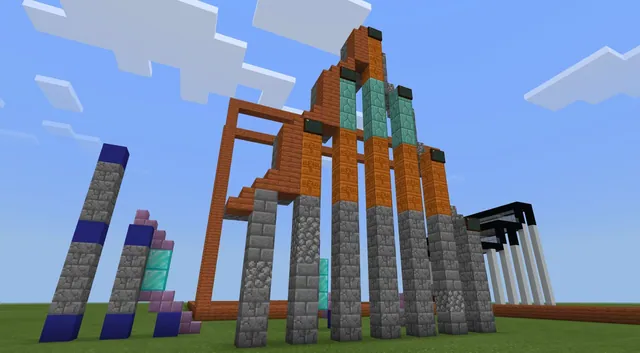
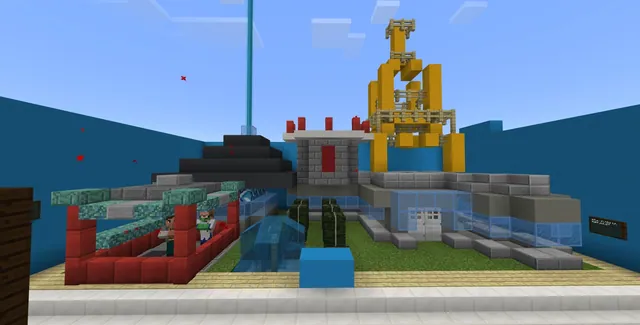
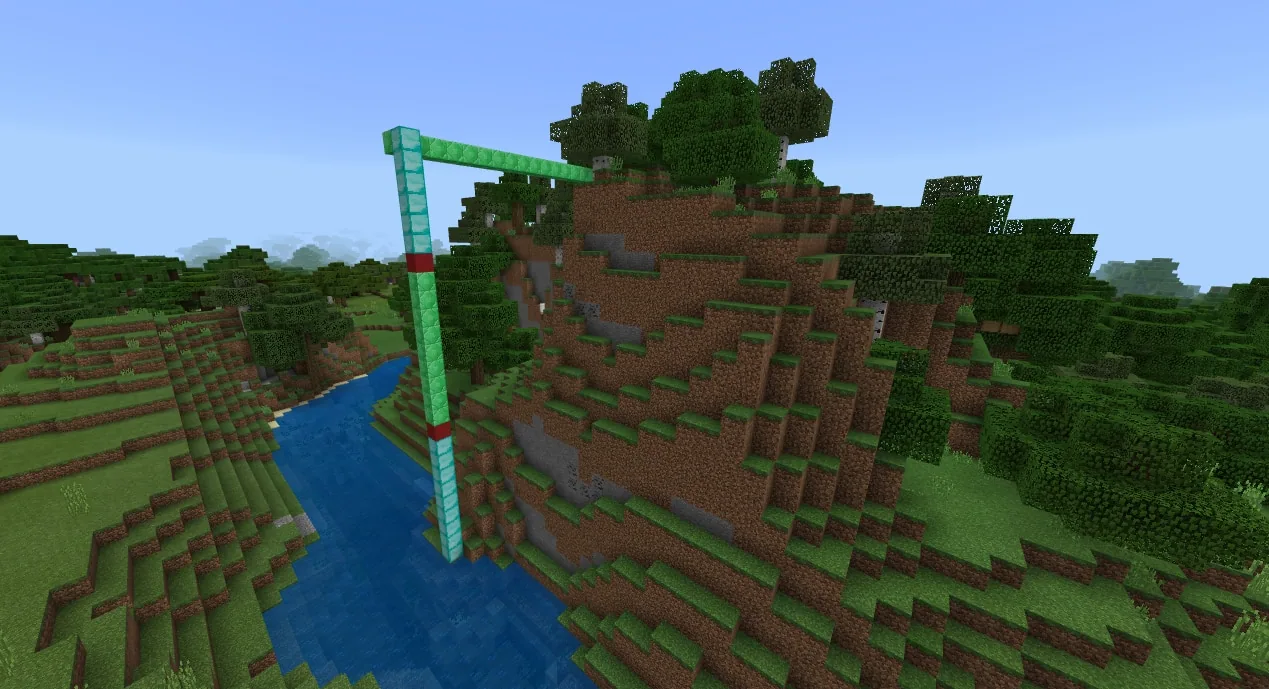
Using a downloadable Minecraft world, learners identify three different landforms and quantify their lengths using newly defined block units. Working with peers, they translate measurements between different invented units and evaluate the mathematical trade-offs of using larger or smaller units.
Learning objectives
By the end of this lesson students will be able to:
- Define a custom unit of measurement by assigning it a specific number of Minecraft blocks.
- Measure at least three separate landforms using a distinct unit of measurement for each.
- Convert a classmate's landform measurement into a personal custom unit.
- Explain the advantages and disadvantages of using large versus small units of measurement.
Blocks and items used in this lesson


Key vocabulary
- unit of measurement
- A set quantity used as a standard to measure size, length, or distance.
- equivalent fractions
- Different fractions that describe the exact same amount or value.
- rounding
- Changing a number to the nearest whole value to simplify calculations.
- landform
- A recognizable physical feature of the terrain, such as a mountain, hill, or valley.
Before class
Lesson sequence
- Brainstorm and Big Idea
Display the slideshow images on the whiteboard and lead a group brainstorm about how to measure terrain in Minecraft. Connect student observations about place values and rounding to the big idea: units of measurement were invented by people to quantify the world around them.
- Unit Design and Worksheet Setup
Hand out student worksheets and list real-world units of measurement together, such as inches, feet, gallons, and kilometers. Direct students to invent their own measurement unit, give it a name, and specify how many Minecraft blocks long it is.
- Landform Measurement Exploration
Students enter the Minecraft world and locate at least three landforms. For each landform, students must create a brand-new measurement unit based on block length, measure the feature, and record the results in their math notebooks or worksheets.
- Peer Conversion Activity
Pair students to examine each other's recorded data. Each student converts their partner's landform measurement into their own invented measurement unit using equivalent fractions and proportional reasoning.
- Debrief and Reflection
Gather the class to discuss patterns noticed in equivalent fractions during conversions. Prompt students to explain the advantages of large units versus small units and to identify the benefits and drawbacks of rounding measurements to whole numbers.
Assessment: success criteria
- Student creates and defines a distinct custom measurement unit based on a specific block count for each landform.
- Student accurately measures and records data for at least three separate landforms.
- Student calculates equivalent values to convert a peer's measurement data into their own unit system.
- Student articulates the benefits, drawbacks, and rounding implications of using different unit sizes.
Differentiation
Allow students to use graph paper and simple block counts, such as two or four blocks per unit, to simplify conversions.
Challenge students to incorporate fractional units, such as measurements involving halves and fourths, when recording and converting data.
Knowledge check
5 questions to check understanding after the lesson. Tap an answer to see if it is right; the score appears at the end.
1What is the historical origin of measurement units highlighted in this lesson?
Answer: B. The guiding idea states that unit measurements were invented by people just like the students to measure things.
2What requirement must students follow when measuring the three landforms in Minecraft?
Answer: D. The student activity instructions explicitly state that students should make up a new unit measurement for each landform.
3How do students establish the size of their invented measurement unit?
Answer: C. Students name their measurement and define how many blocks long that unit is.
4What is the primary task during the peer conversation segment?
Answer: A. The activity requires students to look at a peer's data and convert that measurement into their own invented unit.
5Which topic is directly examined during the debrief conversation?
Answer: B. The debrief questions prompt students to reflect on the advantages of large versus small units, rounding, and equivalent fractions.
Resources
- Lesson package (.zip)Everything the author attached to this lesson in one download.
- Slideshow
- Worksheet
- Rubric
- Lesson worldOpens the world page in Minecraft Education (sign-in with a school account may be needed).
Part of the Grade 3 Math curriculum
This is lesson 9 of 15 in Grade 3 Math.
- Algebra Architecture
- Building Word Problems
- Division Into Equal Numbers
- Finding the Unknown
- Fractions Pixel Art
- Fractions Steeplechase
- Liquid Measurements
- Make a Regrouping Video
- Measuring Landforms
- Repeated Addition with Parkour
- Round Numbers Video
- Shapes From Shapes
- Survival City Making Roads
- Survival Olympics Bar Graphs
- Two Step Word Problems
Frequently Asked Questions
What supporting files and materials are required for this lesson?
Teachers need math notebooks, pencils, the lesson slideshow, the student worksheet, the assessment rubric, and the downloadable Minecraft world provided with the lesson.
How does the peer conversion step function in practice?
Students compare their recorded measurements with a classmate and translate the classmate's value into their own unit, practicing equivalent fractions through comparisons like coffees to quadblocks.
How are students assessed according to the rubric?
A four-level Depth of Knowledge rubric evaluates whether students can generate landform data, round whole numbers, find equivalent fractions, invent custom units, convert peer data, and analyze unit sizes.
Adapted from Measuring Landforms by Minecraft Education on Minecraft Education, last updated Sep 16, 2023. This classroom version, the timings and the quiz were written by 9Minecraft Education.