- Type
- Lesson plan
- Ages
- Ages 11-13
- Duration
- about 75 min (suggested)
- Skills
- Critical thinking
How can two conduits with different rise and run dimensions share the exact same slope?
Overview
Slope represents the constant rate of vertical change compared to horizontal change along a line. By examining similar right triangles, students can discover why different rise and run measurements produce the same steepness, leading to the linear equations y = mx and y = mx + b.
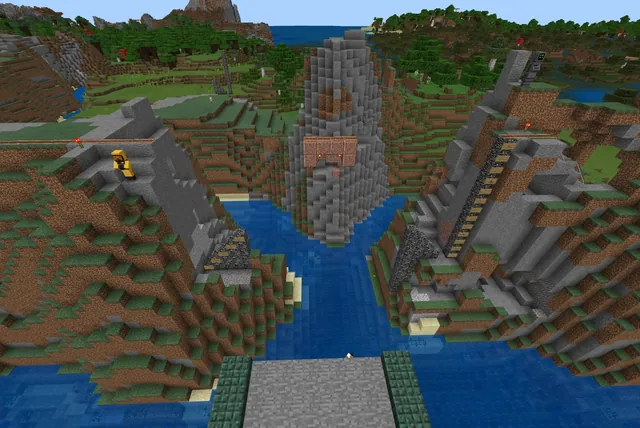
In this lesson, learners put math into practice using Code Builder. Students instruct their Agent to dig two water conduits through a mountainside using repeat loops and obstacle-clearing commands. Because both channels follow proportional rise and run ratios, students visualize negative slope before releasing water through their mountain aqueducts.
Learning objectives
By the end of this lesson students will be able to:
- Draw two similar right triangles on graph paper to establish proportional rise and run ratios.
- Program the Agent using repeat loops and obstacle destruction commands to carve tunnels through rock.
- Demonstrate why the slope m is identical between points on a line using similar triangles.
- Derive linear equations for lines passing through the origin and lines with a vertical intercept.
Blocks and items used in this lesson


Key vocabulary
- Slope
- The steepness of a line, measured as the ratio of vertical change (rise) to horizontal change (run).
- Similar Triangles
- Triangles that share identical angle measures and proportional sides, retaining the same shape at different sizes.
- Conduit
- A channel, pipe, or tunnel constructed to transport water from one location to another.
- Repeat Loop
- A programming structure that runs a specified set of code blocks a set number of times.
Before class
Lesson sequence
Suggested timing: about 75 minutes in total.
- Graph Paper Planning15 min
Before launching the game, students plot two similar right triangles on graph paper. They choose two sets of proportional rise and run values that will produce the same negative slope when excavated in the world.
- World Orientation10 min
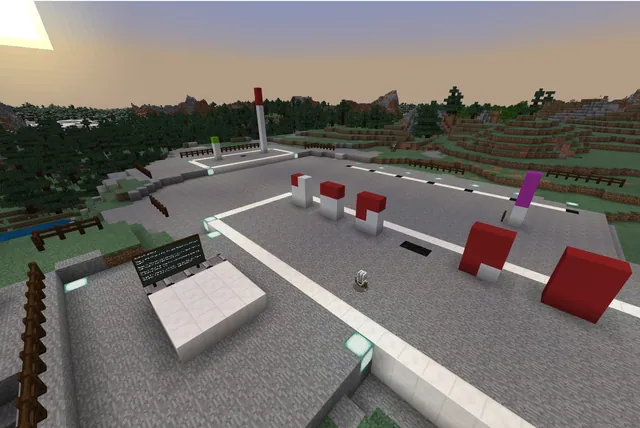
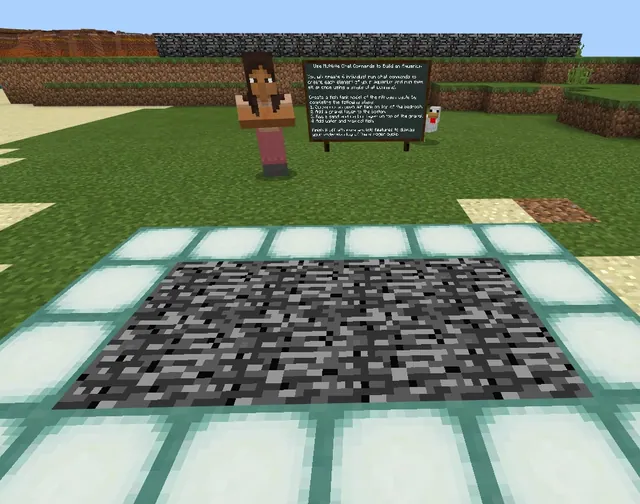
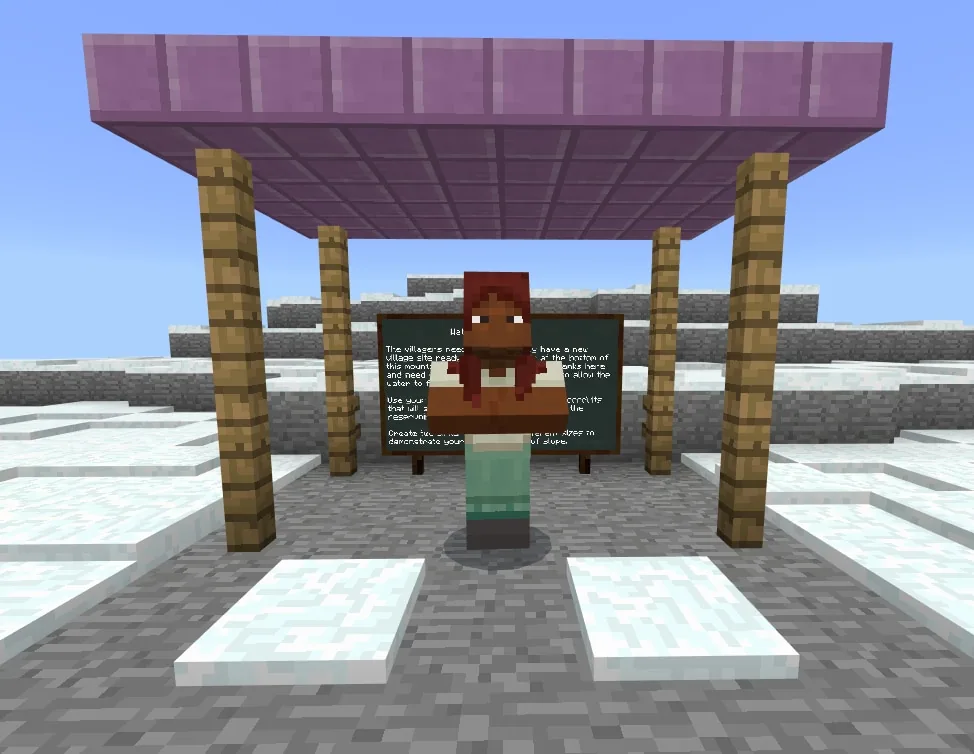
Students spawn into the world individually or in pairs and speak to the villager to receive their task. They then travel to the empty pool atop the mountain where their Agent will begin work.
- Coding the Mountain Conduits25 min
Using Code Builder, students program their Agent to enable destroy obstacles and move forward and down based on their chosen run and rise. By wrapping these instructions in a repeat loop, the Agent digs through the mountain to the village reservoir. Students then code a second, proportional conduit alongside the first.
- Water Flow Test10 min
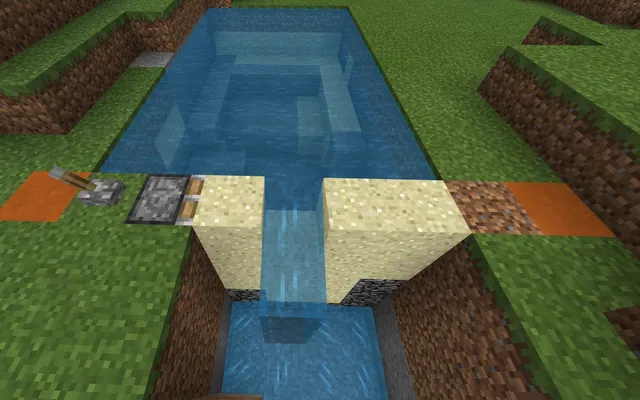
Once both tunnels punch through to the reservoir, students destroy the red sandstone blocks holding back the water tanks. Water fills the upper pool and flows through both conduits, verifying that both channels are continuous.
- Mathematical Analysis15 min
Students analyze the dimensions of their two conduits. Using the rise and run of each triangle, they explain why the slope remains constant and derive the equations y = mx and y = mx + b.
Assessment: success criteria
- Student successfully programs the Agent using loops and the destroy obstacles command.
- Both excavated conduits reflect proportional dimensions forming similar triangles with negative slope.
- Student correctly explains how slope remains unchanged despite differing rise and run values.
- Water flows freely from the upper tanks through both conduits into the village reservoir.
Differentiation
Provide struggling learners with pre-selected rise and run pairs on graph paper before they write their Agent loops.
Have advanced students derive the exact algebraic equations for both conduits and test steeper or shallower equivalent ratios.
Knowledge check
5 questions to check understanding after the lesson. Tap an answer to see if it is right; the score appears at the end.
1What must students create on graph paper before opening the Minecraft world?
Answer: A. Students are instructed to plot two similar triangles on graph paper to plan their conduit slopes before entering the game.
2Which Agent instruction is needed so the Agent can dig directly through the mountain rock?
Answer: B. Enabling destroy obstacles allows the Agent to clear blocks in its path while moving forward and down.
3Why do the two conduits have the same slope even though one is larger than the other?
Answer: C. Similar triangles share the same ratio of rise over run, meaning their slope remains identical regardless of size.
4How do students test that their conduits are complete and functional?
Answer: D. Breaking the red sandstone blocks releases the water so it can flow through the conduits and into the reservoir.
5Why should the Agent's movement commands be placed inside a repeat loop?
Answer: A. Wrapping the rise and run commands in a repeat loop automates the digging sequence until the conduit reaches the other side.
Resources
- Lesson package (.zip)Everything the author attached to this lesson in one download.
- World FileStudent world file
Part of the Code for STEM curriculum
This is lesson 16 of 20 in Code for STEM.
- 3-D Fractions
- Aquarium
- Build a Dam
- Canyon Arch Bridge
- Chicken or the Egg
- Creeper Tower Test
- Energy Transfer
- Forces
- Hour of Code: AI for Good
- Minecraft Code Town
- Molecules
- Number Line Railroad
- Plate Motions
- Road Construction Ahead
- Scale
- Slope
- Surface Area and Perimeter
- Units of Measurement
- Walled Fortress
- Wave Properties
Frequently Asked Questions
Can students collaborate on this project?
Yes. Students can work independently or in pairs sharing the same Minecraft world to build their conduits.
Where does the Agent start digging?
The player places the Agent inside the empty pool located at the top of the mountain to begin excavating downward toward the reservoir.
What linear equations can students derive from the finished conduits?
Students can derive y = mx for a line passing through the origin and y = mx + b for a line intercepting the vertical axis at b.
Adapted from Slope by John Miller on Minecraft Education, last updated Feb 28, 2025. This classroom version, the timings and the quiz were written by 9Minecraft Education.