- Type
- Lesson plan
- Subject
- Math
- Topics
- Math & Economics
- Ages
- Ages 6-13
How do perimeter and area change when you alter a shape or connect it to another figure?
Overview
Understanding the distinction between area and perimeter is a foundational mathematical concept that often confuses learners when taught only on paper. In this lesson, students discover how boundary length and surface coverage behave independently by constructing various quadrilaterals and composite shapes with fixed block counts or specific target dimensions.
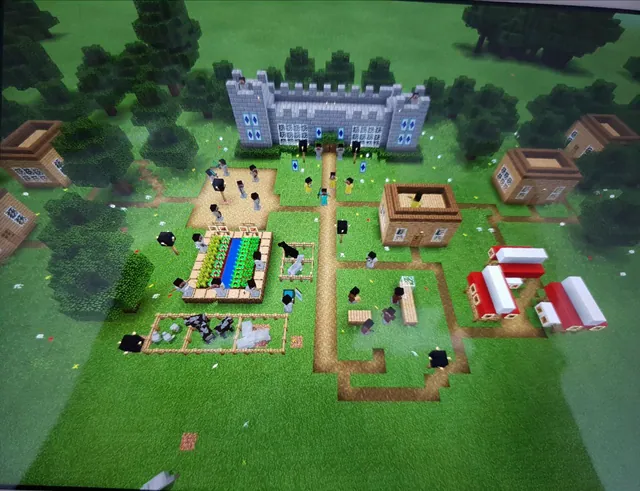
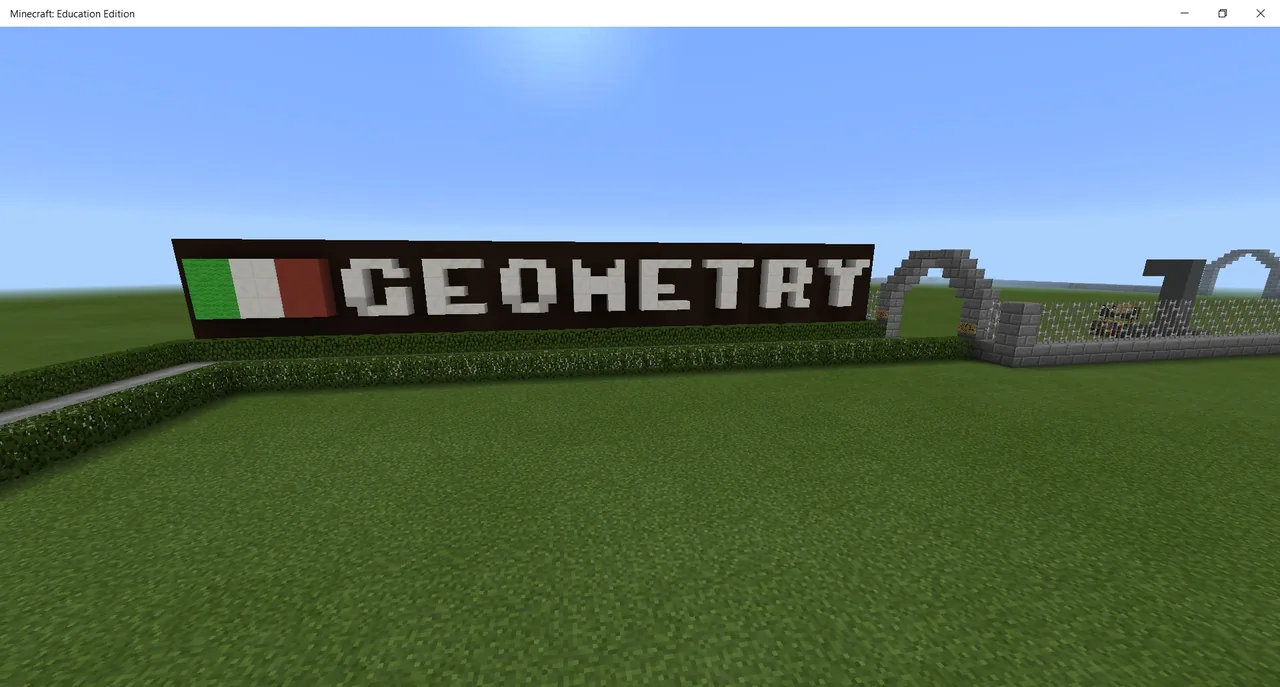
Using the custom Geometry World, students work in small groups across dedicated zones in survival mode. By placing blocks to form single and adjacent rectangles, learners physically verify why combining shapes adds their areas together while changing their shared boundary, all while managing limited supplies from shared chests.
Learning objectives
By the end of this lesson students will be able to:
- Construct rectangles with specific perimeters or areas and calculate the missing measurement
- Identify rectangles that produce the maximum and minimum perimeters for a fixed area
- Calculate the perimeter of non-rectangular shapes built from a set number of blocks
- Explain why combining adjacent figures adds their areas together but does not equal the sum of their individual perimeters
Blocks and items used in this lesson


Key vocabulary
- Perimeter
- The total distance around the outside edge of a shape.
- Area
- The total amount of flat space covered inside a shape, measured in square units or blocks.
- Adjacent Figures
- Two or more shapes placed directly next to each other so that they share a common border.
Before class
Lesson sequence
- Zone Orientation and Free Building
Place students in their assigned building zone with two teammates. Direct learners to open their shared chest, review the posters containing eight assignments, and build warm-up rectangles without focusing on calculations yet.
- Targeted Rectangles and Extrema
Have students read the posters to construct rectangles matching specific target areas or perimeters. Challenge them to find all possible configurations for a given perimeter and identify the rectangles that yield the absolute maximum and minimum perimeter for a set area.
- Non-Rectangular and Adjacent Figures
Instruct students to create at least three non-rectangular figures using a set count of blocks and determine their perimeters. Next, ask groups to build two touching figures using two distinct block types and write their measurements on a board.
- Mathematical Reflection
Gather the class to examine how shared borders affect calculations. Have students explain why the combined area equals the sum of both parts, whereas the combined perimeter is smaller than the sum of the two separate perimeters.
Assessment: success criteria
- Student accurately defines area and perimeter using Minecraft block examples.
- Student constructs distinct rectangles that share the same area but have different perimeters.
- Student correctly calculates the boundary perimeter of non-rectangular shapes.
- Student explains on an in-game board why the perimeter of adjacent figures does not equal the simple sum of their individual perimeters.
Differentiation
Allow learners to build shapes horizontally on the ground and physically count perimeter blocks step by step before calculating.
Have advanced students measure the physical classroom to calculate its perimeter and area, then recreate it in Minecraft to explore volume.
Knowledge check
5 questions to check understanding after the lesson. Tap an answer to see if it is right; the score appears at the end.
1What happens to the total area when two separate rectangles are joined along a shared edge?
Answer: B. The combined surface area remains the sum of the two distinct block areas regardless of orientation.
2Why does the world host keep the time set to day using the /time set day command?
Answer: B. Keeping daytime active protects students from monsters while they share limited chest items in survival mode.
3If two different rectangles have the exact same area, what can be true about their perimeters?
Answer: A. Rectangles with the same area can have varying dimensions that result in different perimeters, including maximum and minimum values.
4How can students manage tight workspace within their assigned team zone?
Answer: D. Constructing vertical rectangles allows students to conserve ground space within their limited building zone.
5Why is the combined perimeter of two adjacent shapes less than the sum of their individual perimeters?
Answer: A. When two shapes touch, the shared interior edge is no longer on the outside boundary and is excluded from the perimeter.
Resources
- Lesson package (.zip)Everything the author attached to this lesson in one download.
- Geometry World fileThe file of the Geometry World
- Lesson Plan pdf file
Frequently Asked Questions
How many students can work in the Geometry World at the same time?
The world is arranged into nine distinct building zones designed for three learners each, accommodating up to 27 students simultaneously.
Where do students find their building challenges in the game?
Each of the nine zones contains posters displaying eight specific geometry tasks that guide student builds step by step.
Adapted from Geometry World by Marco Vigelini on Minecraft Education, last updated Jun 6, 2022. This classroom version, the timings and the quiz were written by 9Minecraft Education.