How do the natural materials available in an environment dictate the design, function, and structure of human architecture?
Overview
In this project-based challenge, students investigate an unfamiliar planet divided into distinct ecological zones. The central concept emphasizes that the raw and crafted materials naturally present in any environment directly dictate architectural possibilities, functionality, and aesthetic style, mirroring how real-world societies built structures throughout history.
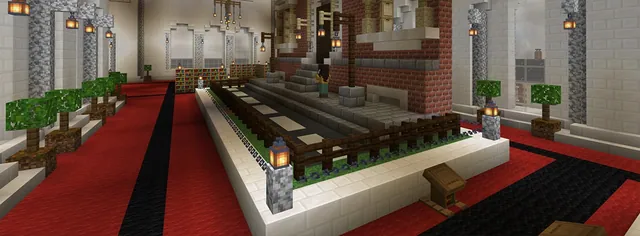
Using a custom Minecraft world, student teams travel via teleportation hubs and rail lines to explore assigned biomes. Because their operational time outside the spacecraft is restricted, learners must record resource samples, calculate block volumes mathematically, draft precise two-dimensional blueprints, and erect a finished exhibition house complete with informational signage for future visitors.
Learning objectives
By the end of this lesson students will be able to:
- Calculate precise block volumes to predict the raw and crafted resources needed for construction.
- Relate in-game resources and their crafted forms to real-world materials like clay, bricks, marble, and granite.
- Draft two-dimensional floor plans and elevations that accurately guide a three-dimensional build.
- Collaborate in assigned roles to gather resources and construct a functional, well-lit exhibition facility.
Blocks and items used in this lesson


Key vocabulary
- Biome
- A large distinct region characterized by specific terrain, environmental conditions, and plant life.
- Blueprint
- A detailed technical drawing showing the layout, floor plan, or exterior elevation of a planned building.
- Raw Material
- A natural resource found in the environment before being processed, such as clay before it is fired into brick.
- Volume Calculation
- Using mathematical measurements of space to determine the exact number of blocks needed to build a structure.
Before class
Lesson sequence
Suggested timing: about 615 minutes in total.
- Arrival and Sample Collection90 min
Students arrive at the central teleportation hub, transfer to the railway station, and travel by wagon to their designated biome. Remind learners to remain inside their wagons until reaching their final stop so they do not get lost.
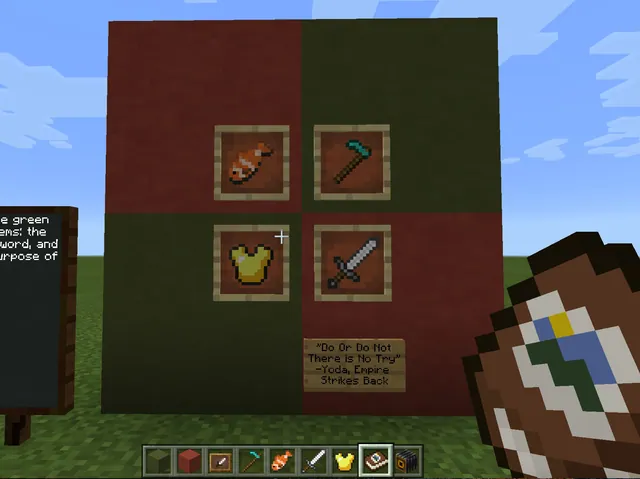
Once in the biome, teams inspect the local environment, gather native resource samples, experiment with basic crafting recipes, and review the instructional signs placed at the site.
- Blueprints and Planning240 min
Teams organize their internal roles and divide construction responsibilities. Working outside of gameplay, students draft 2D blueprints detailing the building exterior views and floor layouts.
Students perform volume calculations to determine the exact quantity of blocks needed to construct the planned exhibition house, connecting in-game resources to real-world equivalents.
- Gathering and Construction240 min
Working under time limitations to simulate restricted time away from the spacecraft, teams efficiently collect raw materials and craft the exact blocks required by their blueprints.
Students construct their 3D exhibition building to match their 2D plans, ensuring it features practical components such as proper lighting, accessible entryways, and informative display boards for visitors.
- Exhibition Tours and Reflection45 min
Teams visit each other's exhibition structures to evaluate building quality and read the interpretive signs describing local materials.
Lead a concluding discussion on how regional geology influenced history, comparing student builds to real-world examples such as the rarity of wood in ancient Egypt, the abundance of marble in Italy, or the common use of granite in western France.
Assessment: success criteria
- The physical 3D build matches the measurements and layout shown on the team's 2D blueprints.
- Volume estimates accurately account for the quantities of raw and crafted materials required.
- The building incorporates functional architectural elements including an entrance and adequate lighting.
- Exhibition boards clearly present data comparing biome resources to real-world materials.
Differentiation
Provide pre-drawn grid paper and help calculate simple box volumes for basic rectangular layouts.
Require advanced teams to integrate complex crafted components and research specific historical architectural styles that match their biome's material palette.
Knowledge check
5 questions to check understanding after the lesson. Tap an answer to see if it is right; the score appears at the end.
1Why must students carefully calculate material volume before building?
Answer: C. Teams face limited in-game time away from the spacecraft, requiring them to be highly efficient in gathering and crafting exact quantities.
2What travel instruction must students follow when leaving the hub train station?
Answer: A. Students are instructed not to jump from wagons before reaching their assigned biome to avoid getting lost.
3Which historical example does the lesson use to show that regional resource availability shaped architecture?
Answer: D. The lesson notes that scarce, expensive wood in ancient Egypt influenced how people built, contrasting with marble in Italy or granite in western France.
4What key evaluation criterion connects student drafting work to their Minecraft construction?
Answer: B. Assessment requires that the team's 2D drawn floor plans and exterior elevations match their completed 3D structure.
5Which relationship demonstrates the transition from a raw resource to a crafted building block?
Answer: A. The lesson explicitly uses the transformation of raw clay into brick as an example of raw materials being crafted.
Resources
- Lesson package (.zip)Everything the author attached to this lesson in one download.
- Example of blueprint (French)
- Example of blueprint (in French)
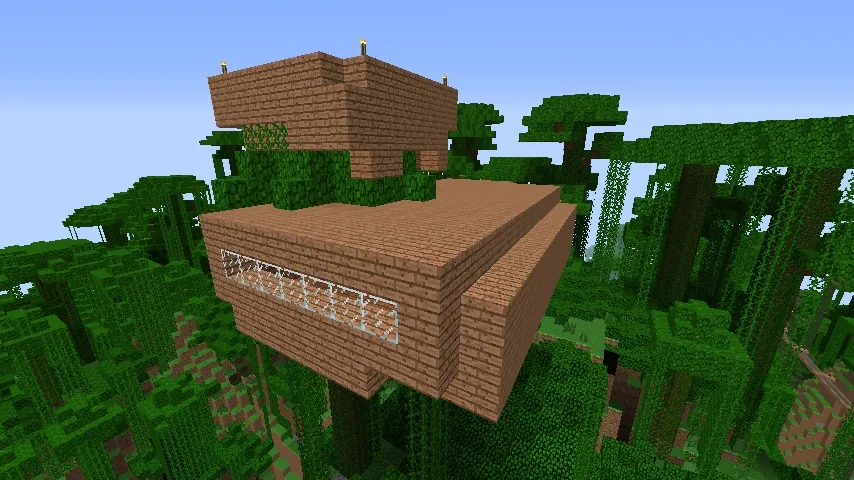
- Building example
- World fileThe Minecraft Education world of the Unknown Planet to import in the game to use this lesson.
Frequently Asked Questions
How do students reach their assigned biome in the world?
Students arrive at a central teleportation hub, transition to an adjoining train station, and ride minecarts directly to one of the five distinct biomes without disembarking early.
What purpose does the exhibition building serve once completed?
The structure functions as an informative pavilion showcasing the biome's resources, equipped with signs that welcome and educate future exploration teams about native materials.
Adapted from Materials availability influence by Stéphane Cloâtre on Minecraft Education, last updated Jul 14, 2022. This classroom version, the timings and the quiz were written by 9Minecraft Education.