- Type
- Lesson plan
- Subject
- Math
- Topics
- Math & Economics
- Ages
- Ages 6-13
- Includes
- Quiz: 5 questions
How are goods produced, distributed, and consumed within an economic community?
Overview
This economics lesson introduces students to how goods and services move through an economy, tracing the lifecycle of products from raw materials to store shelves. By participating in a classroom-wide simulation, learners explore the contrast between unlimited resources and scarcity, while also learning how individual choices and division of labor shape community life.
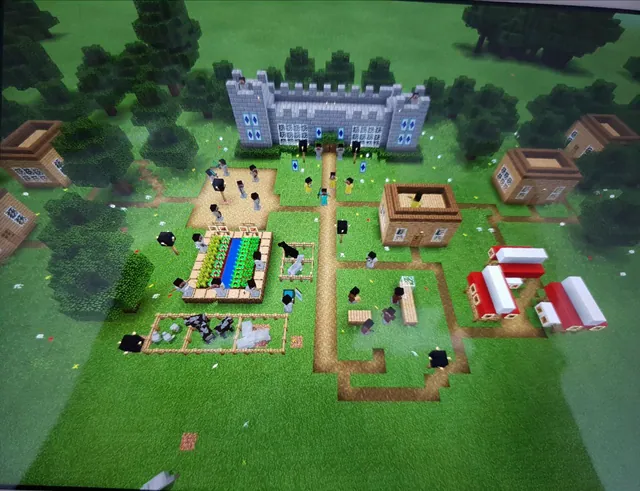
Using Minecraft, students take on specific economic roles such as farmers, loggers, miners, warehouse workers, and store owners. Raw materials are harvested, transported via an automated delivery cart system to a central sorting facility, crafted into retail goods, and bought and sold in a student-built downtown marketplace using in-game currency.
Learning objectives
By the end of this lesson students will be able to:
- Define and use economic vocabulary including production, distribution, consumption, goods, and services.
- Explain how natural resources are harvested, processed, and transported to market.
- Manage in-game currency earned as wages to purchase goods produced by peers.
- Design and stock a storefront that balances available resources, product pricing, and consumer demand.
Blocks and items used in this lesson
 Chest
 Minecart with Chest
 Oak Planks
 Oak Log
 Powered Rail
Key vocabulary
- Goods
- Physical items produced and sold to satisfy community needs or wants.
- Services
- Work or tasks performed by people to help others.
- Production
- The process of gathering raw materials and making items to sell.
- Distribution
- The method of moving goods from where they are made to where consumers can buy them.
- Consumption
- The act of buying, using, or using up goods and services.
- Warehouse
- A central building used for receiving, sorting, and storing goods before they are sold.
Before class
Lesson sequence
- Scarcity Discussion and Housing Build
Have students build an initial house while playing in creative mode where blocks are unlimited. Lead a class discussion comparing this unlimited access to the real world, introducing the concept of scarcity and explaining that limited resources require producers and consumers to make deliberate choices.
- Labor and Production Phase
Assign student groups to work in specific production sectors within the starter town: harvesting crops or managing livestock on the farm, felling trees and cutting planks at the lumber yard, and prospecting or processing ores in the mine. Distribute wages in the chosen currency, such as gold nuggets, as students work.
- Transportation and Warehouse Sorting
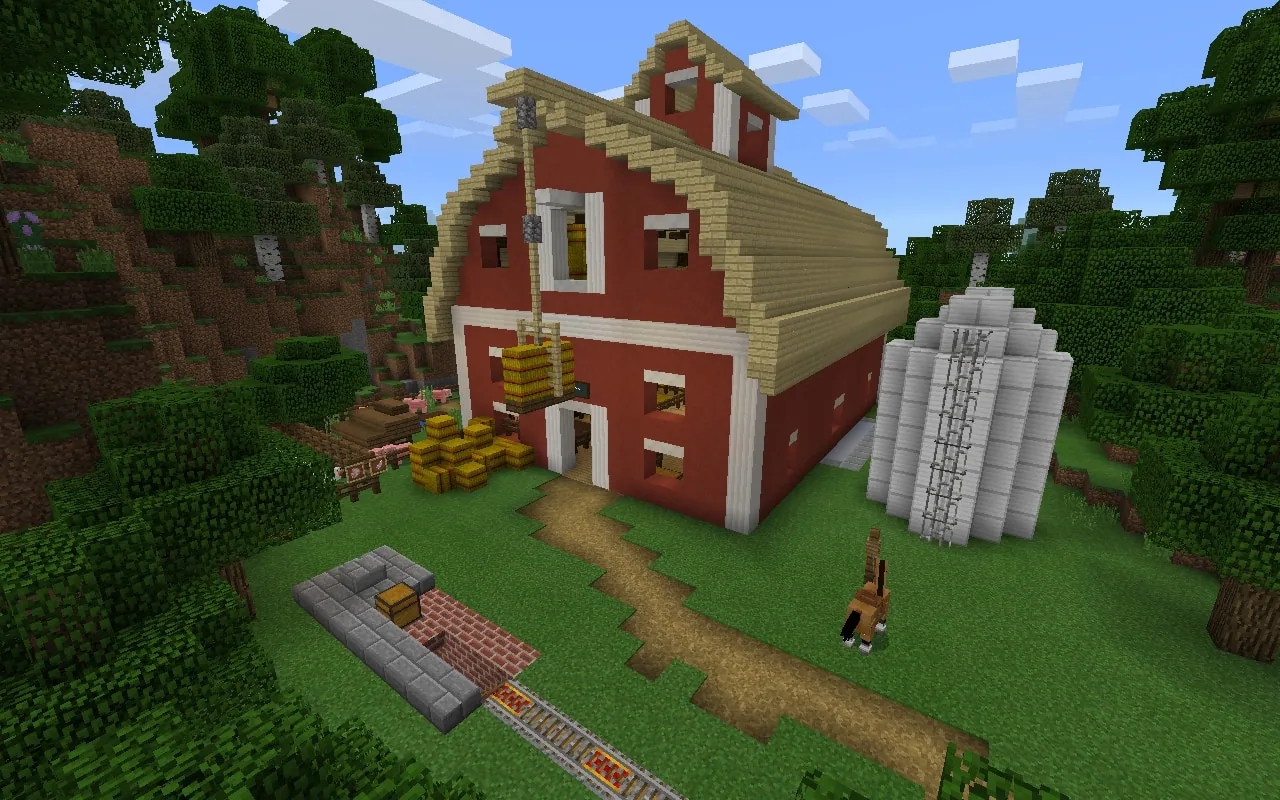
Goods collected at the farm, lumber yard, and mine are sent along an automated cart delivery system to the town warehouse. Assign workers at the warehouse to unload and organize the inbound shipments so that materials are sorted and ready for distribution.
- Product Design and Store Construction
Students analyze the sorted materials available in the warehouse and decide on a final good to produce and sell. Working in creative mode, each student or group constructs an appealing downtown shop, gathers their necessary supplies, crafts their items, and sets retail prices.
- Marketplace Exchange and Reflection
Open the community market for a shopping session where students use the wages earned from their labor jobs to purchase goods from each other's stores. Conclude with a class reflection on how currency facilitated trade, how shortages or surpluses occurred, and how personal choices impacted the town.
Assessment: success criteria
- Student accurately uses vocabulary such as production, distribution, consumption, and resources during class discussions.
- Student plans and manufactures a product while ensuring sufficient raw materials are secured from the warehouse.
- Student creates and stocks a retail shop with clear pricing aimed at community consumers.
- Student clearly explains how in-game currency functions as a medium of exchange compared to barter.
Differentiation
Provide a simple recipe and materials checklist for a basic product so learners can focus on the sequence of gathering, pricing, and selling.
Challenge students to forecast community needs, expand production sites sustainably, or calculate profit margins after paying for raw supplies.
Knowledge check
5 questions to check understanding after the lesson. Tap an answer to see if it is right; the score appears at the end.
1Why is the initial house building done in creative mode?
Answer: B. Building with unlimited creative inventory gives students a baseline to compare against real-world scarcity where resources are limited.
2What is the primary role of the town warehouse in this simulation?
Answer: C. The warehouse receives raw items from automated carts and organizes them to make later product distribution efficient.
3What form of compensation do students receive for working in production zones?
Answer: C. Students earn a wage using a chosen currency like gold nuggets, which they spend later during the marketplace phase.
4Which sector is responsible for harvesting food crops and managing livestock?
Answer: B. The agricultural sector handles growing crops and tending livestock to feed the community.
5What do students do during the final stage of the simulation?
Answer: B. Students go on a shopping spree using money earned from their jobs to purchase finished products at classmate storefronts.
Frequently Asked Questions
Does this lesson require an official world download?
No special download is required. Teachers can set up a basic starter world containing simple work zones for farming, forestry, mining, and a central receiving warehouse connected by minecart tracks.
What in-game items work best as currency?
Gold nuggets are recommended by the source because they are uniform, easy to divide, and distinct from ordinary building supplies.
Adapted from Goods and Services Simulation by Simon Vasey on Minecraft Education, last updated Feb 9, 2018. This classroom version, the timings and the quiz were written by 9Minecraft Education.