- Type
- Lesson plan
- Ages
- Ages 11-18
How do scientists use testing, documentation, and peer review to build and update models of the world?
Overview
Science is an evolving model rather than a complete explanation of the natural world. When empirical tests contradict existing theories, researchers refine their explanations through a continuous cycle of observation, questioning, experimentation, and peer review.
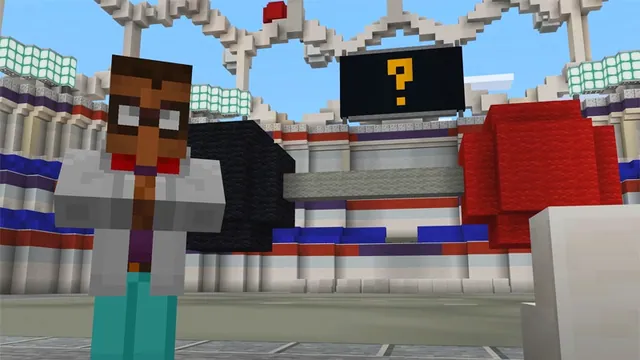
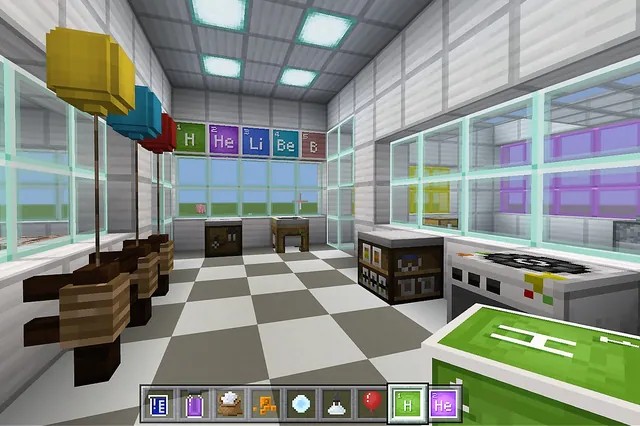
Within Minecraft, learners observe phenomena in physics, biology, and chemistry. Using in-game recording tools like the camera and writable book, students run controlled tests, document their findings, and replicate peer investigations to understand how scientific knowledge develops.
Learning objectives
By the end of this lesson students will be able to:
- Formulate a testable question and hypothesis based on observations inside Minecraft.
- Design and carry out an experiment to gather evidence regarding physical, chemical, or biological systems.
- Maintain an accurate laboratory record using a writable book and camera to document methods, observations, and conclusions.
- Evaluate and replicate a peer's experimental design to test whether results can be reproduced.
Blocks and items used in this lesson


Key vocabulary
- Hypothesis
- A proposed explanation or prediction that can be tested through experimentation.
- Observation
- Information gathered through direct examination of an event or system.
- Replication
- Repeating an existing experiment using recorded procedures to verify its findings.
- Scientific Theory
- An explanation of the natural world supported by evidence that remains open to revision.
Before class
Lesson sequence
- Observation and Inquiry
Introduce science as an ongoing cycle of observing, questioning, testing, and refining models. Direct students to explore the Minecraft world and document initial observations related to gravity, plant growth, or chemical element reactions.
- Hypothesis Formulation
Guide students to narrow their focus onto one testable question. Have them formulate a clear hypothesis predicting what will happen under specific test conditions.
- Experimentation and Data Collection
Students construct and execute their investigation inside the world. Instruct them to record every procedure, visual result, and measurement inside a writable book, capturing photos of key moments with the in-game camera.
- Drawing Conclusions
Learners analyze their collected data, draft a conclusion explaining their discoveries, and evaluate whether the results support or contradict their working hypothesis.
- Presentation and Replication
Students present their lab books to classmates. Each learner then replicates a peer's investigation using only the recorded steps, or designs a new experiment that builds on the peer's findings.
Assessment: success criteria
- Student maintains an organized laboratory book detailing procedures, observations, and conclusions.
- Hypothesis directly corresponds to an observable question within the game's mechanics.
- In-game camera images and written notes provide sufficient detail for another student to replicate the investigation.
- Student clearly presents experimental outcomes and explains how the data supports or refines their ideas.
Differentiation
Provide starter question stems such as how plant growth responds to specific variables or how gravity affects falling blocks.
Challenge learners to design a follow-up experiment that tests a new variable emerging directly from their peer's reported data.
Knowledge check
5 questions to check understanding after the lesson. Tap an answer to see if it is right; the score appears at the end.
1What happens to a scientific theory when new experimental evidence contradicts it?
Answer: B. Scientific theories are models that are revised when reliable experimental results disagree with them.
2Why must scientists keep thorough records of their methods and observations?
Answer: C. Accurate records allow other scientists to repeat experiments and confirm findings.
3Which two items in Minecraft are used to document laboratory data during this lesson?
Answer: A. The lesson specifically instructs students to record notes in a writable book and take photos with the camera.
4What should students do after sharing their findings with the class?
Answer: D. Peer sharing allows students to test each other's procedures and create new experiments based on peer findings.
5Which statement best describes science according to this lesson?
Answer: B. Science is described as an incomplete model of the world that scientists continuously update through experiments.
Resources
Part of the Chemistry curriculum
This is lesson 10 of 12 in Chemistry.
- Atomic Structures and Isotopes
- Build A Molecule
- Characterizing Elements
- Chemical Reactions
- Chemistry All Around You
- Exploring Chemistry Safely
- Properties of Matter
- Science in Minecraft
- Structures, Models, Molecules
- The Scientific Method
- Types of Chemical Reactions
- What is the world made of?
Frequently Asked Questions
What in-game topics can students investigate?
Students can investigate concepts across physics, chemistry, and biology, such as the mechanics of gravity, conditions necessary for plant growth, or reactions between chemical elements.
How should students share their lab books?
Students can present their writable books and camera portfolios directly to peers during classroom presentations, allowing partners to review the procedures and attempt replication.
Is a custom world file required for this lesson?
The source indicates a downloadable world is available, but the experimental tasks can also be applied across standard Minecraft Education environments featuring chemistry and biology mechanics.
Adapted from The Scientific Method by Minecraft Education on Minecraft Education, last updated Jul 21, 2025. This classroom version, the timings and the quiz were written by 9Minecraft Education.