- Type
- Lesson plan
- Ages
- Ages 11-18
- Duration
- about 55 min (suggested)
How can virtual chemistry tools help us understand and model different types of chemical reactions?
Overview
Chemical reactions govern how matter interacts, transforms, and remains stable in the natural world. In this lesson, students explore fundamental reaction types, including combination, displacement, and double displacement processes, while considering practical questions such as how material reactivity affects storage choices and why unreactive metals like gold are favored for ornaments.
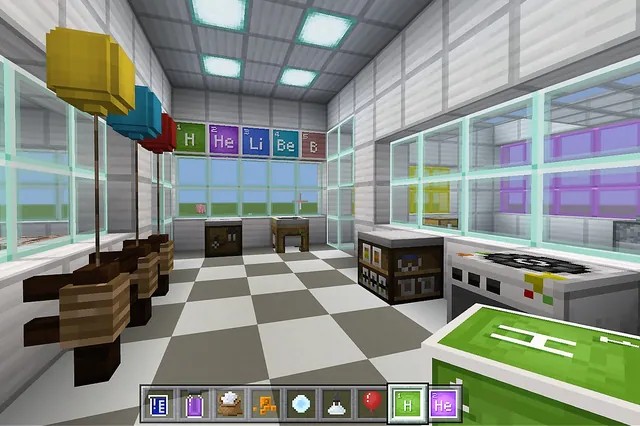
Using Minecraft Education's virtual chemistry features, learners safely model chemical behaviors through gamified lab work. Working with specialized stations—such as the Element Constructor, Compound Creator, Lab Table, and Crafting Table—students manipulate elements, form target compounds, and observe how substances react.
Learning objectives
By the end of this lesson students will be able to:
- Identify and distinguish between combination, displacement, and double displacement reactions.
- Operate the Element Constructor, Compound Creator, Lab Table, and Crafting Table to synthesize compounds.
- Relate the chemical reactivity of materials to real-world applications such as storage methods and metal usage.
- Collaborate with peers to investigate and demonstrate chemical reactions within a virtual lab environment.
Blocks and items used in this lesson


Key vocabulary
- Combination Reaction
- A reaction where two or more substances combine to form a single new substance.
- Displacement Reaction
- A chemical reaction in which a more reactive element displaces another element from its compound.
- Double Displacement Reaction
- A reaction where positive and negative ions of two compounds switch places to form two new compounds.
- Compound Creator
- A specialized Minecraft station used to combine elements in set ratios to produce chemical compounds.
- Lab Table
- A Minecraft chemistry station where players combine compounds and elements to perform chemical reactions.
Before class
Lesson sequence
Suggested timing: about 55 minutes in total.
- Introduction and Guiding Questions10 min
Introduce the concept of chemical reactions. Prompt students with foundational questions: What is a chemical reaction? Why are metals like gold chosen for ornaments? How does reactivity affect how materials are safely stored? Outline the main reaction categories: combination, displacement, and double displacement.
- Chemistry Station Exploration15 min
Guide students through the functions of the four primary workstations:
- Element Constructor: For viewing and configuring elements.
- Compound Creator: For mixing elements to form specific chemical formulas.
- Lab Table: For combining products to initiate reactions.
- Crafting Table: For combining finished chemistry outputs into functional items.
- Virtual Lab Investigation20 min
In pairs or small groups, students explore the lab assets, build requested compounds in the Compound Creator, and initiate reactions at the Lab Table. Students record observations of combination and displacement behaviors demonstrated by their virtual compounds.
- Synthesis and Reflection10 min
Bring the class together to compare results. Discuss how the virtual demonstrations mirrored real-world reaction rules and evaluate how understanding reactivity guides how humans handle and store different materials.
Assessment: success criteria
- Correctly selects and uses the Compound Creator and Lab Table for their intended chemistry functions.
- Explains the difference between a combination reaction and a displacement reaction.
- Successfully synthesizes target compounds using proper element ratios.
- Provides a real-world rationale for why unreactive metals like gold are preferred for jewelry.
Differentiation
Provide formula reference cards showing the exact element recipes required for the Compound Creator.
Ask advanced learners to predict the products of double displacement reactions before running tests at the Lab Table.
Knowledge check
5 questions to check understanding after the lesson. Tap an answer to see if it is right; the score appears at the end.
1Which Minecraft chemistry station is specifically designed to combine individual elements into chemical compounds?
Answer: B. The Compound Creator is used to combine elements into specific chemical compounds.
2What happens during a combination reaction?
Answer: A. In a combination reaction, multiple reactants combine into one single product.
3Why is gold commonly selected for ornaments and jewelry in terms of chemical behavior?
Answer: C. Gold's low reactivity prevents it from tarnishing or corroding easily, making it ideal for jewelry.
4Which block is used to trigger reaction experiments from prepared chemistry materials in Minecraft?
Answer: D. The Lab Table is used to run experiments and observe reactions using created substances.
5In a displacement reaction, what occurs between the reacting materials?
Answer: B. A displacement reaction involves one element taking the place of another element inside a compound.
Resources
Part of the Chemistry curriculum
This is lesson 11 of 12 in Chemistry.
- Atomic Structures and Isotopes
- Build A Molecule
- Characterizing Elements
- Chemical Reactions
- Chemistry All Around You
- Exploring Chemistry Safely
- Properties of Matter
- Science in Minecraft
- Structures, Models, Molecules
- The Scientific Method
- Types of Chemical Reactions
- What is the world made of?
Frequently Asked Questions
Does this lesson require an external world download?
No special world download is required. Teachers can create a standard Minecraft Education world and make sure the Chemistry toggle is active.
What specific chemistry tools must be accessible to students?
Students need access to the Element Constructor, Compound Creator, Lab Table, and Crafting Table to complete the activities.
Adapted from Types of Chemical Reactions by Chandni Agarwal on Minecraft Education, last updated Jul 21, 2025. This classroom version, the timings and the quiz were written by 9Minecraft Education.