- Type
- Lesson plan
- Ages
- Ages 11-18
- Duration
- about 50 min (suggested)
How do elements combine to form compounds and mixtures, and what evidence shows that a chemical reaction has occurred?
Overview
Matter exists in various forms, ranging from single elements to complex mixtures. In this lesson, students explore the core differences between elements, molecules, compounds, and mixtures. They learn that while elements consist of a single type of atom, compounds involve chemically bonded atoms of different elements that can only be separated through chemical reactions, unlike physical mixtures.
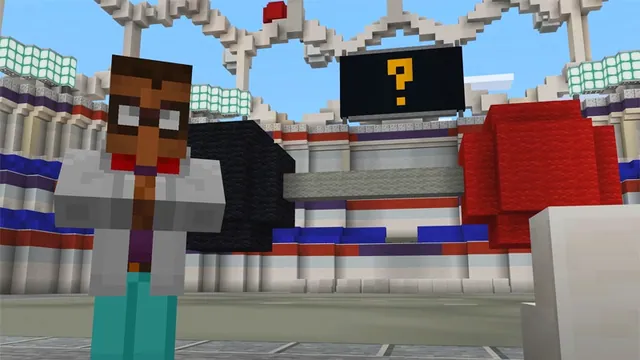
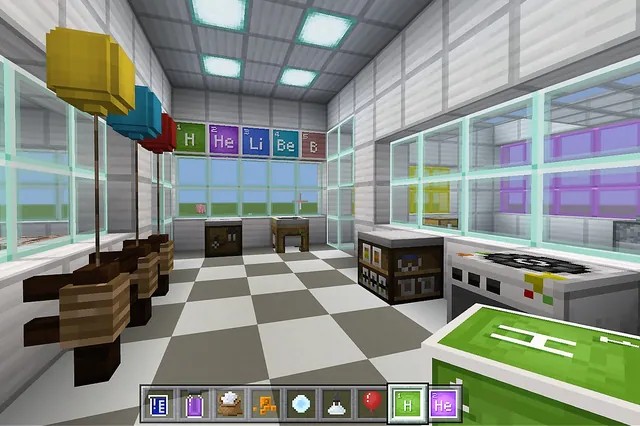
Using Minecraft Education chemistry workstations, students enter formulas into the Compound Creator without knowing the product beforehand. They then combine these compounds to produce items like fertilizer, glow sticks, and elephant's toothpaste, examining the role of catalysts and chemical decomposition in action.
Learning objectives
By the end of this lesson students will be able to:
- Differentiate between elements, molecules, compounds, and mixtures based on their composition.
- Synthesize unfamiliar compounds using chemical formulas in the Compound Creator.
- Combine compounds to produce mixtures such as fertilizer, glow sticks, and elephant's toothpaste.
- Explain the chemical breakdown and catalytic action involved in producing elephant's toothpaste.
Blocks and items used in this lesson


Key vocabulary
- Element
- A pure substance made of only one type of atom that cannot be broken down by chemical means.
- Molecule
- A structure formed when two or more atoms are held together by chemical bonds.
- Compound
- A molecule that contains atoms of at least two different elements bonded together.
- Mixture
- A combination of elements, molecules, or compounds that can be separated by physical processes.
- Catalyst
- A substance that speeds up a chemical reaction while remaining chemically unchanged itself.
Before class
Lesson sequence
Suggested timing: about 50 minutes in total.
- Concept Introduction10 min
Introduce the definitions of elements, molecules, compounds, and mixtures. Use examples such as molecular oxygen, water, and atmospheric air to explain how physical intermingling differs from chemical bonding.
- Compound Creation15 min
Distribute chemical formulas to students without revealing the names of the substances. Students input these ratios into the Compound Creator to discover what compounds they produce.
- Crafting Mixtures15 min
Direct students to combine their newly created compounds into complex mixtures, focusing on crafting fertilizer, glow sticks, and elephant's toothpaste at the chemistry tables.
- Reaction Analysis and Reflection10 min
Discuss what happens when elephant's toothpaste is created. Students identify that hydrogen peroxide decomposes into water and oxygen, potassium iodide acts as an unchanged catalyst, and soap captures the gas to produce foam.
Assessment: success criteria
- Student accurately explains why water is considered both a molecule and a compound.
- Student successfully uses formulas to produce target compounds in the Compound Creator.
- Student identifies that hydrogen peroxide breaks down into water and oxygen during the elephant's toothpaste reaction.
- Student explains the difference between a physical mixture and a chemically bonded compound.
Differentiation
Provide an element reference sheet that visually displays how many atoms of each element are required for each formula.
Ask students to analyze everyday items from previous chemistry topics and categorize each material as an element, compound, or mixture.
Knowledge check
5 questions to check understanding after the lesson. Tap an answer to see if it is right; the score appears at the end.
1What is the defining characteristic of an element?
Answer: B. Elements consist of a single type of atom and cannot be reduced to simpler substances by chemical reactions.
2Why is water (H2O) classified as both a molecule and a compound?
Answer: A. Water is a molecule because it has multiple bonded atoms, and a compound because those atoms represent different elements (hydrogen and oxygen).
3How can the parts of a mixture, such as air, be separated?
Answer: D. Mixtures are physically intermingled substances and can be separated using physical methods.
4What happens to hydrogen peroxide (H2O2) in the elephant's toothpaste reaction?
Answer: B. During the elephant's toothpaste reaction, hydrogen peroxide decomposes into water and oxygen gas.
5What is the role of potassium iodide in the elephant's toothpaste mixture?
Answer: C. Potassium iodide is not consumed in the reaction; it serves as a catalyst that accelerates the breakdown of hydrogen peroxide.
Resources
Part of the Chemistry curriculum
This is lesson 7 of 12 in Chemistry.
- Atomic Structures and Isotopes
- Build A Molecule
- Characterizing Elements
- Chemical Reactions
- Chemistry All Around You
- Exploring Chemistry Safely
- Properties of Matter
- Science in Minecraft
- Structures, Models, Molecules
- The Scientific Method
- Types of Chemical Reactions
- What is the world made of?
Frequently Asked Questions
What Minecraft station do students need to make the initial compounds?
Students use the Compound Creator block, where they combine specific elemental ratios to assemble compounds.
Does the downloadable world provide the necessary chemistry items?
Yes, the lesson indicates a downloadable world is available, which provides the chemistry stations and elements required for the tasks.
Adapted from Properties of Matter by Minecraft Education on Minecraft Education, last updated Jul 21, 2025. This classroom version, the timings and the quiz were written by 9Minecraft Education.