- Type
- Lesson plan
- Subject
- Science
- Topics
- Science
- Ages
- Ages 8-18
- Duration
- about 60 min (suggested)
- Skills
- Critical thinking
How do the fundamental chemical elements in natural and synthetic materials determine what the world is made of?
Overview
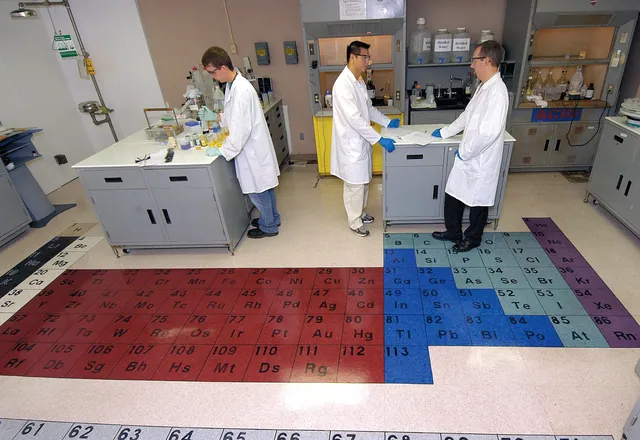
All matter in the universe, whether naturally occurring or synthetically manufactured, is made from basic chemical elements. Even though materials may appear completely different in texture, color, and hardness, many share remarkably similar chemical foundations. For instance, stone-like structures are primarily silicon and oxygen, while living things consist largely of carbon, oxygen, nitrogen, and hydrogen.
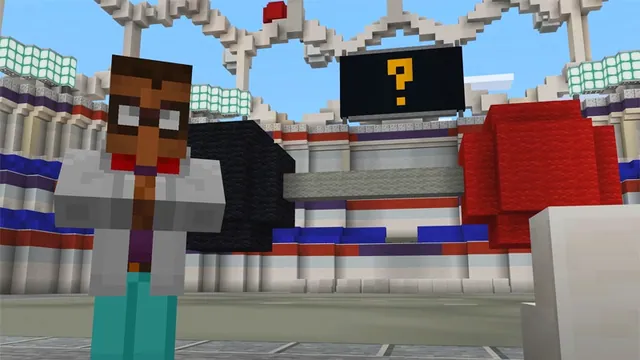
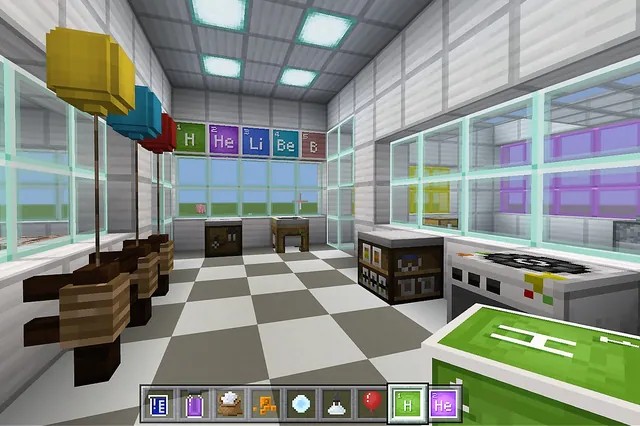
In this lesson, learners explore this foundational chemistry concept using Minecraft Education's Material Reducer. Students gather various blocks from their environment and reduce them into their pure elemental components, comparing composition data across different materials and discovering how natural elements can be recombined into new substances.
Learning objectives
By the end of this lesson students will be able to:
- Identify the elemental composition of natural and synthetic blocks using the Material Reducer.
- Categorize collected blocks according to shared chemical elements.
- Explain why materials with similar elemental makeups, such as wood and coal, can have different physical properties.
- Construct new compounds and synthetic materials from harvested elements.
Blocks and items used in this lesson
 Material Reducer
 Compound Creator
 Dirt
 Stone
 Coal
 Carbon (Element 6)
 Oxygen (Element 8)
 Hydrogen (Element 1)
Key vocabulary
- Material Reducer
- A chemistry workstation in Minecraft that reduces blocks into their constituent chemical elements.
- Element
- A pure chemical substance composed of only one type of atom that cannot be broken down simpler by chemical means.
- Compound
- A substance formed when two or more chemical elements are chemically bonded together.
- Synthetic Material
- A man-made substance produced by chemically altering natural resources.
Before class
Lesson sequence
Suggested timing: about 60 minutes in total.
- Introduction and Guiding Questions10 min
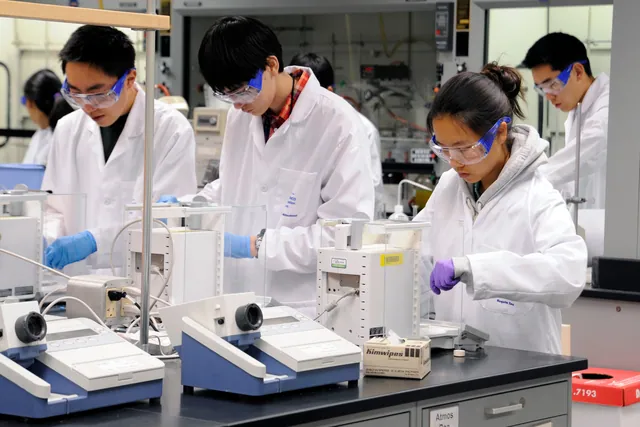
Introduce the concept that every physical object is made of chemical elements, molecules, or compounds. Discuss how real-world scientists use analytical instruments to measure elemental composition, and explain that the in-game Material Reducer performs a similar function.
- Block Harvesting and Elemental Reduction20 min
Direct students to explore the world and collect a wide variety of natural and synthetic blocks, such as dirt, stone, wood, and coal. Students place each collected block into the Material Reducer and record the resulting elements and quantities.
- Data Analysis and Categorization15 min
Have students group their analyzed blocks based on elemental composition. Facilitate a discussion around surprising findings, such as why coal shares an elemental profile with wood rather than stone, and identify which elements appear most frequently across nature.
- Constructing Compounds and Reflection15 min
Challenge students to use the raw elements obtained from natural blocks to assemble new compounds and synthetic materials. Conclude with a class reflection on what materials are abundant in nature and how humans transform natural resources into useful new substances.
Assessment: success criteria
- Student accurately records the elemental components of multiple natural and synthetic blocks.
- Student groups blocks correctly according to shared chemical profiles.
- Student articulates why certain materials like coal and wood share similar elemental makeup despite distinct appearances.
- Student successfully synthesizes new compounds from elements extracted from natural blocks.
Differentiation
Provide a focused list of three specific blocks (such as wood, stone, and dirt) and a pre-formatted chart to guide elemental recording.
Have advanced learners collect a broader variety of synthetic blocks and identify common element pairings across extended compound structures.
Knowledge check
5 questions to check understanding after the lesson. Tap an answer to see if it is right; the score appears at the end.
1Which Minecraft tool is used to separate blocks into their constituent elements?
Answer: C. The Material Reducer acts like real-world analytical instruments to break blocks down into elements.
2Which two elements make up the majority of stone-like materials?
Answer: A. Most stone-like materials are primarily composed of silicon and oxygen.
3What group of elements makes up the vast majority of living things?
Answer: B. Living materials are largely formed from carbon, oxygen, nitrogen, and hydrogen.
4Even though coal visually resembles a stone, its elemental composition is most similar to which material?
Answer: D. Coal originates from plant matter and shares a carbon-rich composition with wood rather than stone.
5How are synthetic materials produced according to the lesson?
Answer: C. Synthetic materials and chemicals are created using elements and compounds sourced from natural resources.
Resources
Part of the Chemistry curriculum
This is lesson 12 of 12 in Chemistry.
- Atomic Structures and Isotopes
- Build A Molecule
- Characterizing Elements
- Chemical Reactions
- Chemistry All Around You
- Exploring Chemistry Safely
- Properties of Matter
- Science in Minecraft
- Structures, Models, Molecules
- The Scientific Method
- Types of Chemical Reactions
- What is the world made of?
Frequently Asked Questions
Can all blocks in Minecraft be placed into the Material Reducer?
Most standard natural blocks and simple manufactured blocks can be reduced, but some complex or custom items may not yield elements. Encourage students to test a variety of blocks to see which ones break down.
What age group is this lesson suitable for?
This lesson can be adapted across ages 8 to 18, ranging from basic identification of elements in upper elementary to discussions of molecular formulas and synthetic manufacturing in high school.
Adapted from What is the world made of? by Minecraft Education on Minecraft Education, last updated Sep 15, 2023. This classroom version, the timings and the quiz were written by 9Minecraft Education.