- Type
- Lesson plan
- Ages
- Ages 11-18
How do structural models reveal molecular properties and arrangements that a chemical formula alone cannot show?
Overview
Chemical formulas convey the quantity of each element within a molecule, but structural models reveal how those atoms connect and arrange in physical space. Through ball-and-stick modeling conventions, students learn how elemental bonding limits—known as valency—determine the shapes and configurations that molecules can take.
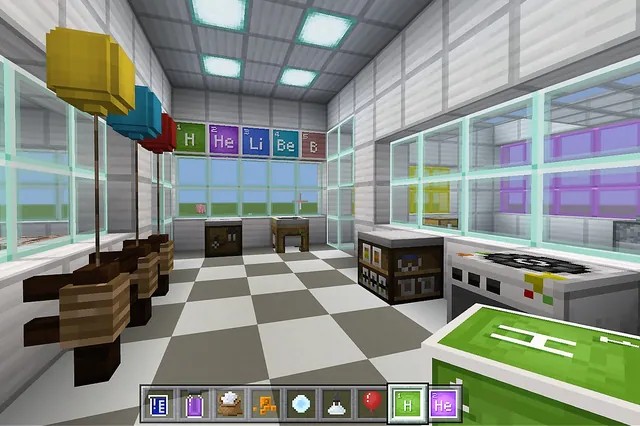
In Minecraft, students use colored blocks such as wool or chemistry element blocks to construct 2D diagrams and 3D molecular structures. By beginning with simple hydrocarbons and progressing to compounds containing oxygen and nitrogen, learners discover firsthand how identical molecular formulas can form distinctly different structural isomers.
Learning objectives
By the end of this lesson students will be able to:
- Identify standard color conventions used to represent common chemical elements.
- Apply valency rules to determine the correct number of bonds for carbon, hydrogen, oxygen, and nitrogen.
- Build 3D ball-and-stick molecular models and 2D compound representations in Minecraft.
- Explain how isomers share an identical chemical formula while maintaining different structural arrangements.
Blocks and items used in this lesson
 Black Wool
 White Wool
 Red Wool
 Blue Wool
 Carbon (Element 6)
 Hydrogen (Element 1)
 Oxygen (Element 8)
 Nitrogen (Element 7)
Key vocabulary
- Chemical Formula
- A written expression showing the exact number of atoms of each element in a molecule.
- Valency
- The number of chemical bonds an atom of a particular element can form.
- Hydrocarbon
- A chemical compound composed exclusively of carbon and hydrogen atoms.
- Isomer
- Molecules that share the exact same chemical formula but possess different spatial structures.
Before class
Lesson sequence
- Introduction to Valency and Modeling
Introduce the concept of valency as the capacity of an atom to form bonds. Review key values: carbon forms four bonds, hydrogen forms one, oxygen forms two, and nitrogen forms three.
Review color conventions for modeling atoms, highlighting white for hydrogen, black for carbon, red for oxygen, and blue for nitrogen.
- Hydrocarbon Construction
Direct students to enter the Minecraft world and construct simple hydrocarbons using colored wool blocks for atoms and connecting lines for bonds.
Have students start with methane (CH4) to practice bonding a single carbon atom with four surrounding hydrogen atoms.
- Adding Heteroatoms
Challenge students to increase model complexity by introducing oxygen and nitrogen atoms into their builds.
Alternatively, students can construct flat two-dimensional structural representations using the element blocks available in the game inventory.
- Investigating Isomers and Review
Present the formula C4H10 and ask students to find multiple ways to assemble the molecule without violating carbon or hydrogen valency rules.
Discuss how these two structures represent isomers, demonstrating why structural models are necessary alongside chemical formulas.
Assessment: success criteria
- Models correctly follow color conventions (e.g., black for carbon, white for hydrogen, red for oxygen).
- Each atom displays the correct number of bonds corresponding to its valency.
- Students successfully construct both basic hydrocarbons and molecules containing oxygen or nitrogen.
- Learners can explain how two different C4H10 structures share the same formula as isomers.
Differentiation
Allow students to build flat 2D representations using element blocks or focus exclusively on simple molecules like methane (CH4).
Challenge students to construct both distinct structural isomers of butane (C4H10) in full 3D space.
Knowledge check
5 questions to check understanding after the lesson. Tap an answer to see if it is right; the score appears at the end.
1What does the valency of an element tell you?
Answer: B. Valency is defined as the number of chemical bonds an atom of a particular element can form.
2What color wool conventionally represents oxygen in molecular models?
Answer: A. According to standard molecular modeling conventions, oxygen atoms are represented in red.
3How many bonds does a carbon atom typically form?
Answer: D. Carbon has a valency of four, meaning it can form four chemical bonds.
4What term describes molecules that have the same chemical formula but different structural arrangements?
Answer: C. Isomers are defined as molecules sharing the same formula but arranged in different structures.
5Which element forms only one chemical bond according to its valency?
Answer: B. Hydrogen has a valency of one and can therefore only form one bond.
Resources
Part of the Chemistry curriculum
This is lesson 9 of 12 in Chemistry.
- Atomic Structures and Isotopes
- Build A Molecule
- Characterizing Elements
- Chemical Reactions
- Chemistry All Around You
- Exploring Chemistry Safely
- Properties of Matter
- Science in Minecraft
- Structures, Models, Molecules
- The Scientific Method
- Types of Chemical Reactions
- What is the world made of?
Frequently Asked Questions
Can students build in two dimensions instead of three?
Yes. Students can build two-dimensional structural representations using element blocks or wool directly on a flat surface if 3D ball-and-stick building is too challenging.
What materials represent bonds between atoms?
Students can connect colored wool blocks using sticks, rods, or thin blocks arranged in lines to represent chemical bonds between the atomic centers.
Which compounds should students begin with?
Start with simple hydrocarbons composed solely of carbon and hydrogen, such as methane (CH4), before advancing to molecules that include oxygen and nitrogen.
Adapted from Structures, Models, Molecules by Minecraft Education on Minecraft Education, last updated Sep 15, 2023. This classroom version, the timings and the quiz were written by 9Minecraft Education.