- Type
- Build challenge
- Subject
- Science
- Duration
- about 60 min (suggested)
How do individual atoms combine in three-dimensional space to form distinct molecular structures?
Overview
Molecules are the fundamental building blocks of chemical compounds, and their three-dimensional shapes determine how substances interact and behave across physical and chemical processes. Understanding how individual atoms link together helps students visualize core principles across chemistry and physics.
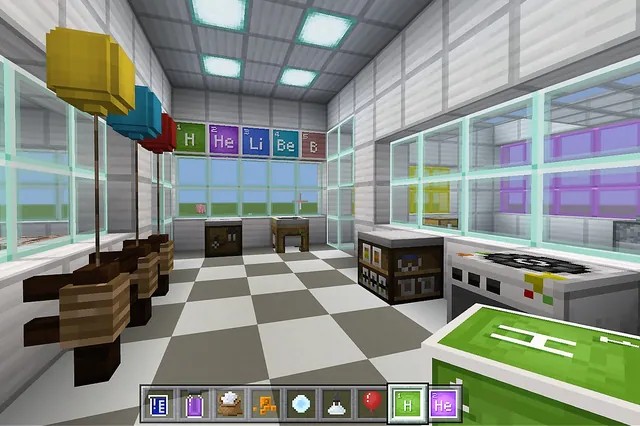
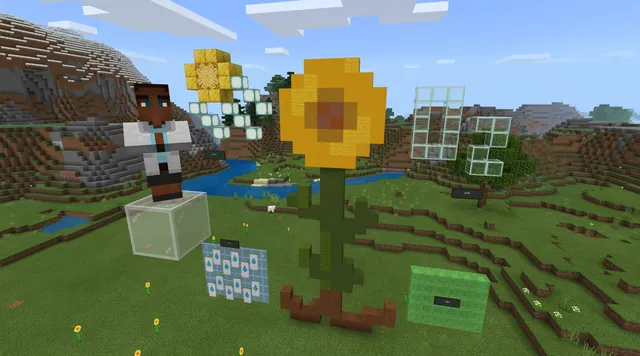
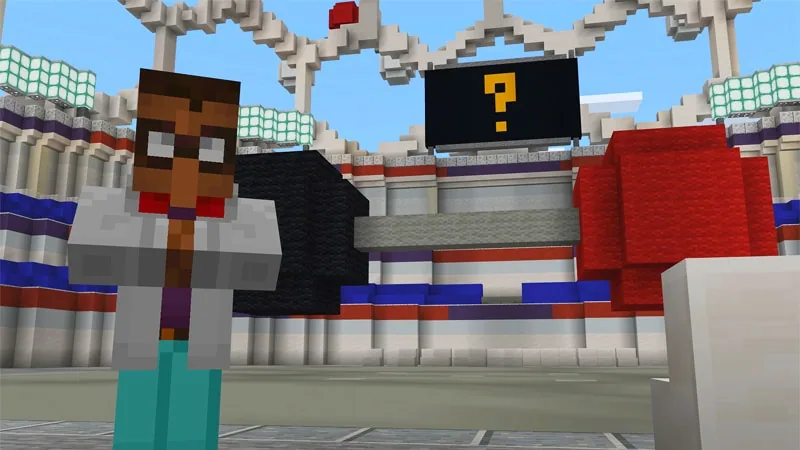
In this lesson, students enter a chemistry-themed environment to observe pre-built molecular models and construct their own three-dimensional representations. Working within the virtual dome, learners gain direct insight into molecular form and structure while using in-game communication tools like signs and posters to present their work.
Learning objectives
By the end of this activity students will be able to:
- Build a three-dimensional model of a molecule inside the dome environment.
- Identify pre-built molecular structures provided in the challenge world.
- Label elements and molecular parts using in-game posters and signs.
- Communicate scientific observations about molecular form and structure to peers.
Blocks and items used in this lesson


Key vocabulary
- Atom
- The basic building block of all matter, composed of subatomic particles.
- Molecule
- A distinct group of two or more atoms held together by chemical bonds.
- Element
- A pure chemical substance consisting of only one type of atom.
- Molecular Structure
- The specific three-dimensional arrangement of atoms within a molecule.
Before class
Lesson sequence
Suggested timing: about 60 minutes in total.
- Orientation and Exploration10 min
Introduce the session goals and direct students into the chemistry dome to inspect the pre-built displays.
Have students examine the models and work to identify which real-world molecules are shown.
- 3D Molecular Construction25 min
Assign or allow students to choose a specific molecule to build inside the dome.
Students construct the atoms and connecting bonds in three dimensions, focusing on proper shape and structural relationships.
- Documentation and Labeling10 min
Direct students to place posters and signs adjacent to their build to describe the molecule.
Students identify each element present and explain the overall structure of their model.
- Peer Review and Discussion15 min
Conduct a virtual gallery walk where learners visit neighboring builds within the dome.
Students share feedback and discuss how differing atomic configurations create distinct substances.
Assessment: success criteria
- Student constructs an accurate three-dimensional molecular model within the dome.
- Student correctly identifies pre-existing molecules located in the world.
- Student labels elements and atomic details clearly using in-game posters or signs.
- Student articulates key features of molecular form and structure during peer review.
Differentiation
Provide reference diagrams of simple two- or three-atom molecules for students to recreate block-by-block.
Challenge students to model complex multi-element molecules or build a physical hands-on counterpart using craft materials.
Knowledge check
5 questions to check understanding after the lesson. Tap an answer to see if it is right; the score appears at the end.
1Where does the primary building activity take place in this challenge world?
Answer: C. The source specifies using the space inside the dome to build in a 3D environment.
2Which in-game tools are recommended for labeling and describing elements?
Answer: A. The source instructions mention labeling and describing each element using posters and signs.
3Besides building from scratch, what can students do with existing models in the world?
Answer: B. The source suggests going through a variety of pre-built molecules to try to identify all of them.
4What primary science concept is explored by building these models?
Answer: C. The source states the goal is to build a molecule and learn about its form and structure.
5Which extension activity is suggested to take learning beyond the screen?
Answer: B. The extensions list includes creating a physical model of the molecules built in Minecraft.
Resources
Part of the Chemistry curriculum
This is lesson 2 of 12 in Chemistry.
- Atomic Structures and Isotopes
- Build A Molecule
- Characterizing Elements
- Chemical Reactions
- Chemistry All Around You
- Exploring Chemistry Safely
- Properties of Matter
- Science in Minecraft
- Structures, Models, Molecules
- The Scientific Method
- Types of Chemical Reactions
- What is the world made of?
Frequently Asked Questions
Can students work collaboratively inside the dome?
Yes. The activity emphasizes communication skills, making it suitable for pairs or small teams to construct complex molecules together or analyze pre-built structures as a group.
How can this challenge connect to physical science lab work?
Teachers can take the molecules students model digitally and use them directly in follow-up hands-on experiments or physical modeling tasks with craft materials as suggested in the extensions.
Adapted from Build A Molecule by Minecraft Education on Minecraft Education, last updated Jul 21, 2025. This classroom version, the timings and the quiz were written by 9Minecraft Education.