- Type
- Build challenge
- Subject
- ScienceArt, Music & Design
- Topics
- ScienceArt and Design
- Duration
- about 60 min (suggested)
- Includes
- Quiz: 5 questionsMinecraft world
How do individual parts connect and interact to make a system function as a whole?
Overview
A system is composed of connected components working together to form a functioning whole. Studying systems helps learners recognize how individual parts influence one another, whether in the living world or in technological and societal structures. By examining inputs, outputs, and relationships between elements, students develop critical thinking and communication skills.Learning objectives
By the end of this activity students will be able to:
- Define a system as a collection of interrelated parts that form a unified structure.
- Select and research either a natural or human-made system to model.
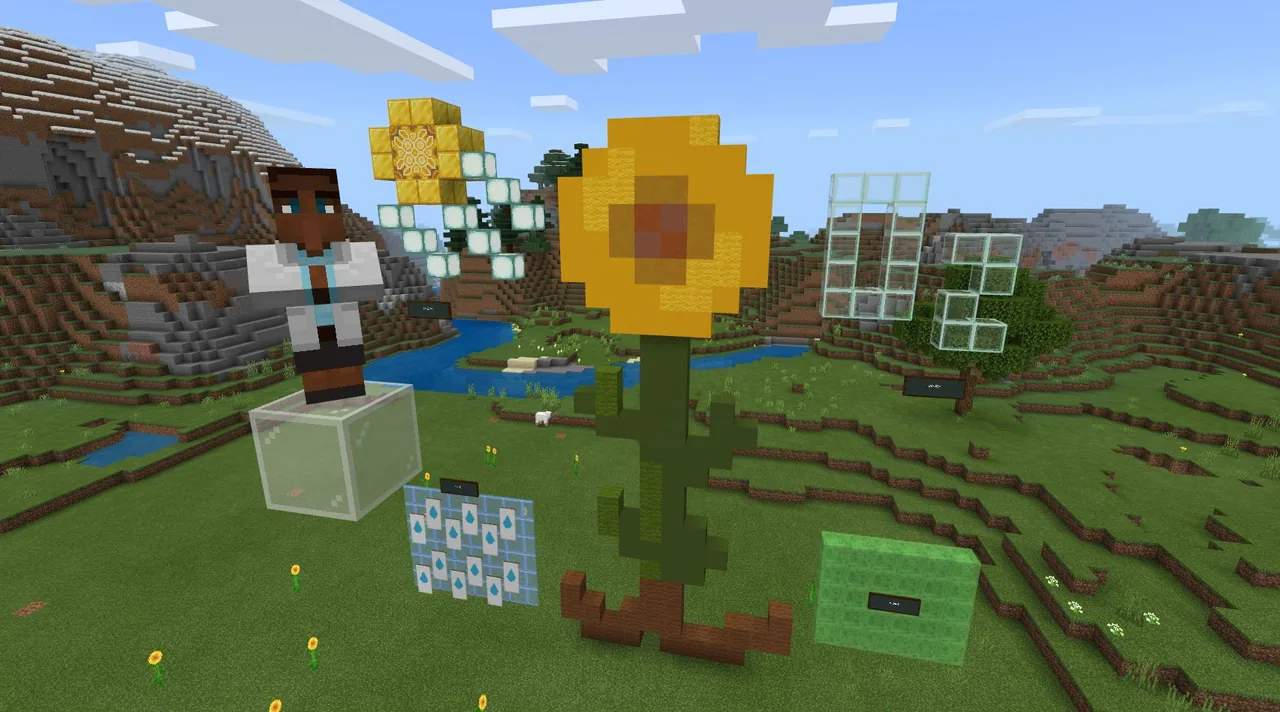
- Build a representative model in Minecraft showing how components interact.
- Communicate how individual parts within the model affect the overall function of the system.
Blocks and items used in this lesson


Key vocabulary
- System
- A collection of connected elements that function together as a unified whole.
- Natural System
- A system occurring in nature, such as the water cycle, photosynthesis, or a circulatory network.
- Human-Made System
- A system designed by people, such as an electrical circuit, a camera, or a political process.
- Energy Transfer
- The movement of energy from one part of a system to another.
- Open or Closed System
- A classification based on whether energy and matter can freely enter and leave the system.
Before class
Lesson sequence
Suggested timing: about 60 minutes in total.
- Introduction to Systems10 min
Introduce the concept of a system as a group of connected elements that operate together. Discuss examples from nature, such as photosynthesis or the water cycle, and human-made examples like electrical circuits or political structures.
- Planning and Selection10 min
Have students select one specific system to represent. Prompt them to list the primary components, note how each part interacts with the others, and sketch a basic layout before placing blocks.
- System Build Challenge30 min
Students enter Minecraft to construct their chosen system. Remind them to make the relationships between parts clearly visible through layout, labeling, or functional mechanisms.
- Review and Discussion10 min
Have learners present their models to peers or the class. Ask them to explain what happens to the overall system if one critical component is altered or removed.
Assessment: success criteria
- The build clearly demonstrates distinct components connected into a unified whole.
- The student accurately identifies whether their project represents a natural or human-made system.
- The student clearly explains the functional relationship between at least two parts of the system.
Differentiation
Learners needing extra support can model a basic cause-and-effect machine with two or three interacting parts.
Advanced learners can construct a complex Rube Goldberg machine or track energy transfer while identifying their model as an open or closed system.
Knowledge check
5 questions to check understanding after the lesson. Tap an answer to see if it is right; the score appears at the end.
1What defines a system?
Answer: B. A system is defined as a group of interrelated elements that work together to form a unified whole.
2Which of the following is listed as an example of a natural system?
Answer: A. The challenge lists the water cycle, photosynthesis, and the circulatory system as examples of natural systems.
3Which of these is an example of a human-made system mentioned in the lesson?
Answer: C. Electrical circuits, optical cameras, and political processes are human-made systems identified in the challenge.
4What type of device can students build as an advanced extension challenge?
Answer: D. The extensions suggest creating a Rube Goldberg style machine for a bigger challenge.
5What additional concept can students track in their systems as an extension?
Answer: A. The lesson extension suggests tracking energy transfer and defining whether the system is open or closed.
Resources
Frequently Asked Questions
Can students choose abstract concepts like political systems for this build?
Yes. The challenge explicitly includes human-made systems such as political processes, which can be represented through symbolic structures, flowcharts, or voting chambers in Minecraft.
Does the system in Minecraft need to be fully automated?
No. While students can build functional cause-and-effect or Rube Goldberg machines, they may also illustrate biological or conceptual systems through explanatory visual models.
Adapted from Building Systems by Minecraft Education on Minecraft Education, last updated Oct 21, 2026. This classroom version, the timings and the quiz were written by 9Minecraft Education.