- Type
- Lesson plan
- Subject
- Science
- Ages
- Ages 11-18
- Skills
- Critical thinking
How do subatomic particles determine the identity, mass, and properties of an element and its isotopes?
Overview
Atoms are the fundamental building blocks of matter, composed of protons, neutrons, and electrons. The number of protons inside the nucleus defines the atomic number and identity of an element, while variations in neutron count yield different isotopes that share chemical behaviors but differ in physical properties such as mass and stability.
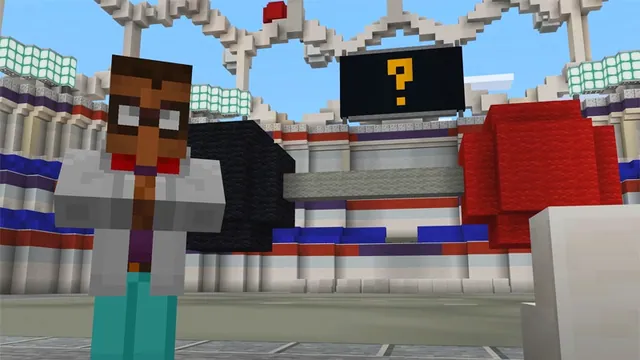
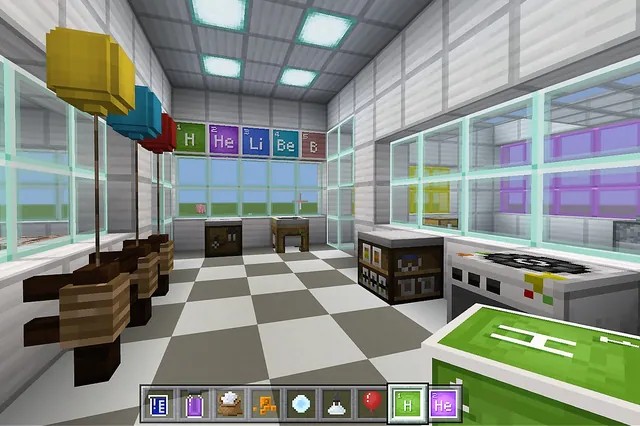
Using the Element Constructor and Compound Creator in Minecraft Education, students adjust subatomic particle counts to build specific elements and their isotopes. Learners directly observe how changing protons alters the element entirely, whereas altering neutrons produces isotopes like deuterium and tritium.
Learning objectives
By the end of this lesson students will be able to:
- Construct models of atoms using protons, neutrons, and electrons.
- Explain how the count of protons determines an element's identity and atomic number.
- Compare the subatomic composition and physical properties of different isotopes.
- Assemble simple molecules using isotopes within the Compound Creator.
Blocks and items used in this lesson


Key vocabulary
- Nucleus
- The central core of an atom formed by protons and neutrons, containing most of its mass.
- Atomic Number
- The number of protons found in the nucleus of an atom.
- Atomic Mass
- The total combined mass of an atom's protons, neutrons, and electrons.
- Isotope
- A form of an element that has the same number of protons but a different number of neutrons.
- Deuterium
- An isotope of hydrogen consisting of one proton, one neutron, and one electron.
- Tritium
- An isotope of hydrogen consisting of one proton, two neutrons, and one electron.
Before class
Lesson sequence
- Introduction to Atomic Structure
Review the components of an atom with the class, highlighting that protons and neutrons form the nucleus while electrons occupy the surrounding space. Explain that atomic number matches the number of protons and that neutral elements have equal counts of protons and electrons.
- Element Building and Particle Correlation
Students open the Element Constructor in Minecraft. Have them assemble baseline elements by balancing protons and electrons, taking note of how modifying the proton count directly changes the atomic number and resulting element.
- Constructing Isotopes
Direct students to produce hydrogen and its isotopes: standard hydrogen (1 proton, 0 neutrons), deuterium (1 proton, 1 neutron), and tritium (1 proton, 2 neutrons). Students calculate the atomic weight for each isotope and note differences in mass and stability.
- Molecule Synthesis and Reflection
Learners place their created isotopes into the Compound Creator to formulate molecules. Conclude with a class discussion reinforcing that isotopes retain identical chemical behaviors because their electron arrangements remain unchanged.
Assessment: success criteria
- Student successfully configures an element and at least one of its isotopes in the Element Constructor.
- Student demonstrates that the atomic number is identical to the number of protons.
- Student correctly calculates the atomic weight of specific isotopes based on subatomic particles.
Differentiation
Provide a reference chart listing the specific particle counts for hydrogen, deuterium, and tritium to guide slider adjustments in the Element Constructor.
Challenge students to model more complex elements and compare how varying neutron counts alters isotopic stability and total mass.
Knowledge check
5 questions to check understanding after the lesson. Tap an answer to see if it is right; the score appears at the end.
1Which subatomic particle defines the atomic number of an element?
Answer: B. The atomic number of an element is always equal to the number of protons in its nucleus.
2Where is the majority of an atom's mass located?
Answer: C. Protons and neutrons reside in the nucleus and account for the vast majority of an atom's mass.
3How does tritium differ from common hydrogen?
Answer: A. Common hydrogen contains no neutrons, whereas tritium contains two neutrons along with one proton and one electron.
4What happens to the chemical properties of an atom when its neutron count changes to form an isotope?
Answer: C. Isotopes share the same electron configuration, which means they maintain the same chemical properties despite having different physical masses.
5Roughly how many times smaller is an electron compared to a proton or neutron?
Answer: D. An electron is approximately 2000 times smaller than a proton or neutron.
Resources
Part of the Chemistry curriculum
This is lesson 1 of 12 in Chemistry.
- Atomic Structures and Isotopes
- Build A Molecule
- Characterizing Elements
- Chemical Reactions
- Chemistry All Around You
- Exploring Chemistry Safely
- Properties of Matter
- Science in Minecraft
- Structures, Models, Molecules
- The Scientific Method
- Types of Chemical Reactions
- What is the world made of?
Frequently Asked Questions
Which specific in-game workstations are required for this lesson?
Students will need access to the Element Constructor to combine subatomic particles into elements and isotopes, and the Compound Creator to assemble molecules from those elements.
Why do isotopes react chemically in the same way as their standard elements?
Chemical reactions depend on interactions between the electron clouds of atoms; because isotopes have the exact same number and configuration of electrons, their chemical behavior remains identical.
Adapted from Atomic Structures and Isotopes by Minecraft Education on Minecraft Education, last updated Jul 21, 2025. This classroom version, the timings and the quiz were written by 9Minecraft Education.