- Type
- Lesson plan
- Ages
- Ages 11-13
- Skills
- CollaborationCreativity
How can we use descriptive details from a novel to accurately plan and build its setting in a collaborative virtual world?
Overview
Students bridge literacy and spatial design by translating descriptive passages from literature into a three-dimensional environment. Working in small collaborative teams, learners scrutinize the text of the novel to identify key physical details, spatial relationships, and structural elements of the camp setting.Learning objectives
By the end of this lesson students will be able to:
- Reference textual evidence from the novel to inform building choices.
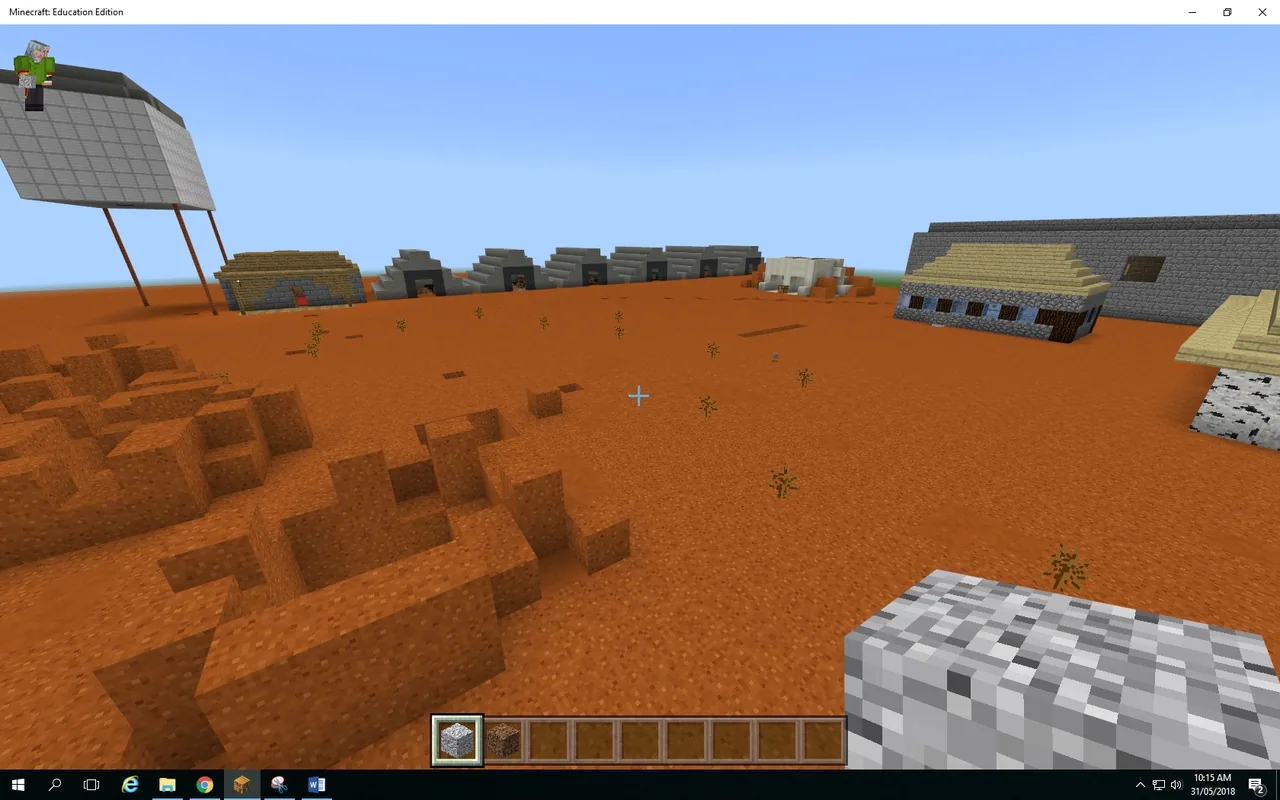
- Construct a detailed three-dimensional representation of Camp Green Lake.
- Collaborate within a team by assigning specific roles, planning layouts, and monitoring build progress.
- Expand the virtual setting to include narrative landmarks and interactive scavenger hunt elements.
Blocks and items used in this lesson


Key vocabulary
- Setting
- The specific time, place, and environment where the events of a story happen.
- Implementation Plan
- A structured step-by-step strategy created by a team to carry out a project.
- Constructive Feedback
- Helpful and specific suggestions offered to peers to help improve their work.
Before class
Lesson sequence
- Planning the Camp Layout
Organize students into groups of three or four. Each group reviews chapters 4 and 5 to compile a list of all required camp buildings and facilities.
Teams sketch a shared layout plan on paper and agree on the design before delegating specific construction assignments to each group member.
- World Creation and Construction
One student creates a new world using the Block of Grass template, configuring the game settings to Creative and Peaceful.
Remaining teammates join the world using the host device IP address and begin building Camp Green Lake according to their architectural plan and text evidence.
- Camp Showcase and Task 1 Assessment
Groups guide their classmates through their completed camp, explaining architectural choices and highlighting specific textual details they included.
Teachers evaluate builds against the learning objectives while students complete individual and group self-reflections using the Task 1 Assessment worksheet.
- Beyond Camp Green Lake Extension
Teams expand their world to incorporate later novel elements, including Sam's boat (Mary Lou), God's Thumb, surrounding mountains, white cliffs, dug holes, weeds and water, and the water truck.
Students incorporate interactive gameplay by concealing the objects Stanley lost en route to God's Thumb: the shovel, the glass jars, and the burlap sack.
- Peer Review and Final Reflection
Teams tour each other's extended worlds, test the hidden item challenges, and offer constructive, critical feedback.
Students finalize the project by completing the Task 2 Assessment worksheet, reflecting on their group cohesion, technical growth, and understanding of the novel.
Assessment: success criteria
- World accurately incorporates specific structures and landscape details cited directly from the novel.
- Group members complete their assigned roles according to their initial sketch and implementation plan.
- Students interact cooperatively and respectfully within the shared multiplayer environment.
- Completed assessment worksheets demonstrate thoughtful reflection on personal and group performance.
Differentiation
Provide a focused checklist of core Camp Green Lake structures alongside specific chapter page references to guide planning.
Challenge students to integrate the interactive scavenger hunt by hiding Stanley's dropped gear along the route toward God's Thumb.
Knowledge check
5 questions to check understanding after the lesson. Tap an answer to see if it is right; the score appears at the end.
1What planning step must groups complete before placing any blocks in Minecraft?
Answer: A. Teams must first make a list of structures, agree on a sketched layout, and allocate building jobs before constructing.
2Which game mode settings should the host student choose when setting up the initial world?
Answer: B. The source specifies that worlds are created using the Block of Grass template set to Creative and Peaceful.
3Which chapters from the novel are specifically used to establish the initial Camp Green Lake build?
Answer: D. Task 1 focuses on recreating Camp Green Lake as described in chapters 4 and 5 and developed across the text.
4In the continuation task, which items dropped by Stanley are students challenged to hide?
Answer: B. Task 2 challenges students to hide the items Stanley dropped on the way to God's Thumb: the shovel, glass jars, and burlap sack.
5Which of the following is a landmark introduced in the Task 2 continuation activity?
Answer: C. Sam's boat named Mary Lou is one of the specific continuation elements introduced in Task 2.
Resources
- Lesson package (.zip)Everything the author attached to this lesson in one download.
- Task 1 AssessmentSelf Assessment
- Task 2 AssessmentPeer Assessment
Frequently Asked Questions
What base template should students use when creating their world?
The host student should select the Block of Grass template, ensuring the game mode is set to Creative and the difficulty is on Peaceful.
How do team members enter the same Minecraft world?
One team member generates and hosts the world, and the other group members connect to it using the host's IP address.
How is student progress assessed across the two tasks?
Assessment combines teacher evaluation against core learning objectives, student-led showcase tours, and written self-reflections using the Task 1 and Task 2 assessment worksheets.
Adapted from Holes Novel Study by Robert LeBreton on Minecraft Education, last updated Dec 17, 2018. This classroom version, the timings and the quiz were written by 9Minecraft Education.