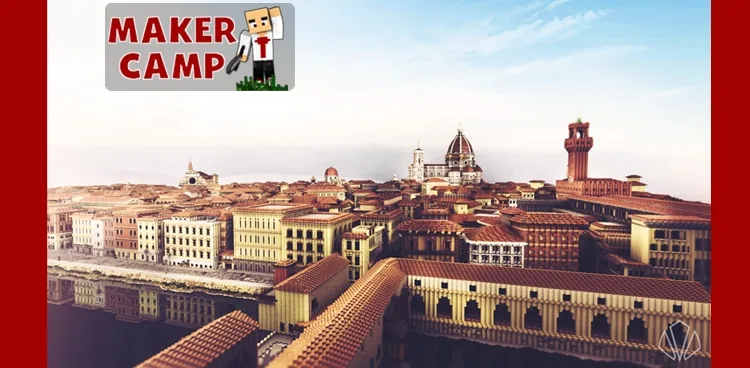
How do the monuments, bridges, and public squares of Florence reflect its historical evolution from Roman times through the Renaissance and beyond?
Overview
Florence is a cornerstone of European history and Renaissance art, characterized by renowned public spaces, religious basilicas, and civic palaces. This lesson invites students to explore the city's urban landscape, examining how its monuments reflect its progression from an ancient Roman forum to a flourishing medieval and Renaissance hub.
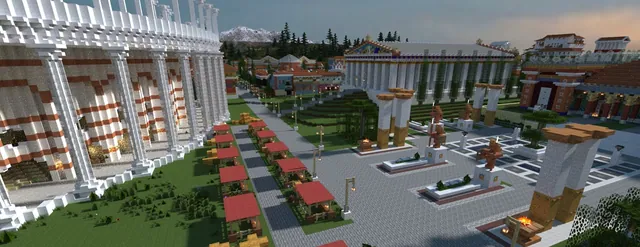
Students navigate an extensive digital recreation of Florence, utilizing coordinates to travel between sites such as the Piazza del Duomo, Piazza della Signoria, Ponte Vecchio, and Santa Maria Novella. As they investigate landmarks and interact with non-player characters, learners carry out research queries and reconstruct missing historical features like statues and connected palaces.
Learning objectives
By the end of this lesson students will be able to:
- Identify and locate principal Florentine landmarks, including the Piazza del Duomo, Palazzo Vecchio, and Ponte Vecchio.
- Explain the historical purpose of specialized architectural works, such as the Vasari Corridor above the Ponte Vecchio.
- Reconstruct missing artistic and architectural elements in Minecraft, such as classical statues or the Palazzo Pitti.
- Describe the historical significance of the Roman forum layout and 20th-century artistic developments preserved in Florence.
Blocks and items used in this lesson


Key vocabulary
- Vasari Corridor
- An elevated enclosed passageway built in 1565 above the Ponte Vecchio to connect Palazzo Vecchio with Palazzo Pitti.
- Loggia dei Lanzi
- A vaulted open-air gallery of statues located beside Palazzo Vecchio on Piazza della Signoria.
- Cardo and Decumanus
- The two primary intersecting north-south and east-west streets of an ancient Roman city grid.
- Segmental Arch Bridge
- A bridge design that uses shallow curved arches, seen in the medieval stone construction of Ponte Vecchio.
Before class
Lesson sequence
- Orientation and Civic Centers
Introduce the geography of Florence. Have students teleport to Piazza del Duomo (
/tp @p 1053 17 3339) and Piazza della Signoria (/tp @p 1156 17 3798) to observe the cathedral, Giotto's Campanile, and Palazzo Vecchio while interacting with in-game non-player characters. - Art and Statue Research
Direct students to Piazzale degli Uffizi and Palazzo Vecchio. Students investigate the 28 statues of notable historical figures outside the Uffizi Gallery and begin rebuilding missing statues in Minecraft, such as the replica of Michelangelo's David or works within the Loggia dei Lanzi.
- Bridges and Palaces
Learners teleport to Ponte Vecchio (
/tp @p 916 17 4014) to study its medieval segmental arch structure. Students research the function of the Vasari Corridor built by Giorgio Vasari in 1565 and work together to plan and build the missing Palazzo Pitti across the river. - Ancient Forum and Modern Art
Have students travel to Piazza della Repubblica (
/tp @p 993 17 3538) to discover its origins as a Roman forum, then teleport to Piazza di Santa Maria Novella (/tp @p 547 17 3346) to examine Florence's first great basilica and the 20th-century collections in the Museo Novecento. - Review and Discussion
Gather students to present their reconstructions and discuss how different historical periods—from ancient Rome through the Renaissance to the 19th and 20th centuries—shaped the public squares and architecture of Florence.
Assessment: success criteria
- Students can pinpoint and visit major historical landmarks using provided in-game coordinates.
- Students accurately explain the defensive and political roles of the Palazzo Vecchio and the Vasari Corridor.
- Reconstructed in-game structures (such as missing statues or Palazzo Pitti) reflect accurate historical context.
- Students describe the connection between Piazza della Repubblica and the Roman forum.
Differentiation
Supply students with a written coordinate sheet and pair them together to complete landmark visits before starting any building tasks.
Challenge advanced students to construct the full facade of Palazzo Pitti or research and present short biographies on multiple figures commemorated at the Uffizi Gallery.
Knowledge check
5 questions to check understanding after the lesson. Tap an answer to see if it is right; the score appears at the end.
1Why was the Vasari Corridor built above the Ponte Vecchio in 1565?
Answer: B. Cosimo I de' Medici had Giorgio Vasari build the corridor to connect Palazzo Vecchio directly to Palazzo Pitti.
2Which site in Florence originally served as the forum of the ancient Roman city?
Answer: C. Piazza della Repubblica marks the site of the ancient Roman forum, defined by the cardo and decumanus.
3What function does Palazzo Vecchio hold in the city of Florence?
Answer: A. Palazzo Vecchio overlooks Piazza della Signoria and functions as the town hall of Florence.
4What era of artwork is the focus of the collections at the Museo Novecento?
Answer: D. The Museo Novecento is dedicated to Italian art of the 20th century, displaying around 300 works.
5Chronologically, which building is the first great basilica and principal Dominican church in Florence?
Answer: A. The Basilica di Santa Maria Novella is chronologically the first great basilica in Florence and its principal Dominican church.
Resources
Part of the Cities and Civics curriculum
This is lesson 9 of 12 in Cities and Civics.
- Egypt Toybox Lesson 1 of 5
- Black Wall Street
- Egypt
- Jamestown
- Kyiv: Craft a City Guidebook
- Mesopotamia
- Peter Is Here: AI for Cultural Heritage
- Rome
- The City Of Florence (Italy)
- The Round City of Baghdad
- Touring Mini Melbourne
- Washington D.C.
Frequently Asked Questions
How can students quickly move between distant landmarks in this map?
Students can use standard teleport commands in the chat window, such as typing /tp @p 1053 17 3339 for Piazza del Duomo or /tp @p 916 17 4014 for Ponte Vecchio.
What specific building projects are included in the student activities?
Students are encouraged to rebuild missing statues outside Palazzo Vecchio and in the Loggia dei Lanzi, as well as construct the missing Palazzo Pitti across the Arno River.
Adapted from The City Of Florence (Italy) by Marco Vigelini on Minecraft Education, last updated Jun 10, 2025. This classroom version, the timings and the quiz were written by 9Minecraft Education.