- Type
- Lesson plan
- Subject
- History & Social Studies
- Ages
- Ages 11-18
- Duration
- 45 min
- Level
- Beginner
How did religious beliefs, everyday practices, and political leadership define society in ancient Egypt?
Overview
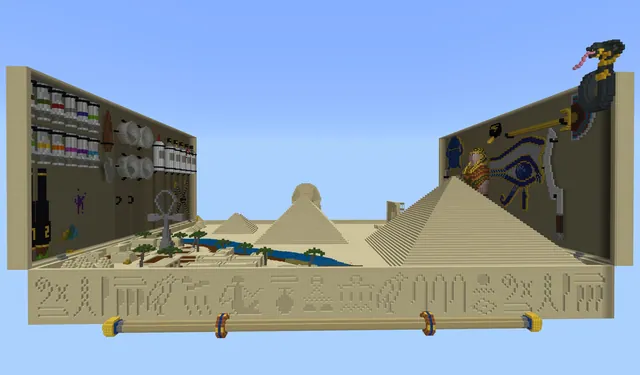
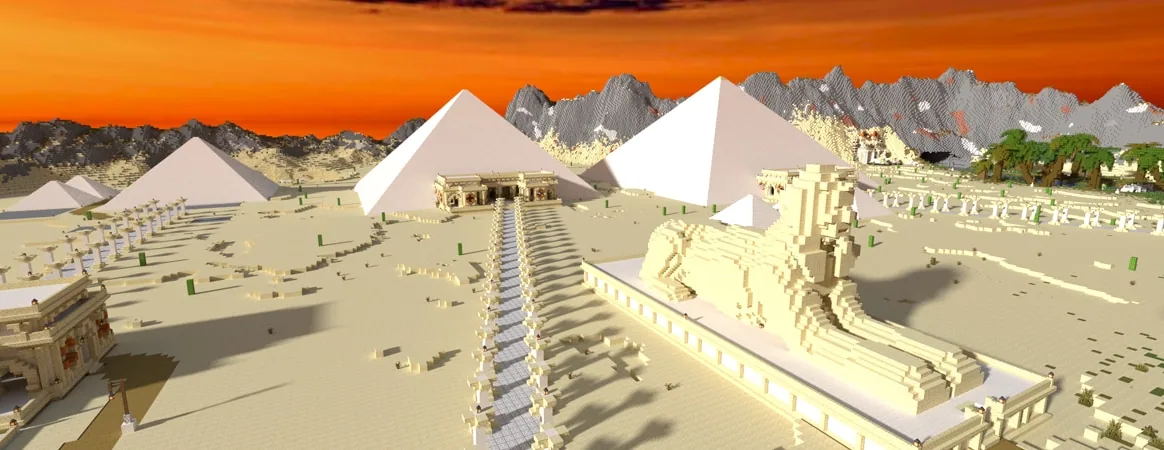
Ancient Egyptian civilization developed complex political structures, distinctive religious practices, and notable architectural achievements. In this lesson, students investigate how geography and spiritual beliefs shaped society, from the role of the pharaoh and major deities connected to nature to the cultural focus on the afterlife and monumental construction projects.
Using the provided Minecraft Education world, learners travel through historical environments and interact directly with non-player characters. Through these character interactions, students gather primary historical insights about ordinary citizen routines, archaeological evidence, the reign and territorial expansion of Ramses II, and the eventual decline of the New Kingdom.
Learning objectives
By the end of this lesson students will be able to:
- Identify key Egyptian deities and explain their connection to natural forces.
- Explain the religious and political significance of the pharaoh, pyramids, the Sphinx, and mummification.
- Describe aspects of everyday Egyptian life and how modern archaeologists uncover them.
- Summarize the expansion of Egypt under Ramses II and the later decline of the New Kingdom.
Blocks and items used in this lesson


Key vocabulary
- Pharaoh
- The political and religious leader of ancient Egypt, viewed as both a ruler and an earthly representative of the gods.
- Afterlife
- The existence believed to follow death, central to Egyptian religious customs and tomb preparation.
- Mummification
- The process of preserving a deceased body to prepare it for the afterlife.
- Sphinx
- A monumental limestone statue with the body of a lion and the head of a human, built for protection and symbolic power.
- Ramses II
- A prominent New Kingdom pharaoh known for extensive military campaigns, building projects, and territorial expansion.
Before class
Lesson sequence
Suggested timing: about 45 minutes in total.
- Introduction and Historical Context10 min
Introduce the essential question and review prior knowledge regarding early civilizations. Highlight key themes students will investigate, including Egyptian deities tied to nature, the role of the pharaoh, and the spiritual reasons behind building pyramids and preserving bodies.
- In-World Exploration and Character Interviews25 min
Students log into the Minecraft world and navigate the historical setting. As they explore, they locate and interact with various in-game characters to collect facts about daily routines, archaeological discovery methods, Ramses II's empire boundaries, and New Kingdom cultural shifts.
- Synthesis and Group Reflection10 min
Bring the class together to compare notes. Have students discuss how archaeological evidence informs our understanding of ordinary citizens versus rulers, and summarize how foreign conquerors later adopted Egyptian traditions during the decline of the New Kingdom.
Assessment: success criteria
- Student accurately identifies at least one major deity and describes its link to the natural environment.
- Student explains why pyramids and the Sphinx were built and why mummification was practiced.
- Student provides examples of everyday Egyptian life and explains how archaeologists study ancient daily habits.
- Student outlines the territorial extent under Ramses II and describes the decline of the New Kingdom.
Differentiation
Provide a guided questionnaire with specific character names and targeted questions to help students focus their in-world investigation.
Ask advanced learners to compare the lifestyle and environmental adaptations of ancient Egyptians with those of nomadic hunter-gatherer societies.
Knowledge check
5 questions to check understanding after the lesson. Tap an answer to see if it is right; the score appears at the end.
1Why did ancient Egyptians practice mummification and construct massive pyramids?
Answer: B. Ancient Egyptians mummified bodies and built tombs like pyramids due to their deep religious focus on the afterlife.
2How did ancient Egyptians view their major gods in relation to the world around them?
Answer: A. Egyptian religious belief connected major deities directly to natural forces and the physical environment.
3Which ruler is known for significantly expanding the geographic extent of the Egyptian empire during the New Kingdom?
Answer: C. Ramses II is identified in the curriculum for the notable geographic expansion of the Egyptian empire.
4How do modern historians and archaeologists discover what everyday life was like in ancient Egypt?
Answer: B. Archaeologists and historians learn about daily life through the examination of material culture, excavations, and preserved art.
5What commonly occurred when foreign conquerors took control during the decline of the New Kingdom?
Answer: C. A key learning objective addresses the ways foreign conquerors adopted Egyptian culture during the New Kingdom's decline.
Resources
- Lesson package (.zip)Everything the author attached to this lesson in one download.
- Egypt Teaching GuideUse this guide in conjunction with the Egypt world in Minecraft.
- Hunter-Gatherer Teaching GuideUse this guide in conjunction with the Egypt world in Minecraft.
- Lesson worldOpens the world page in Minecraft Education (sign-in with a school account may be needed).
Part of the Cities and Civics curriculum
This is lesson 3 of 12 in Cities and Civics.
- Egypt Toybox Lesson 1 of 5
- Black Wall Street
- Egypt
- Jamestown
- Kyiv: Craft a City Guidebook
- Mesopotamia
- Peter Is Here: AI for Cultural Heritage
- Rome
- The City Of Florence (Italy)
- The Round City of Baghdad
- Touring Mini Melbourne
- Washington D.C.
Frequently Asked Questions
What prior knowledge do students need before entering the world?
Students only need basic Minecraft movement controls. Introductory concepts about early societies or hunter-gatherers can be helpful context, but all required historical facts are found by interacting with characters in the world.
Can this lesson be split across multiple class periods?
Yes. While structured for a 45-minute overview, teachers can divide the lesson into two sessions: one covering religion, daily life, and monuments, and a second focusing on Ramses II, empire expansion, and historical decline.
Adapted from Egypt by K12 Inc. on Minecraft Education, last updated Jul 14, 2025. This classroom version, the timings and the quiz were written by 9Minecraft Education.