- Type
- Lesson plan
- Ages
- Ages 11-13
- Includes
- Quiz: 5 questions
How can humans design a sustainable, self-sufficient colony to survive the extreme environment of Mars?
Overview
Establishing a human presence on Mars requires solving complex challenges related to life support, climate resilience, and resource management. In this lesson, students investigate the harsh conditions of the red planet and determine the critical survival needs humans must satisfy when inhabiting an extreme outer planet.
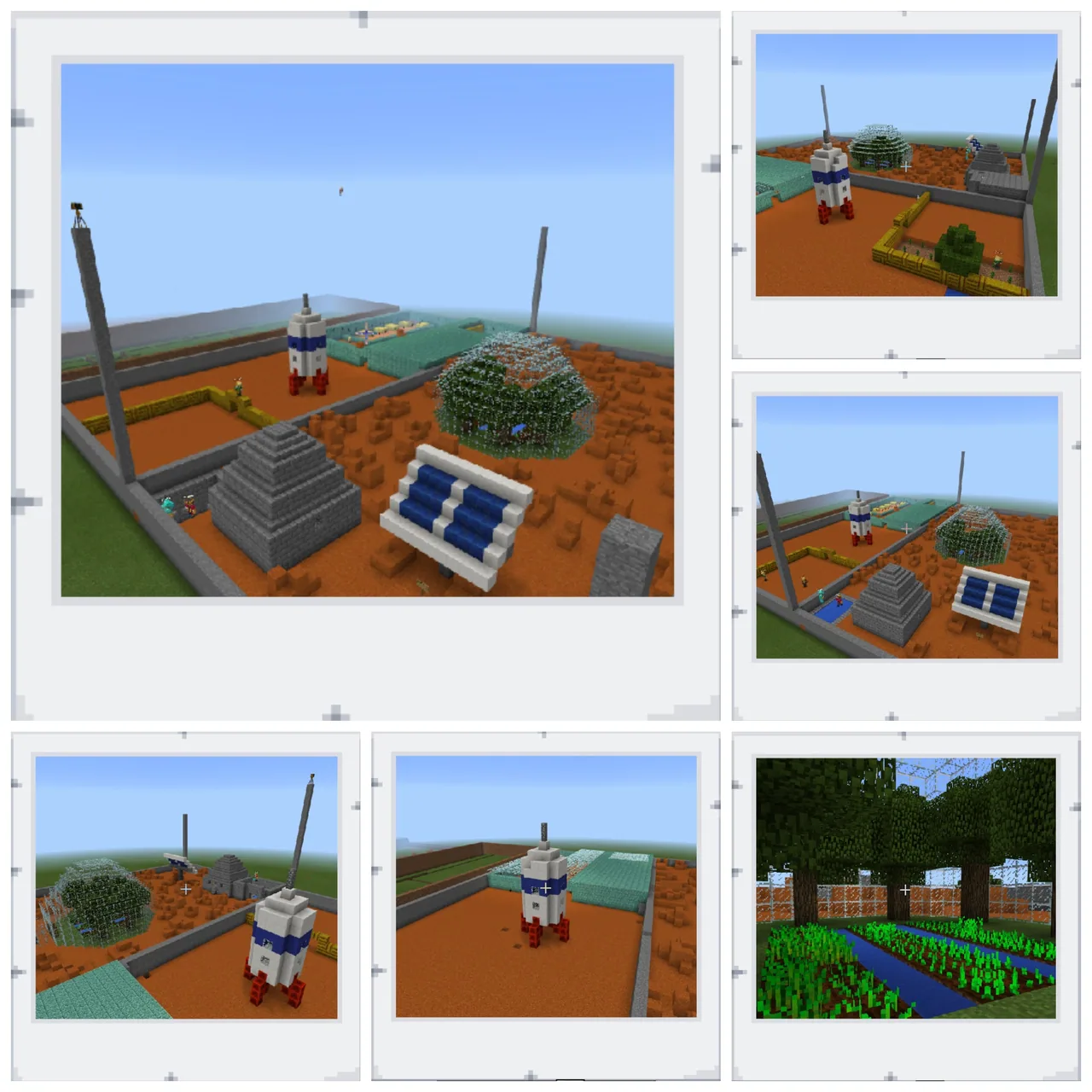
Stepping into the role of astronauts in a space colonization program, students collaborate inside Minecraft to design and construct a viable Martian settlement. They research existing aerospace efforts, select suitable building materials for the Martian climate, integrate renewable energy systems, and document their completed habitats using in-game photography tools.
Learning objectives
By the end of this lesson students will be able to:
- Identify the essential physical and environmental requirements for human survival on Mars.
- Research previous and ongoing Mars space exploration missions.
- Collaborate in teams to construct a Martian habitat featuring sustainable resources and renewable energy.
- Document colony designs and explain functional choices using the in-game camera tool.
Blocks and items used in this lesson


Key vocabulary
- Colonization
- Establishing a permanent, functioning human community in a new and uninhabited location.
- Sustainable Environment
- An ecosystem or living space capable of supporting life without exhausting its resources.
- Renewable Energy
- Power collected from ongoing natural sources that replenish themselves continuously.
Before class
Lesson sequence
- Mission Introduction
Introduce the challenge by framing students as astronauts assigned to a Mars colonization program. Share background information regarding the Martian climate, temperature, and atmospheric conditions to establish the real-world constraints of their assignment.
- Research and Planning
Direct student teams to explore information about past Mars missions and space survival strategies. Groups divide tasks, analyze why sustainable environments are necessary on other planets, and plan their colony layout based on core survival needs.
- Colony Construction
Students join a shared Minecraft world and build their planned Martian settlement simultaneously. Guide learners to select appropriate building blocks that could withstand the Martian climate and to incorporate renewable energy generation into their design.
- Documentation and Reflection
Learners use the in-game camera tool to photograph key features of their colony. Teams assemble their images into a digital portfolio explaining how their settlement maintains life support and generates sustainable power.
Assessment: success criteria
- Colony design addresses essential human needs such as shelter, air, water, and food.
- Settlement includes functional representations of renewable energy sources.
- Students select logical construction blocks appropriate for the environmental hazards of Mars.
- Digital portfolio includes in-game photographs with explanations of the colony systems.
Differentiation
Provide a basic checklist of necessary survival structures and recommend specific in-game blocks before students begin building.
Ask advanced learners to design backup systems and contingency plans for unexpected power or resource failures in their colony.
Knowledge check
5 questions to check understanding after the lesson. Tap an answer to see if it is right; the score appears at the end.
1What is the primary reason for creating a sustainable environment on Mars?
Answer: A. A sustainable habitat must support human life on an ongoing basis without running out of critical resources.
2Why is block selection important when building a Martian base in Minecraft?
Answer: B. The extreme Martian climate requires structures built from durable materials capable of sheltering inhabitants.
3Which type of power generation should students integrate into their Martian colony?
Answer: C. The lesson specifically focuses on incorporating renewable energy sources to maintain self-sufficiency.
4How do students document and explain their finished structures?
Answer: D. The source specifies using the in-game camera tool to build a digital portfolio explaining the colony details.
5What should student groups do prior to placing blocks in their Minecraft world?
Answer: B. The lesson structure requires students to conduct background research and outline essential needs before building.
Frequently Asked Questions
Does this lesson require a custom downloadable Minecraft world?
No custom world download is needed. Teachers can generate a standard flat world or a biome with minimal vegetation, such as a desert or badlands, to represent Mars.
How can teams organize their building responsibilities effectively?
Students should divide assignments before entering the world, designating specific roles for power systems, life-support facilities, habitat structures, and portfolio documentation.
Adapted from Living on the Mars! by Yunus Emre Calik on Minecraft Education, last updated Dec 21, 2016. This classroom version, the timings and the quiz were written by 9Minecraft Education.