- Type
- Lesson plan
- Ages
- Ages 11-13
- Duration
- 45 min
- Level
- Beginner
How do architectural remains and historical evidence reveal the daily life, culture, and governance of ancient Rome?
Overview
This history lesson guides middle school students through the cultural and political systems of ancient Rome. Learners investigate how emperors unified the empire, explore the commercial importance of the Silk Road, and discover how public structures shaped civic life.
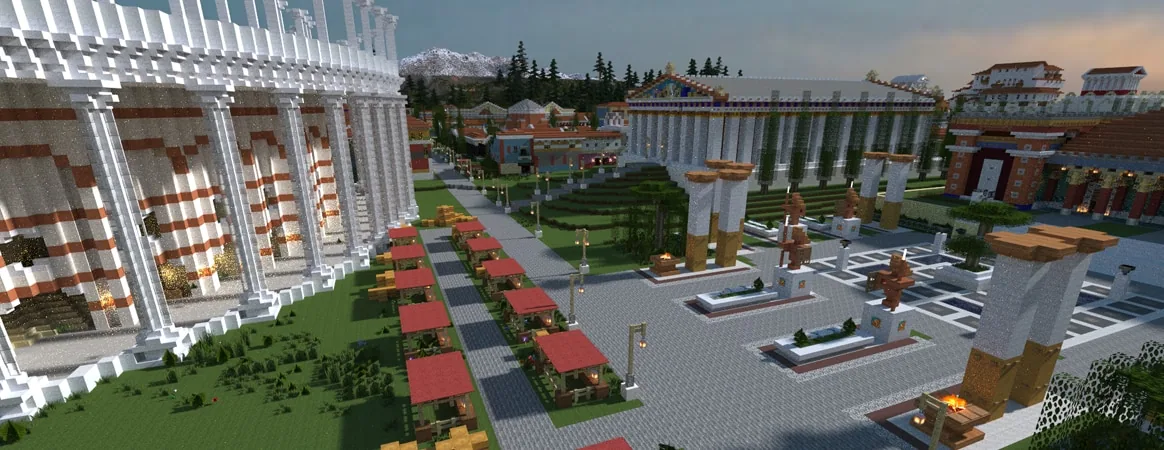
Using a large custom Minecraft world, students teleport between Rome, an imperial battlefield, and Pompeii. This virtual environment lets learners analyze architectural features such as aqueducts, forums, and amphitheaters alongside archaeological and written records.
Learning objectives
By the end of this lesson students will be able to:
- Define essential Roman concepts including the Pax Romana, Forum, aqueduct, Colosseum, and Circus Maximus.
- Explain how imperial initiatives and Silk Road trade routes connected and sustained the Roman Empire.
- Identify Virgil as the creator of the Aeneid and evaluate how modern archaeology expands upon written records like Pliny's accounts.
- Analyze physical structures in Rome and Pompeii to draw conclusions about daily life across social classes.
Blocks and items used in this lesson


Key vocabulary
- Pax Romana
- A prolonged era of peace and stability across the Roman Empire.
- Forum
- A central public square used for government business, markets, and assemblies.
- Aqueduct
- An engineered bridge or channel built to convey water into cities.
- Atrium
- An open central courtyard or hall within a traditional Roman house.
- Colosseum
- A massive amphitheater in Rome utilized for public contests and spectacles.
- Circus Maximus
- An enormous ancient Roman stadium primarily used for chariot races.
Before class
Lesson sequence
Suggested timing: about 45 minutes in total.
- Introduction and Context10 min
Introduce the geographical scope of the Roman Empire at its peak. Review core concepts such as the Pax Romana, trade with the East via the Silk Road, and the political purpose behind bread and circuses.
- Exploring Rome and the Battlefield15 min
Direct students to teleport to the city of Rome using /tp @s 445 65 573 and the Battlefield at /tp @s -85 65 -943. Have students observe monumental structures like the Colosseum, Circus Maximus, and aqueducts, noting how these builds supported civic needs.
- Investigating Pompeii15 min
Have students teleport to Pompeii using /tp @s -598 64 949. Students explore residential features like the atrium and examine archaeological evidence to compare with historical writings by Pliny.
- Synthesis and Reflection5 min
Conclude with a class discussion on how archaeological discoveries reshape modern historical understanding. Remind students of literary contributions from the era, notably Virgil's Aeneid.
Assessment: success criteria
- Student accurately defines at least three key vocabulary terms, such as Pax Romana, aqueduct, or Colosseum.
- Student identifies Virgil as the author of the Aeneid.
- Student explains how archaeological ruins in Pompeii provide insights into daily Roman life.
- Student describes at least one method Roman emperors used to unify the empire.
Differentiation
Provide a printed coordinate sheet and assign learners to focus on inspecting a single major landmark, such as an aqueduct or the Forum.
Ask learners to write a short comparison between Pliny's historical writings and the preserved physical evidence found in Pompeii.
Knowledge check
5 questions to check understanding after the lesson. Tap an answer to see if it is right; the score appears at the end.
1Which Roman poet wrote the epic poem known as the Aeneid?
Answer: B. The unit objectives identify Virgil as the author of the Aeneid.
2Which in-game destination is located at the coordinates -598, 64, 949?
Answer: C. The source specifies that typing /tp @s -598 64 949 teleports the player to Pompeii.
3What trade network connected ancient Rome with goods and markets in the East?
Answer: A. The lesson objectives highlight trade between Rome and the East via the Silk Road.
4Whose historical writings are analyzed alongside archaeological evidence to study life in Pompeii?
Answer: D. The lesson objectives direct students to analyze Pliny's writings to understand daily life in Pompeii.
5Which structure was engineered by the Romans to transport fresh water into urban centers?
Answer: B. An aqueduct is the Roman engineering structure built specifically to carry water.
Resources
- Rome Teaching GuideUse this guide in conjunction with the Rome world in Minecraft.
- Lesson worldOpens the world page in Minecraft Education (sign-in with a school account may be needed).
Part of the Cities and Civics curriculum
This is lesson 8 of 12 in Cities and Civics.
- Egypt Toybox Lesson 1 of 5
- Black Wall Street
- Egypt
- Jamestown
- Kyiv: Craft a City Guidebook
- Mesopotamia
- Peter Is Here: AI for Cultural Heritage
- Rome
- The City Of Florence (Italy)
- The Round City of Baghdad
- Touring Mini Melbourne
- Washington D.C.
Frequently Asked Questions
How do students travel between the different lesson locations?
Because the world is large, students should open the chat bar and use the /tp @s command with the coordinate sets provided for Pompeii, the Battlefield, and Rome.
What additional materials accompany this lesson?
The lesson includes a dedicated Rome Teaching Guide document to help instructors lead the unit.
Adapted from Rome by K12 Inc. on Minecraft Education, last updated Sep 15, 2026. This classroom version, the timings and the quiz were written by 9Minecraft Education.