- Type
- Lesson plan
- Ages
- Ages 8-18
How did the geography, design, and institutions of 8th-century Baghdad establish it as a vibrant global site of encounter and learning?
Overview
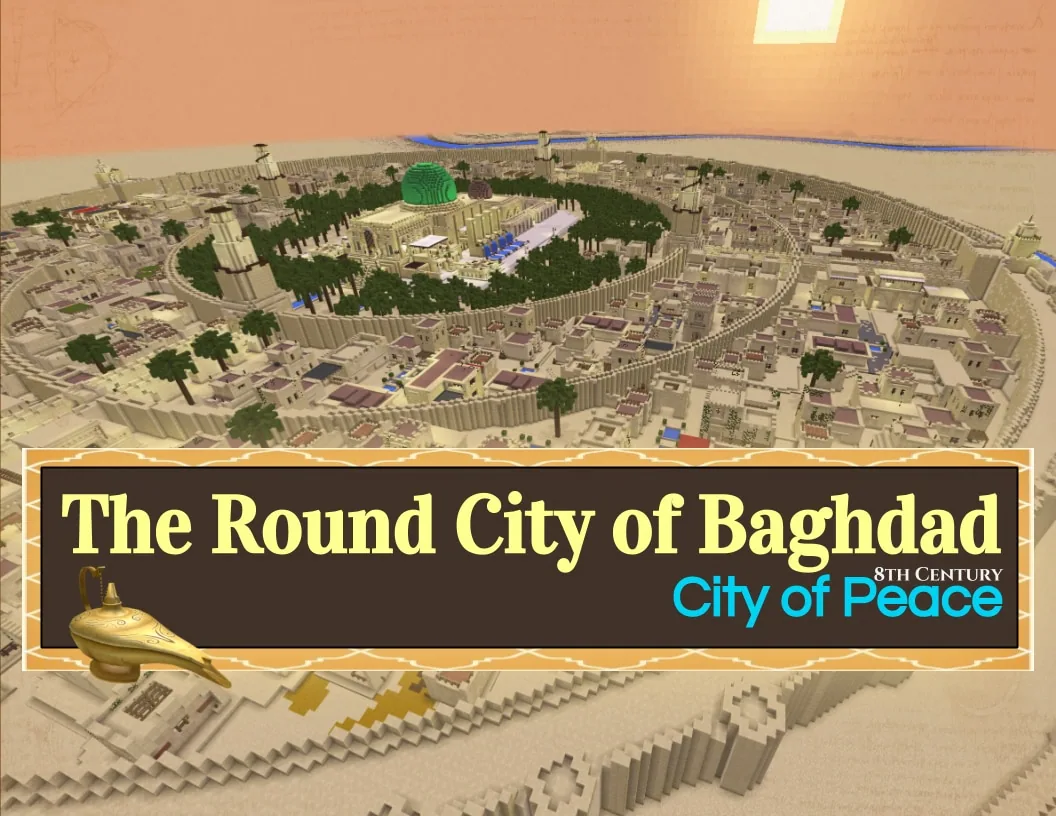
During the Islamic Golden Age, Caliph al-Mansur founded the Round City of Baghdad in 763 beside the Tigris River. Planned as an administrative hub, the circular settlement quickly evolved into a bustling cultural, academic, and economic capital known as the City of Peace. Baghdad served as a critical Silk Road stop where scholars, merchants, astronomers, and philosophers gathered in an atmosphere of broad religious and intellectual tolerance.
Students step inside a student-built 1:2 scale recreation of historic Baghdad to explore its circular layout, market networks, and three houses of wisdom. Through historical role-play, NPC quests, creative writing, and architectural construction, learners investigate how geography and trade shaped this historic site of encounter and contribute their own structures to the surrounding landscape.
Learning objectives
By the end of this lesson students will be able to:
- Analyze primary and secondary sources to build background knowledge on Abbasid Baghdad.
- Role-play a historical resident of Baghdad by developing a biographical sketch and participating in a marketplace exchange.
- Investigate the three houses of wisdom to formulate historical research questions.
- Construct historically grounded expansions such as farmland communities, bridges, or the al-Khuld Palace.
Blocks and items used in this lesson


Key vocabulary
- Caliph
- A political and religious leader in the Islamic Empire.
- Round City
- The original circular, walled city of Baghdad founded by Caliph al-Mansur in 763.
- House of Wisdom
- An academic institution dedicated to study, research, translation, and preserving knowledge.
- Site of Encounter
- A location where people from diverse cultures meet to exchange goods, technologies, and ideas.
- Silk Road
- A historic network of trade routes connecting East Asia, the Middle East, and Europe.
Before class
Lesson sequence
- Foundational Reading and Source Analysis
Students examine primary and secondary sources alongside a brief historical fiction backstory. Working collaboratively, they annotate documents and complete graphic organizers to establish content knowledge about 8th-century Baghdad, the Abbasid Caliphate, and Silk Road trade routes.
- Character Development and World Orientation
Learners choose a historical occupation, such as an astronomer, merchant, scholar, poet, or architect, and draft a biographical sketch. Students then log into the 1:2 scale Round City map to orient themselves along the circular walls and primary thoroughfares.
- Market Exchange and Houses of Wisdom Investigation
Students enact a market day exchange to trade Silk Road goods, role-playing their assigned citizens. Next, they visit the map's three houses of wisdom to review texts, interact with non-player characters, complete quests, and record research questions.
- Architectural Expansion and Creative Writing
Students extend the virtual world by constructing relevant features outside the walls, such as surrounding farmland, bridges spanning the Tigris River, or the al-Khuld Palace. In addition, students compose written work such as an original tale for 1001 Nights or expository books placed inside the libraries.
- Presentation and Synthesis
Learners share their work by creating portfolios of architectural additions, recording video tours of their narrative stories, or mapping trade stops along the Silk Road.
Assessment: success criteria
- A completed biographical sketch demonstrating historically plausible details about an 8th-century resident.
- Accurate participation in the market day simulation reflecting Silk Road trade dynamics.
- Research questions and written expository texts or narrative stories demonstrating clear historical understanding.
- Architectural additions outside the city walls that match the historical setting, such as bridges across the Tigris or agricultural fields.
Differentiation
Provide structured character templates with preselected occupations and guided graphic organizers for document annotations.
Have students write custom dialogue for new NPCs, build out waypoints along outer roads, or code the expansion of surrounding terrain using Code Builder.
Knowledge check
5 questions to check understanding after the lesson. Tap an answer to see if it is right; the score appears at the end.
1Which leader founded the Round City of Baghdad in 763?
Answer: A. The source states that the circular city was designed for and founded by Caliph al-Mansur in the year 763.
2Along which river was historic Baghdad established?
Answer: C. The text notes that the city was situated next to the Tigris River, providing an abundant water supply.
3What scale did the student builders use to reconstruct the Round City of Baghdad in Minecraft?
Answer: D. The source identifies the recreation as a massive build created on a 1:2 scale.
4Approximately how long did the historic Round City stand?
Answer: A. According to the guiding ideas in the source, the city stood for approximately two centuries.
5Which major trade network was Baghdad an important stop along during this era?
Answer: B. The source highlights that Baghdad served as a stop on the Silk Road during the Golden Age of Islam.
Resources
Part of the Cities and Civics curriculum
This is lesson 10 of 12 in Cities and Civics.
- Egypt Toybox Lesson 1 of 5
- Black Wall Street
- Egypt
- Jamestown
- Kyiv: Craft a City Guidebook
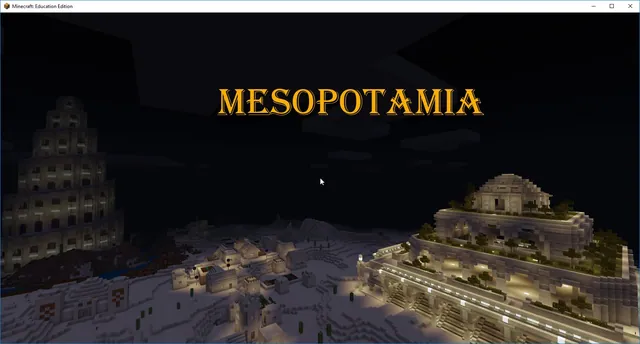
- Mesopotamia
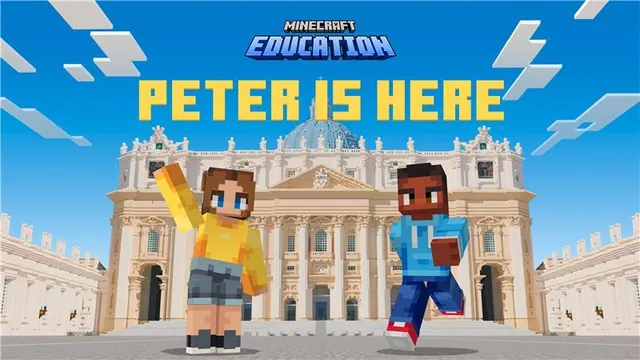
- Peter Is Here: AI for Cultural Heritage
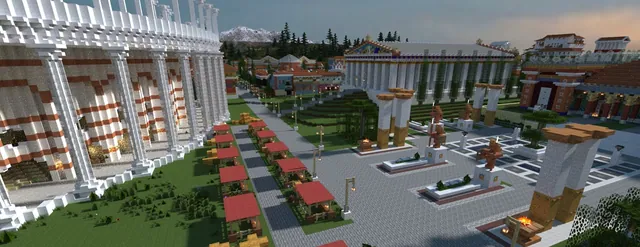
- Rome
- The City Of Florence (Italy)
- The Round City of Baghdad
- Touring Mini Melbourne
- Washington D.C.
Frequently Asked Questions
What subject areas can this lesson support?
The lesson supports cross-curricular connections in history, social studies, reading and writing, religion and philosophy, economics, and mathematics.
Do students need to read primary and secondary texts before joining the Minecraft world?
Yes. The teacher sequence requires students to complete close readings, annotations, and graphic organizers using provided sources before entering the map.
What types of writing can students complete during this unit?
Students can write character biographical sketches, first-person diary entries, original stories styled after 1001 Nights, NPC dialogue, or expository books to place in the houses of wisdom.
Adapted from The Round City of Baghdad by John Miller on Minecraft Education, last updated Jul 16, 2025. This classroom version, the timings and the quiz were written by 9Minecraft Education.