- Type
- Lesson plan
- Subject
- Science
- Topics
- Science
- Ages
- Ages 11-13
- Duration
- about 50 min (suggested)
How do different combinations of atoms form the diverse materials found in our world?
Overview
Matter is constructed from tiny building blocks known as atoms. Elements combine in various ways to form molecules and compounds, creating materials with distinct properties. While living organisms are largely composed of carbon, hydrogen, nitrogen, and oxygen, mineral structures such as stone are primarily made of silicon and oxygen.
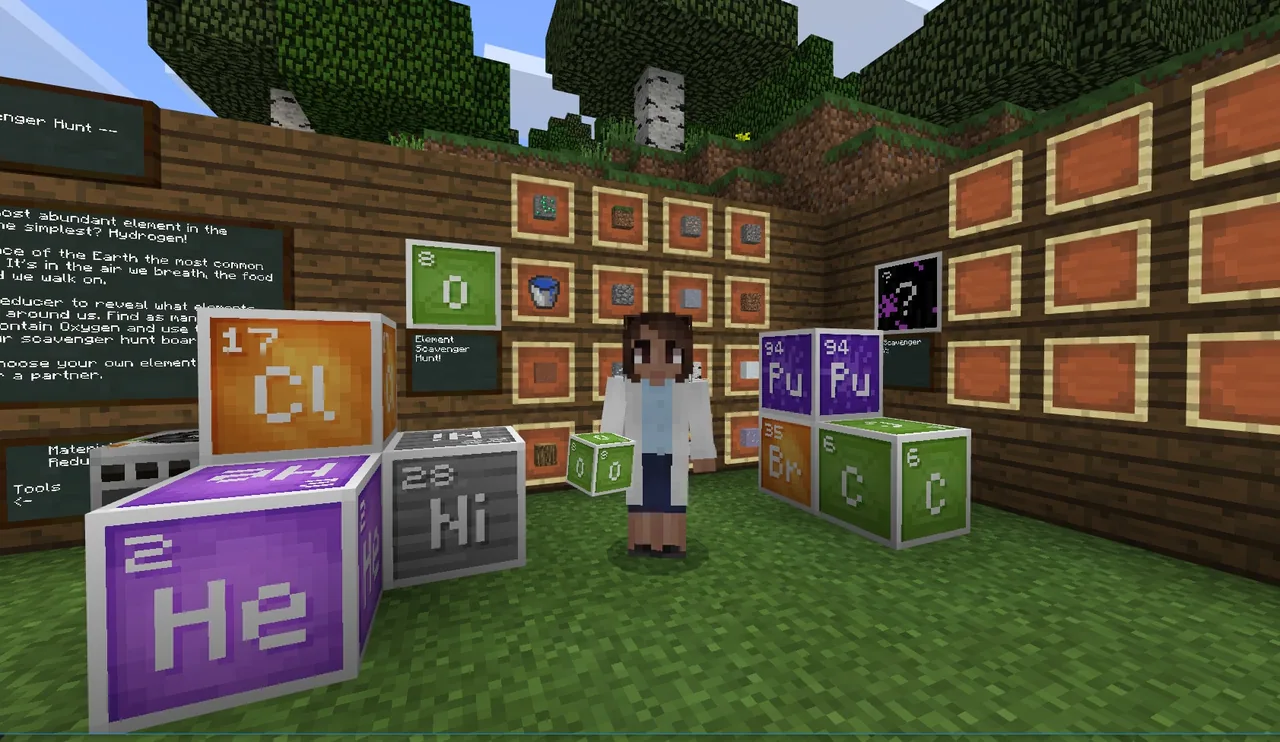
In this lesson, students explore the elemental makeup of matter within a dedicated Minecraft scavenger hunt world. Using the Material Reducer, learners break down environmental blocks to identify which ones contain oxygen, placing verified items into picture frames to visualize how real-world instruments like mass spectrometers function.
Learning objectives
By the end of this lesson students will be able to:
- Analyze Minecraft blocks using the Material Reducer to determine their elemental components.
- Identify materials and substances that contain the element oxygen.
- Relate in-game decomposition tools to real-world analytical chemistry techniques.
Blocks and items used in this lesson


Key vocabulary
- Atom
- The fundamental unit of matter made of smaller subatomic parts.
- Element
- A pure substance made of only one type of atom.
- Compound
- A material formed when two or more chemical elements are chemically bonded together.
- Material Reducer
- A Minecraft Chemistry tool that reduces blocks into their constituent elements.
- Mass Spectrometry
- A laboratory technique used by scientists to measure the elemental composition of matter.
Before class
Lesson sequence
Suggested timing: about 50 minutes in total.
- Introduction to Matter and Oxygen10 min
Introduce the concept that all matter is composed of atoms and elements. Explain that oxygen is the most abundant element on Earth's surface and discuss how different elements combine to form common living and non-living materials.
- Material Reducer Scavenger Hunt25 min
Have students open the scavenger hunt world and access the Material Reducer. Challenge students to gather various blocks, reduce them to see their atomic makeup, and verify which materials contain oxygen.
As students confirm that a block contains oxygen, they place that block inside an assigned picture frame, racing to fill all frames.
- Extension and Scientific Comparison15 min
Discuss real-world techniques used to detect elemental composition, such as CHNS Analysis and Mass Spectrometry. For students who finish early, assign a new element to search for and reduce in the game.
Optionally, conduct a physical classroom demonstration such as Elephant Toothpaste or mixing vinegar and baking soda to show the presence and release of oxygen.
Assessment: success criteria
- Student accurately identifies blocks containing oxygen using the Material Reducer.
- Student mounts verified oxygen-bearing blocks into the designated picture frames.
- Student demonstrates understanding that materials are made from combinations of different atoms.
Differentiation
Allow students to work in pairs and offer a short list of suggested blocks to test in the Material Reducer.
Assign advanced students a different target element, such as silicon or carbon, to locate and catalog in new frames.
Knowledge check
5 questions to check understanding after the lesson. Tap an answer to see if it is right; the score appears at the end.
1What is the most common element found on Earth's surface?
Answer: C. The lesson specifically highlights that oxygen is the most common element on Earth's surface.
2Which tool in Minecraft Education reduces blocks into their elemental parts?
Answer: A. The Material Reducer is the specific station used to break materials down into individual elements.
3According to the lesson, most stone-like materials are primarily made of which elements?
Answer: B. The guiding ideas explain that most stone-like materials are composed of silicon and oxygen.
4How do students display their confirmed oxygen-bearing materials in the lesson?
Answer: C. Students verify oxygen content and then place the confirmed blocks inside picture frames.
5Which real-world analytical method is mentioned as comparable to the Material Reducer?
Answer: A. Mass Spectrometry is presented alongside CHNS Analysis as a real-world method for measuring elemental composition.
Resources
- Lesson Handout
- Lesson worldOpens the world page in Minecraft Education (sign-in with a school account may be needed).
Frequently Asked Questions
How can I assess student progress during the in-game hunt?
You can monitor students as they fill their picture frames with confirmed oxygen-containing blocks and verify their understanding through the accompanying lesson handout.
What hands-on experiments can I pair with this lesson?
You can demonstrate oxygen's presence in matter through simple physical chemistry demonstrations such as making Elephant Toothpaste or combining vinegar and baking soda.
Adapted from Element Scavenger Hunt by Minecraft Education on Minecraft Education, last updated May 22, 2025. This classroom version, the timings and the quiz were written by 9Minecraft Education.