- Type
- Lesson plan
- Grade
- Primary (Grades 3-5)
- Ages
- Ages 8-10
- Duration
- 45 min
- Level
- Beginner
How can we use algorithms and loops to automate environmental cleanup and protect endangered sea turtles?
Overview
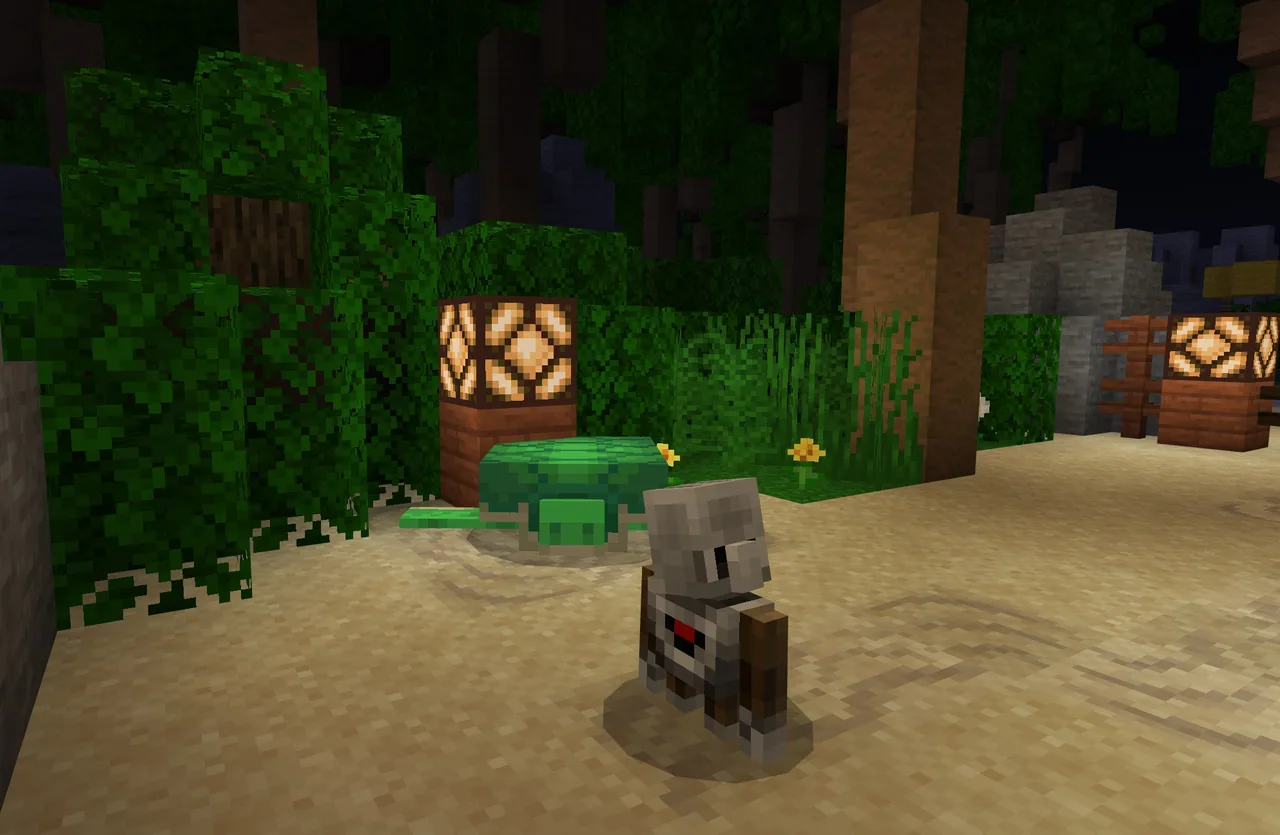
In this lesson from the Animal Research Center (ARC) series, students travel to the Galapagos Islands to investigate reports of tourists disturbing fragile sea turtle nesting sites. Because fewer than one percent of sea turtle hatchlings survive to maturity, even minor habitat disruptions can threaten local populations. Students learn how conservationists use technology to assess habitat damage and assist wildlife.
Using Minecraft Education, learners write algorithms to navigate the Agent through coastal environments. Through guided tasks, students practice writing pseudocode, recognizing patterns, commanding the Agent to turn and clear blocked paths, and applying loops to automate beach clean-up routines.
Learning objectives
By the end of this lesson students will be able to:
- Write algorithms using pseudocode to plan the Agent's movements
- Use repeat loops to automate recurring actions and clean up debris
- Apply sequencing and Agent commands to turn and destroy obstacles
- Test and debug code when the Agent encounters unexpected path blocks
Blocks and items used in this lesson


Key vocabulary
- Algorithm
- A detailed set of step-by-step instructions for solving a problem or finishing a task.
- Loop
- A coding structure that repeats a block of commands multiple times.
- Sequencing
- Arranging coding commands in the exact order they need to run.
- Pseudocode
- A plain-language plan that outlines what code should do before it is programmed.
- Agent
- The robotic assistant in Minecraft that carries out programmed tasks.
Before class
Lesson sequence
Suggested timing: about 45 minutes in total.
- Mission Briefing10 min
Introduce the ARC assignment in the Galapagos Islands. Explain that tourists have disturbed turtle nesting grounds, and discuss why this is critical when less than 1% of hatchlings reach adulthood. Review key concepts including algorithms, pseudocode, and sequencing using the presentation slides.
- Agent Navigation15 min
Students log into the world and begin Activity 1 (Turtle Tracks) and Activity 2 (Agent Turn). Learners write pseudocode to plan their paths, program the Agent to follow turtle trails, and practice commanding the Agent to change directions smoothly.
- Path Clearing & Clean-Up15 min
Direct students to Activity 3 (Blocked Path) and Activity 4 (Garbage Clean-Up). Students code the Agent to destroy obstacles and use repeat loops to automate picking up scattered litter across the nesting area.
- Review & Assessment5 min
Conclude with the formative assessment questions. Ask students to identify which blocks repeat actions, which commands destroy items, and how algorithms guide problem solving. Fast finishers can access the Bonus Activity: Beach Clean-Up.
Assessment: success criteria
- Student accurately defines an algorithm as a set of detailed instructions.
- Student uses a loop block to repeat commands without writing redundant lines of code.
- Student successfully programs the Agent to navigate turns and destroy blocking items.
- Student tests and debugs path errors during turtle track navigation.
Differentiation
Have students write their path steps on paper as pseudocode before dragging blocks into the coding workspace.
Direct students to complete the Bonus Beach Clean-Up activity using minimal blocks by optimizing their loop counts.
Knowledge check
5 questions to check understanding after the lesson. Tap an answer to see if it is right; the score appears at the end.
1According to the lesson briefing, what percentage of baby sea turtles make it to maturity?
Answer: A. The lesson notes that fewer than one percent of baby sea turtles reach maturity in the wild.
2What is an algorithm?
Answer: C. An algorithm is defined as detailed instructions or formulas for solving a problem or finishing a task.
3What coding concept repeats a set of instructions over and over?
Answer: B. A loop repeats a section of code over and over for a set number of times.
4Which helper character do students code to explore and clean the nesting grounds?
Answer: D. Students write programs to command the Agent to navigate, turn, and clear items.
5Which block command tells the Agent to remove an obstacle blocking the path?
Answer: B. The Agent destroy block commands the Agent to break an item or clear a blocked path.
Resources
- Lesson package (.zip)Everything the author attached to this lesson in one download.
- Coding Fundamentals Part 1: Sea Turtle AssistanceEDU Guide and Formative Assessment
- Coding Fundamentals Part 1: Sea Turtle AssistanceClassroom Presentation
- Coding Fundamentals Part 1: Animal Research CenterCurriculum Overview
- Animal Research TemplateUse this lesson plan and student research template if you want to conduct the research portion of this computer science unit.
- Lesson worldOpens the world page in Minecraft Education (sign-in with a school account may be needed).
Part of the Coding Fundamentals curriculum
This is lesson 13 of 17 in Coding Fundamentals.
- Basic Moves and the Agent
- Coding Challenge
- Dinosaur Run
- Earth’s Moon & Mars
- Ganymede (Jupiter's Moon) & Saturn's Rings
- Gray Wolves
- Mercury and Venus
- Minecraft Space Center
- Panda's Protected Habitat
- Polar Bear Rescue
- Revisiting Biomes
- Revisiting Planets
- Sea Turtle Assistance
- The Experiment
- Uranus’ Rings and Neptune's Moon, Triton
- We Need Beets!
- Wild West
Frequently Asked Questions
Does this lesson require previous coding experience?
No. This lesson is designed for beginners ages 8 to 10 and introduces core concepts like sequencing, loops, and Agent commands in a scaffolded sequence.
How does the optional Animal Research component work?
The animal research component uses an external student template and requires internet access outside of Minecraft. It explores sea turtle biology and will extend the lesson duration beyond 45 minutes.
What should students do if the Agent gets stuck on a path?
Encourage students to practice debugging by checking their sequence order, verifying the Agent's facing direction, and ensuring an Agent destroy block is used for obstacles.
Adapted from Sea Turtle Assistance by Minecraft Education on Minecraft Education, last updated Feb 4, 2025. This classroom version, the timings and the quiz were written by 9Minecraft Education.