- Type
- Lesson plan
- Grade
- Primary (Grades 3-5)
- Ages
- Ages 8-10
- Duration
- 1 hour
- Level
- Beginner
- Skills
- Critical thinking
How can comparison operators and Boolean logic help automate resource collection in outer space?
Overview
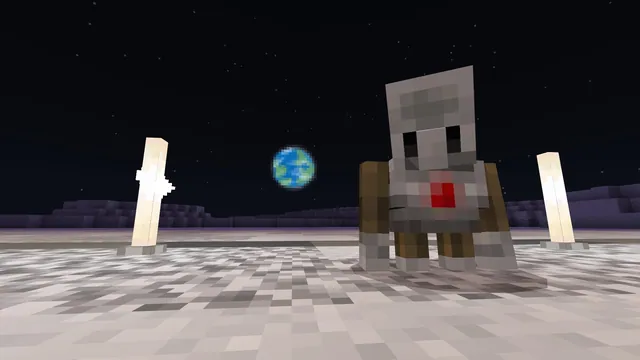
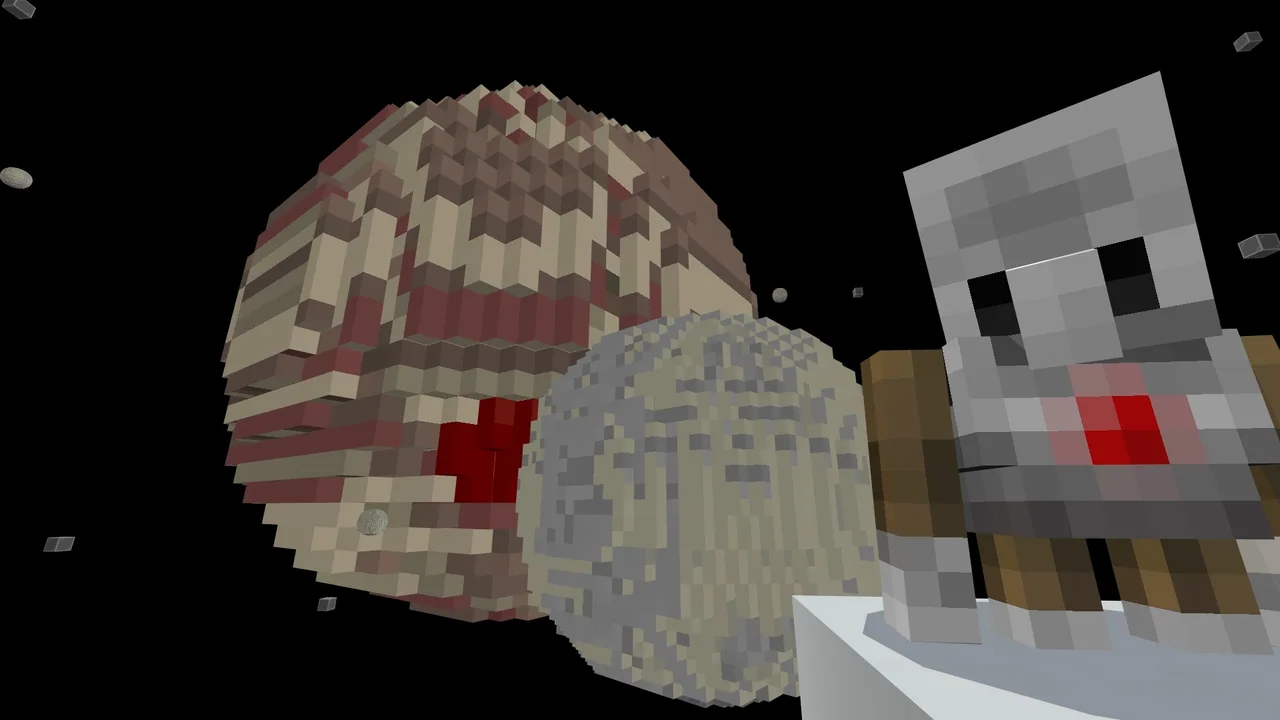
In this lesson, students continue their journey beyond the asteroid belt to explore the gas giants Jupiter and Saturn. Because these giant planets do not offer a solid surface for landing, students redirect their exploration to Jupiter's largest moon, Ganymede, and the icy ring system of Saturn to gather valuable resources.
Using Minecraft, students learn core computer science concepts such as Boolean logic, comparison operators, and disjunctions within conditional statements. Through three structured in-game tasks and an optional simulation challenge, learners write, test, and debug code to automate their space exploration missions.
Learning objectives
By the end of this lesson students will be able to:
- Apply comparison operators and Boolean logic within conditional coding structures.
- Test and debug code to solve exploration challenges on Ganymede and Saturn's rings.
- Explain the role of sequencing, Booleans, and comparison operators in programming.
- Demonstrate a resilient coding mindset when analyzing and correcting errors.
Blocks and items used in this lesson


Key vocabulary
- Boolean
- A data type that can only evaluate to one of two values: true or false.
- Comparison Operator
- A symbol used to compare two values, such as equal to, greater than, or less than.
- Conditional
- A statement that performs different actions depending on whether a condition is true or false.
- Sequencing
- Arranging coding commands in the exact order they should be executed.
- Disjunction
- A logical compound statement using OR that is true if at least one of its conditions is true.
Before class
Lesson sequence
Suggested timing: about 60 minutes in total.
- Introduction & Concept Presentation10 min
Introduce the mission beyond the asteroid belt, discussing why landing on gas giants is impossible. Use the classroom presentation to introduce Boolean logic, comparison operators, and disjunction in programming.
- Activity 1: Ganymede, In the Groove15 min
Students load into the world and begin their first coding assignment on Ganymede. They write and run basic conditional code using comparison operators to explore the terrain.
- Activity 2: Ganymede, Ready to Rock15 min
Students expand their programs to handle rock collection on Ganymede. Encourage learners to test their code, watch for unexpected behavior, and debug logic errors.
- Activity 3: Saturn's Rings, Mining Precious Metals15 min
Students travel to Saturn's rings to write automated mining routines. Learners apply disjunctions and comparison operators to successfully identify and gather target metals.
- Review & Code Analysis5 min
Review key terms as a group and display the sample code snippet from the guide. Ask students to explain how the Booleans and comparison operators directed the actions in their programs.
Assessment: success criteria
- Students can explain the function of comparison operators and Booleans in their own words.
- Students write and execute code containing conditionals to gather materials in the designated zones.
- Students successfully identify and debug errors in their programs.
- Students can interpret and explain the provided classroom coding snippet.
Differentiation
Walk through sample comparison statements together using visual true-or-false flashcards before students write code in Minecraft.
Have students tackle the bonus Simulations activity or complete the external planet research template.
Knowledge check
5 questions to check understanding after the lesson. Tap an answer to see if it is right; the score appears at the end.
1Why do explorers land on Ganymede instead of Jupiter to gather materials?
Answer: A. Jupiter and Saturn are gas giants that lack a solid landing surface, so materials are collected from moons and rings instead.
2What values can a Boolean expression produce?
Answer: B. Boolean logic operates on strictly binary conditions that evaluate to either true or false.
3What is the main purpose of a comparison operator in computer programming?
Answer: C. Comparison operators test how two values relate to one another to produce a true or false outcome.
4What does sequencing mean in a computer science context?
Answer: D. Sequencing refers to placing coding commands in a precise order so they execute correctly.
5What is the recommended action when your automated space code does not work as expected?
Answer: A. Testing and debugging code is a core learning objective and reflects a resilient coding mindset.
Resources
- Lesson package (.zip)Everything the author attached to this lesson in one download.
- Coding Fundamentals Part 2: Ganymede and Saturn's RingsEDU Guide and Formative Assessment
- Coding Fundamentals Part 2: Ganymede and Saturn's RingsClassroom Presentation
- Coding Fundamentals Part 2: Minecraft Space CenterCurriculum Overview
- Planet Research TemplateUse this lesson plan and student research template if you want to conduct the research portion of this computer science unit.
- Lesson worldOpens the world page in Minecraft Education (sign-in with a school account may be needed).
Part of the Coding Fundamentals curriculum
This is lesson 5 of 17 in Coding Fundamentals.
- Basic Moves and the Agent
- Coding Challenge
- Dinosaur Run
- Earth’s Moon & Mars
- Ganymede (Jupiter's Moon) & Saturn's Rings
- Gray Wolves
- Mercury and Venus
- Minecraft Space Center
- Panda's Protected Habitat
- Polar Bear Rescue
- Revisiting Biomes
- Revisiting Planets
- Sea Turtle Assistance
- The Experiment
- Uranus’ Rings and Neptune's Moon, Triton
- We Need Beets!
- Wild West
Frequently Asked Questions
Do students need extensive coding experience to participate?
No, the lesson is designed for beginners aged 8 to 10, though familiarity with basic block-based commands from earlier lessons in the series is helpful.
How should I fit the Planet Research component into class time?
The Planet Research task takes place outside of Minecraft and requires internet access, so it is best assigned as an extension project or taught in a separate class session.
Adapted from Ganymede (Jupiter's Moon) & Saturn's Rings by Minecraft Education on Minecraft Education, last updated Feb 4, 2025. This classroom version, the timings and the quiz were written by 9Minecraft Education.