- Type
- Lesson plan
- Subject
- ScienceArt, Music & Design
- Grade
- Primary (Grades 3-5)
- Ages
- Ages 8-10
- Duration
- about 70 min (suggested)
- Skills
- CollaborationCreativity
What makes a bee a bee?
Overview
In this lesson, students investigate what defines an insect and discover the distinct anatomical traits of honeybees. By contrasting general insect features with specialized bee structures, learners understand how structure relates to function in the animal kingdom.
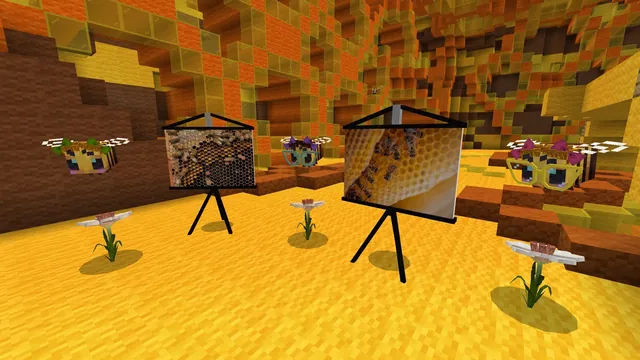
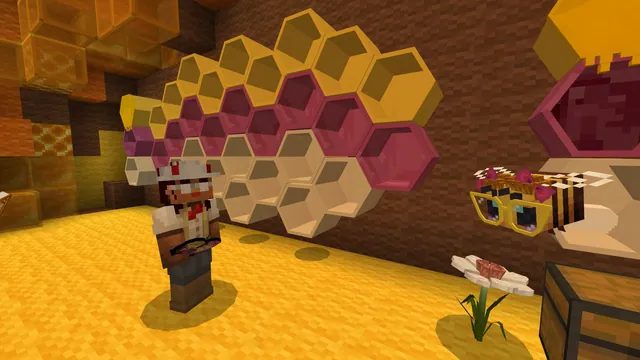
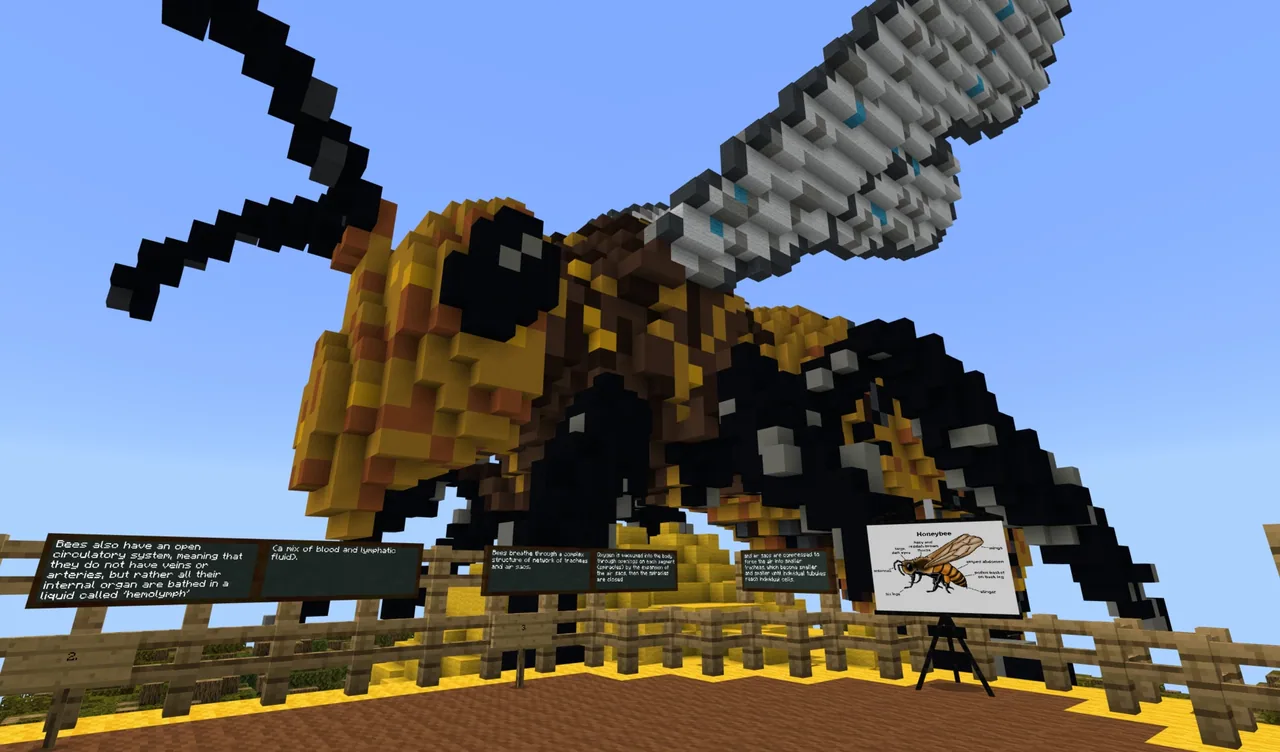
Students enter a dedicated Minecraft world to explore the Anatomy Section at the top of a giant beehive. Equipped with an in-game camera, quill, and notepad, they collect observations to verify their initial hypotheses before using craft materials to construct their own physical bee models.
Learning objectives
By the end of this lesson students will be able to:
- Identify physical characteristics shared by all insects.
- Distinguish anatomical traits that are unique to honeybees.
- Document in-game observations using the camera and quill.
- Design and assemble a physical bee model using an iterative process.
Blocks and items used in this lesson


Key vocabulary
- Invertebrate
- An animal that does not have a backbone.
- Exoskeleton
- A hard outer covering that supports and protects an insect's body.
- Thorax
- The middle section of an insect's body between the head and the abdomen, where legs and wings attach.
- Abdomen
- The rear section of an insect's body located behind the thorax.
Before class
Lesson sequence
Suggested timing: about 70 minutes in total.
- Introductory Discussion & Comparison Table20 min
Review defining traits of mammals before asking students to identify features shared by all insects, recording their ideas on the board. Introduce the Bee Anatomy chart and provide the Bee Anatomy Comparison Table.
Have students work individually or in pairs to fill in three columns: traits shared with all insects, parts unique to bees, and parts they are uncertain about. Invite volunteers to share and justify their ideas.
- Minecraft Beehive Exploration10 min
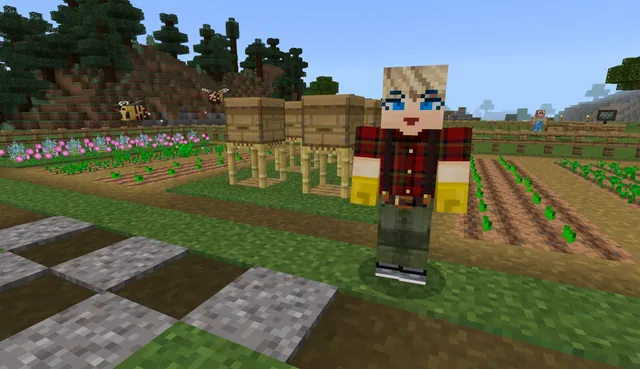
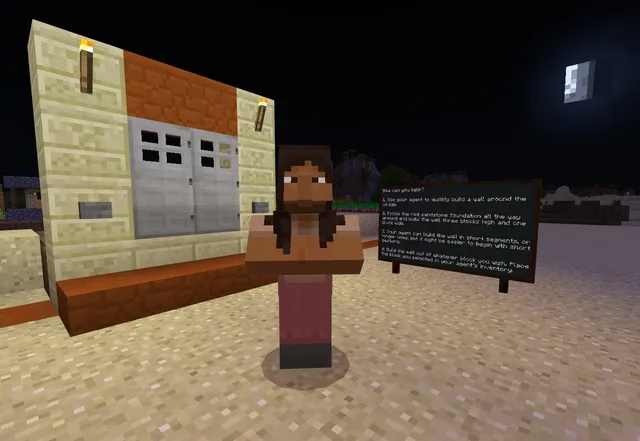
Instruct students to load the Kids and Bees world, speak with Bee Girl, and head to the hive. At the outdoor lab, students meet a scientist NPC to collect a bee costume, camera, and quill and paper from a chest.
Students then transport to the hive, meet Bee Girl again, and fly up to the Anatomy Section to examine bee structures, take photos, record notes, and revise their comparison tables.
- Model Building & Design Reflection40 min
Provide crafting materials such as cardboard tubes, egg cartons, craft wire, paper, and glue. Students use their notes to design and construct their own physical bee models, practicing iterative design to accurately portray bee anatomy.
Assessment: success criteria
- Lists general insect characteristics such as an exoskeleton, three body segments, six legs, and wings.
- Accurately separates shared insect traits from unique bee structures on the comparison sheet.
- Gathers observations from the Minecraft Anatomy Section using the camera and quill.
- Constructs a physical model that incorporates key anatomical structures of a bee.
Differentiation
Allow students to complete the comparison table in pairs and reference the projected anatomy diagram throughout the activity.
Challenge students to label their physical models and explain the specific function of each specialized bee part.
Knowledge check
5 questions to check understanding after the lesson. Tap an answer to see if it is right; the score appears at the end.
1Which set of characteristics belongs to all insects?
Answer: B. All insects are invertebrates with an exoskeleton, three main body parts (head, thorax, abdomen), antennae, three pairs of legs, and two pairs of wings.
2What three items do students retrieve from the chest in the scientist's lab?
Answer: C. The scientist outside the beehive instructs students to collect a bee costume, a camera, and quill and paper from the chest.
3Where in the Minecraft beehive do students go to examine bee body parts?
Answer: A. Students are directed to fly to the top of the hive to explore the Anatomy Section.
4What are the three main body segments of an insect?
Answer: C. Insects share the three distinct body sections: head, thorax, and abdomen.
5What should students do if they are not sure whether a feature is unique to bees on their table?
Answer: B. The third column of the comparison table is specifically designated for body parts students are not sure are bee-specific.
Resources
- Lesson package (.zip)Everything the author attached to this lesson in one download.
- Bee Anatomy Comparison TableThis worksheet asks students to compare honeybee anatomy with the anatomy of other insects.
- The Honey Bee BodyThis worksheet asks students to label internal and external parts of the honeybee’s body.
- Kids and Bees: Anatomy Teacher's Guide
- Lesson worldOpens the world page in Minecraft Education (sign-in with a school account may be needed).
Part of the Build with Bees curriculum
This is lesson 1 of 11 in Build with Bees.
- BUILD WITH BEES: ANATOMY
- BUILD WITH BEES: BEE A HERO
- BUILD WITH BEES: BEE NESTS
- BUILD WITH BEES: BEE TREASURES
- BUILD WITH BEES: BEESWAX
- BUILD WITH BEES: BUMBLE BUZZ
- BUILD WITH BEES: FARMING
- BUILD WITH BEES: HABITAT
- BUILD WITH BEES: HONEY
- BUILD WITH BEES: LIFE CYCLE
- BUILD WITH BEES: POLLINATION
Frequently Asked Questions
What world file do I need to run this lesson?
You will need the Kids and Bees world file created by Lifeboat, which contains the laboratory, NPC characters, and the giant beehive with an Anatomy Section.
How does this lesson incorporate hands-on learning outside Minecraft?
After exploring the digital anatomy exhibits, students use craft supplies like egg cartons, paper tubes, pipe cleaners, and paper to design and assemble their own physical models of bees.
How should students document what they find inside the beehive?
Students use the in-game camera to photograph exhibits and the quill and paper to record notes, which they then use to update their anatomy comparison tables.
Adapted from BUILD WITH BEES: ANATOMY by Sarah Red-Laird on Minecraft Education, last updated Jul 30, 2025. This classroom version, the timings and the quiz were written by 9Minecraft Education.