- Type
- Lesson plan
- Grade
- Primary (Grades 3-5)
- Ages
- Ages 8-10
- Duration
- about 50 min (suggested)
What stages do honeybees go through as they grow, and how do colony members help them survive at each stage?
Overview
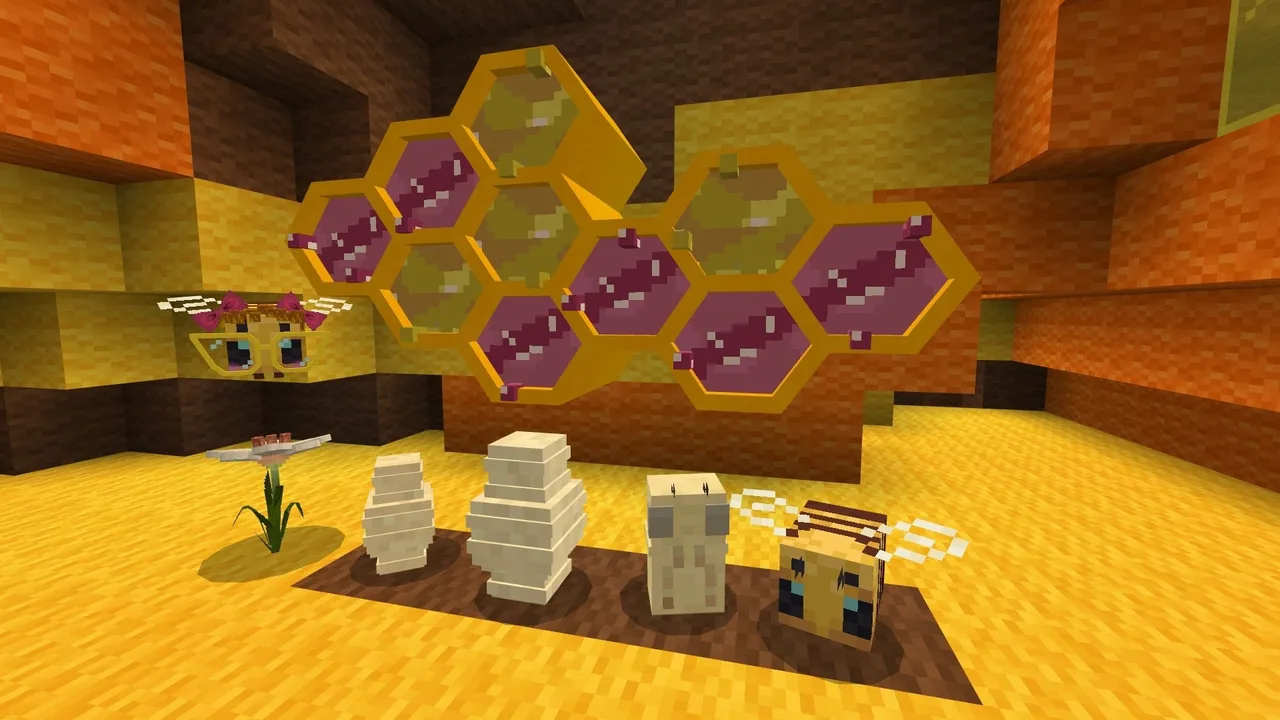
In this lesson, students explore the four distinct developmental stages of honeybees: egg, larva, pupa, and adult. By comparing honeybee growth to other insects and tracking what bees require to thrive, learners discover how specialized colony roles support new generations and ensure hive survival.
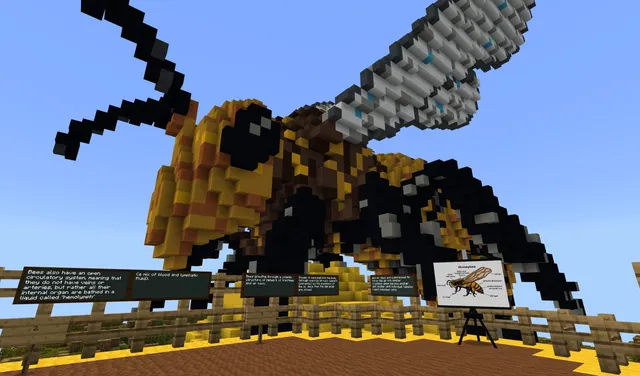
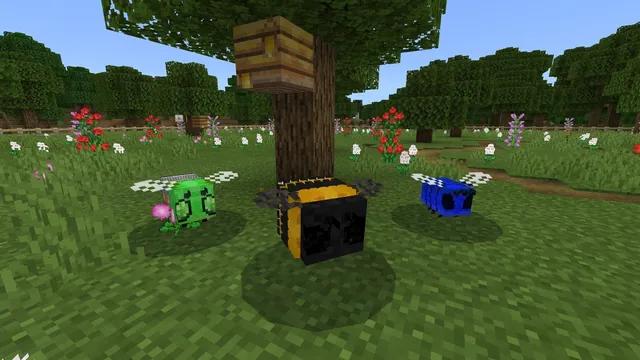
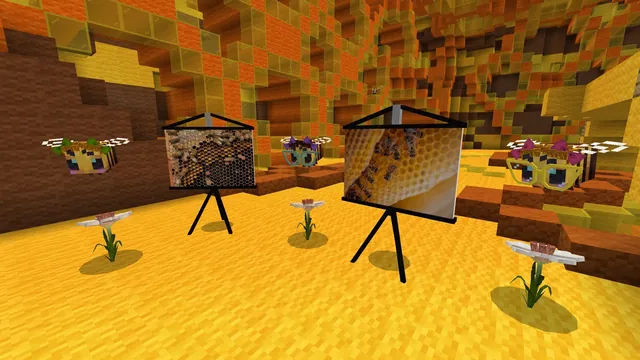
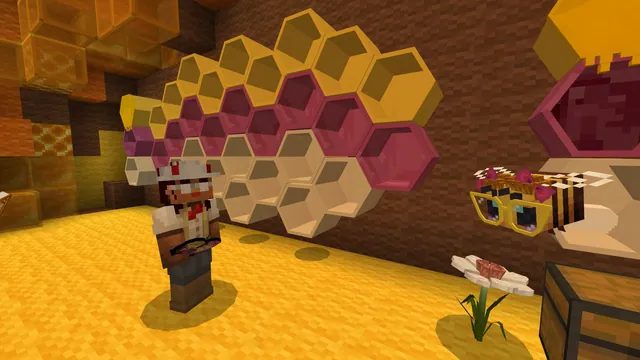
Inside the Kids and Bees Minecraft world, students suit up as bees and explore the hive nursery. By gathering ingredients to create bee bread, feeding growing larvae, and warming developing pupae, students actively experience the duties of worker nurse bees while recording their observations with an in-game camera and journal.
Learning objectives
By the end of this lesson students will be able to:
- Identify and sequence the four stages of the honeybee life cycle: egg, larva, pupa, and adult.
- Describe the different castes and specialized tasks performed by worker bees within the hive.
- Explain what conditions and resources honeybees require to survive during each stage of development.
- Document in-game observations of bee care and metamorphosis using the camera and book and quill.
Blocks and items used in this lesson


Key vocabulary
- Larva
- The early, grub-like feeding stage of a bee after hatching from an egg.
- Pupa
- The non-feeding developmental stage where a larva transforms into an adult bee.
- Bee Bread
- A mixture of pollen and nectar prepared by worker bees to feed growing larvae.
- Caste
- A specialized role or social group within the bee colony, such as a worker or queen.
- Nurse Bee
- A worker bee responsible for feeding and caring for developing larvae in the nursery.
Before class
Lesson sequence
Suggested timing: about 50 minutes in total.
- Video Observation and Class Discussion10 min
Screen the National Geographic bee time-lapse video and invite students to share what they notice and wonder. Guide a brief comparison to butterfly metamorphosis, write the four stages (egg, larva, pupa, adult) on the board in order, and screen the video a second time to prepare students for the in-game life cycle tasks.
- Entering the Beehive5 min
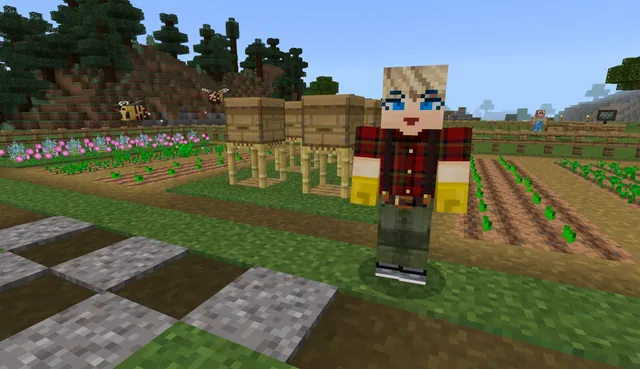
Instruct students to launch the Kids and Bees world, speak to the lab scientist, and collect a bee costume, camera, and book and quill from the chest. Students then transport to the beehive, meet the Bee Girl NPC outside for an orientation, and step inside the hive structure.
- Nursery Work and Metamorphosis25 min
Students locate the nursery and speak with worker bees Lulu and Bella to learn about hive castes. Working with NPC Veronia, students take on nurse bee duties: they prepare bee bread by filling comb cells with pollen and then nectar, feed the larva, wait for the transformation, and warm the pupa by jumping and wiggling nearby. Students record notes and photos throughout.
- Worksheet Reflection and Synthesis10 min
Students return to their desks to complete the Honey Bee Caste Worksheet and Honey Bee Life Cycle Worksheet individually or in pairs. Have them reference their in-game photos and notes to list the stages in order and explain hive roles.
Assessment: success criteria
- The student lists the four stages of the honeybee life cycle in correct chronological order.
- The student identifies factors that support or threaten bee survival at each life stage.
- The student explains the function of bee bread and the role of nurse bees in the hive.
- The student completes the caste and life cycle worksheets using details gathered from the Minecraft nursery.
Differentiation
Allow students to pair up during the Minecraft exploration and remind them to ask the Queen NPC for teleport help if they get lost in the hive.
Challenge students to record detailed field notes on how worker bee tasks shift beyond the nursery as adult bees age.
Knowledge check
5 questions to check understanding after the lesson. Tap an answer to see if it is right; the score appears at the end.
1What is the correct sequence of a honeybee's life cycle stages?
Answer: B. Honeybees develop through four distinct stages: egg, larva, pupa, and finally adult.
2In what order must ingredients be placed into combs to make bee bread in the nursery?
Answer: C. The lesson instructions specify that students must fill combs with pollen and then nectar, in that exact order, to create bee bread.
3What action do students perform in Minecraft to warm the transitioning bee?
Answer: D. Students warm the developing bee by jumping and wiggling around her in the nursery.
4Which NPC inside the nursery guides students in feeding and raising the young bees?
Answer: A. Students assist Veronia in the nursery to care for and raise the new bees.
5What should a student do if they get lost while exploring the beehive world?
Answer: B. Students who have difficulty finding different sections of the hive can ask the queen NPC to send them where they need to go.
Resources
- Lesson package (.zip)Everything the author attached to this lesson in one download.
- Honey Bee Caste WorksheetUsing this worksheet, students label pictures of the different bee castes.
- Honey Bee Life Cycle WorksheetUsing this worksheet, students label pictures of the different bee life stages.
- Kids and Bees: Life Cycle Teacher's Guide
- Lesson worldOpens the world page in Minecraft Education (sign-in with a school account may be needed).
Part of the Build with Bees curriculum
This is lesson 10 of 11 in Build with Bees.
- BUILD WITH BEES: ANATOMY
- BUILD WITH BEES: BEE A HERO
- BUILD WITH BEES: BEE NESTS
- BUILD WITH BEES: BEE TREASURES
- BUILD WITH BEES: BEESWAX
- BUILD WITH BEES: BUMBLE BUZZ
- BUILD WITH BEES: FARMING
- BUILD WITH BEES: HABITAT
- BUILD WITH BEES: HONEY
- BUILD WITH BEES: LIFE CYCLE
- BUILD WITH BEES: POLLINATION
Frequently Asked Questions
Why do students need headphones during this lesson?
Several NPCs throughout the Kids and Bees world feature embedded video links that provide instructional information, so headphones prevent classroom audio overlap.
What items must students retrieve from the chest before traveling to the beehive?
Students need to open the chest in the starting lab area to collect a bee costume, a camera, and a book and quill for taking photos and writing notes.
Adapted from BUILD WITH BEES: LIFE CYCLE by Sarah Red-Laird on Minecraft Education, last updated Jul 21, 2025. This classroom version, the timings and the quiz were written by 9Minecraft Education.