- Type
- Lesson plan
- Grade
- Primary (Grades 3-5)
- Ages
- Ages 8-10
- Duration
- about 1.6 hours (suggested)
Why do honeybees build their honeycombs using hexagons instead of other shapes?
Overview
In this lesson, students investigate the biological cost of beeswax and examine why honeybees build their nests using hexagonal tessellation. Because bees must consume roughly eight pounds of honey to produce a single pound of wax, efficiency is vital to the colony's survival. Learners examine perimeter-to-area relationships to discover how hexagonal combs minimize wax usage while preventing wasted space.
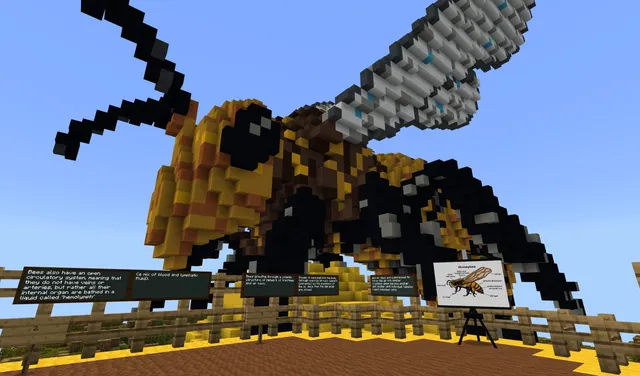
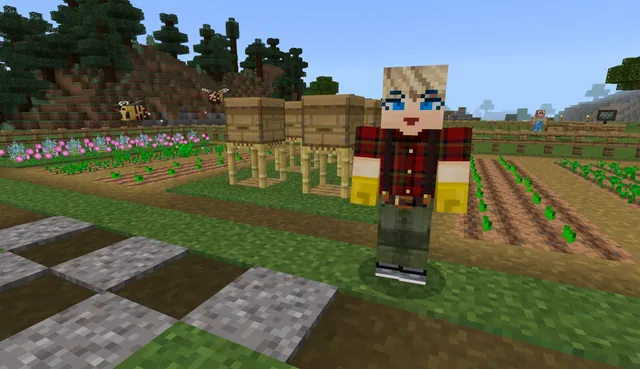
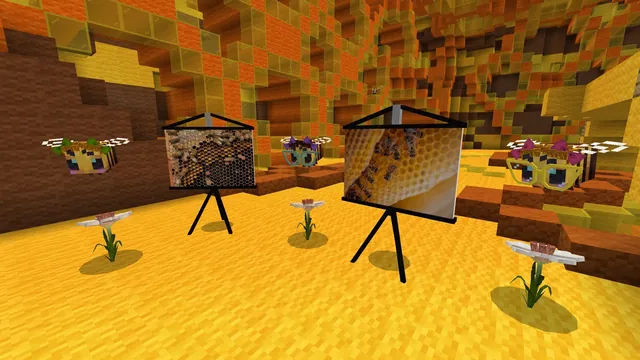
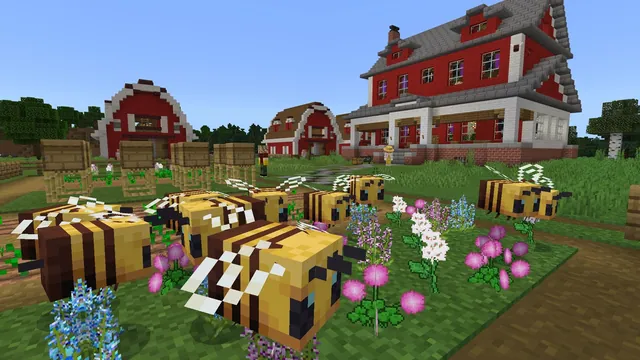
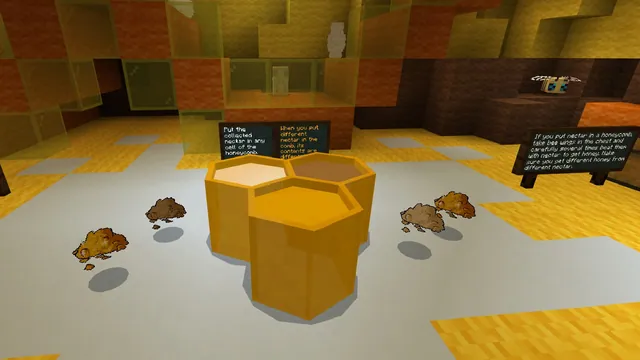
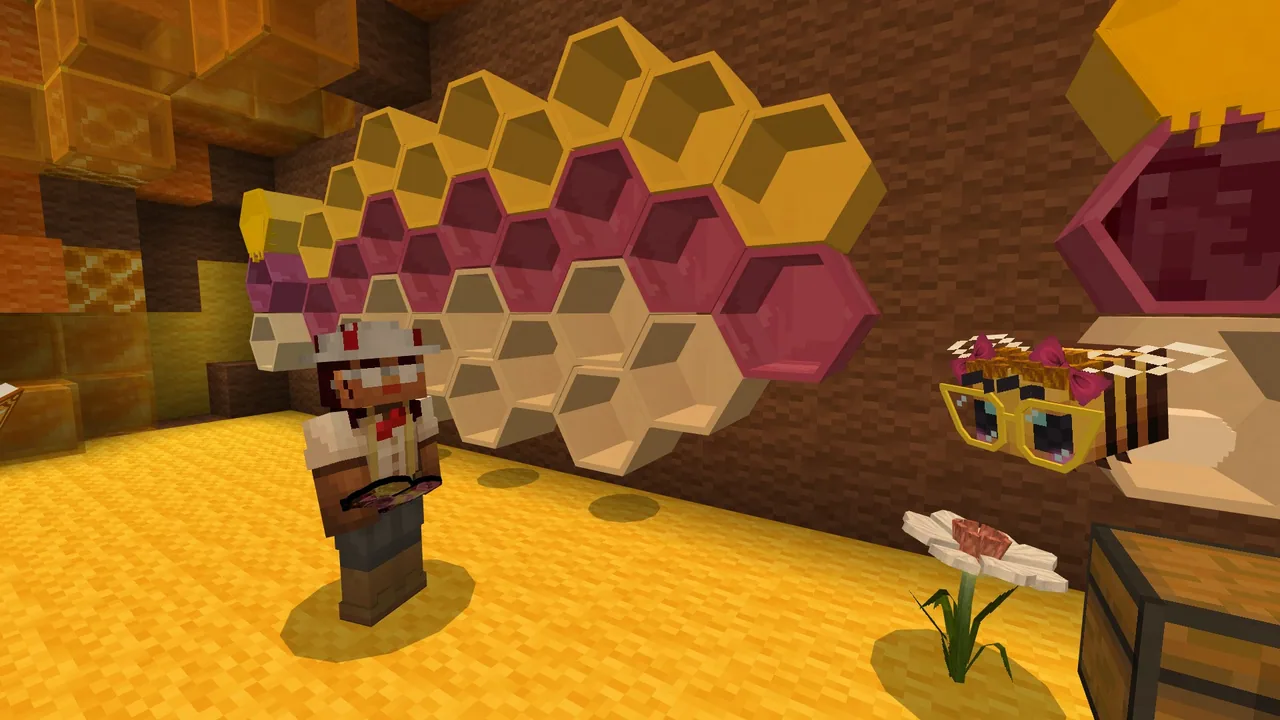
Inside the Kids and Bees Minecraft world, students enter a simulated beehive to meet specialized non-player characters, watch informative videos, and explore comb architecture firsthand. After gathering gear from a scientist and receiving an orientation from Bee Girl, learners construct honeycomb structures, stock them with eggs, bee bread, and honey, and connect these digital designs to classroom math concepts.
Learning objectives
By the end of this lesson students will be able to:
- Describe the biological process bees use to produce wax scales from honey.
- Identify everyday uses of beeswax for both honeybees and humans.
- Construct digital comb cells in Minecraft and fill them with eggs, bee bread, and honey.
- Explain how hexagonal tessellation minimizes wax consumption by eliminating gaps and overlaps.
Blocks and items used in this lesson


Key vocabulary
- Tessellation
- A repeating pattern of flat shapes fitted together without any gaps or overlaps.
- Wax Glands
- Specialized organs on a bee's abdomen that secrete small wax scales.
- Bee Bread
- A mixture of pollen and honey stored in honeycomb cells as food for the hive.
- Waggle Dance
- A movement performed on the comb that bees use to communicate directions to food sources.
Before class
Lesson sequence
Suggested timing: about 95 minutes in total.
- Introductory Discussion5 min
Introduce beeswax by asking students whether they have ever used it and where it comes from. Highlight everyday products like lip balm, candles, and crayons, then explain that bees make wax scales in glands on their abdomen after eating honey. Share that bees require about 8 pounds of honey to yield just 1 pound of wax, letting students feel sample weights if available.
- Minecraft Hive Exploration25 min
Direct students to load the Kids and Bees world and meet the scientist to collect a bee costume, camera, and quill and paper. Students then travel into the hive, meet Bee Girl, and find the beeswax area where guides Isabella, Luciana, and Jada explain wax properties and why hexagons are used.
- Comb Construction and Waggle Dance20 min
Students consult Emma for instructions on stocking comb cells with eggs, bee bread, and honey, and view Victoria's video on the waggle dance. Students complete their honeycomb builds inside the hive, asking the queen for navigation help if they get disoriented.
- Tessellation and Efficiency Analysis45 min
Bring students together to analyze why bees build hexagons rather than circles or other polygons. Discuss tessellation, perimeter-to-area ratios, and how avoiding gaps and overlaps saves the hive energy and honey.
Assessment: success criteria
- Students can explain that bees convert roughly eight pounds of honey into one pound of wax using abdominal glands.
- Students can name at least two practical uses of beeswax for humans and two functions within the hive.
- Students can articulate why hexagons are mathematically more efficient than shapes that leave empty gaps or require extra wax.
Differentiation
Allow students who feel disoriented inside the large hive world to talk directly to the queen NPC for instant teleportation to their objective.
Challenge fast finishers to mathematically compare the perimeter and perimeter-to-area ratio of a hexagon against other tessellating shapes like squares or triangles.
Knowledge check
5 questions to check understanding after the lesson. Tap an answer to see if it is right; the score appears at the end.
1How much honey do honeybees need to consume to produce one pound of wax?
Answer: C. Bees consume energy and nutrients from honey, requiring roughly 8 pounds of honey to make 1 pound of wax.
2Where do worker bees produce the wax scales used to build the comb?
Answer: B. Bees convert digested honey into wax scales using wax glands located on their abdomen.
3Which items do students place inside the honeycomb cells during the in-game activity?
Answer: D. Emma directs students to fill their comb builds with eggs, bee bread, and honey.
4If students get lost while exploring the beehive, which character can transport them to the right room?
Answer: A. Students having trouble finding specific sections of the hive can ask the queen to send them where they need to go.
5Why do honeybees construct hexagonal comb cells instead of circular or irregular shapes?
Answer: C. Hexagons tessellate perfectly without gaps or overlapping walls, making them the most resource-efficient design.
Resources
- Lesson package (.zip)Everything the author attached to this lesson in one download.
- Beeswax! What do the experts think?
- Kids & Bees: Beeswax Teachers Guide
- Lesson worldOpens the world page in Minecraft Education (sign-in with a school account may be needed).
Part of the Build with Bees curriculum
This is lesson 5 of 11 in Build with Bees.
- BUILD WITH BEES: ANATOMY
- BUILD WITH BEES: BEE A HERO
- BUILD WITH BEES: BEE NESTS
- BUILD WITH BEES: BEE TREASURES
- BUILD WITH BEES: BEESWAX
- BUILD WITH BEES: BUMBLE BUZZ
- BUILD WITH BEES: FARMING
- BUILD WITH BEES: HABITAT
- BUILD WITH BEES: HONEY
- BUILD WITH BEES: LIFE CYCLE
- BUILD WITH BEES: POLLINATION
Frequently Asked Questions
What should I do if students have trouble navigating the inside of the beehive?
Students can speak directly to the queen bee NPC, who can teleport them to the specific section of the hive they need to reach.
Do students need sound enabled for this lesson?
Yes, several non-player characters link to short educational videos, so students should use individual headphones during the computer exploration phase.
Adapted from BUILD WITH BEES: BEESWAX by Sarah Red-Laird on Minecraft Education, last updated Jul 21, 2025. This classroom version, the timings and the quiz were written by 9Minecraft Education.