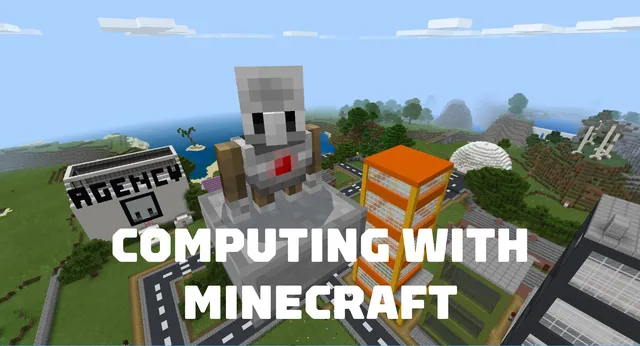
How can computational thinking and coding help us solve problems to escape the mansion before dawn?
Overview
Computational thinking is a robust problem-solving method consisting of decomposition, pattern recognition, abstraction, and algorithms. In this introductory computer science lesson, students apply these core strategies to solve coding challenges using either block-based commands or Python text code.
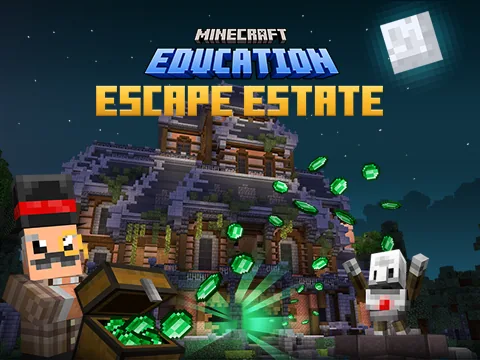
Set within the Escape Estate mansion, learners navigate through puzzle rooms, rescue an in-game Agent, collect lost diary pages, and open trapdoors. Students select their own color-coded route through the estate, working toward a final boss encounter to escape before dawn and secure one million emeralds.
Learning objectives
By the end of this lesson students will be able to:
- Solve coding puzzles using block-based code or Python.
- Apply computational thinking practices including decomposition, pattern recognition, abstraction, and algorithms.
- Navigate escape room pathways by collecting clues and assisting the Agent.
- Explain how computational thinking strategies apply to subjects outside of computer science.
Blocks and items used in this lesson


Key vocabulary
- Computational Thinking
- A problem-solving approach made up of decomposition, pattern recognition, abstraction, and algorithms.
- Decomposition
- Breaking down a complex problem into smaller, more manageable parts.
- Pattern Recognition
- Identifying similarities or shared characteristics across problems to find solutions.
- Abstraction
- Focusing on essential details while filtering out information that is not needed.
- Algorithm
- A clear, step-by-step list of instructions designed to complete a task.
- Agent
- A programmable in-game assistant that executes code to help the player solve puzzles.
Before class
Lesson sequence
Suggested timing: about 45 minutes in total.
- Direct Instruction (I Do)10 min
Present the challenge using the age-appropriate slide presentation. Introduce computational thinking concepts—decomposition, pattern recognition, abstraction, and algorithms—and discuss how these practices help solve problems in computer science and other subjects.
- Guided Instruction (We Do)10 min
Guide students through the opening sequence. Players complete the navigation tutorial, meet Dr. Dodge Breakowski outside the estate, enter the attic, find the lost diary, and rescue the Agent from beneath the trapdoor.
- Independent Coding and Mansion Escape (You Do)20 min
Students unlock and choose their pathway through the mansion:
- Green Pathway (4 rooms): Attic, Study, Kitchen, and Parlor (recommended for beginners).
- Yellow Pathway (5 rooms): Attic, Alchemy Room, Conservatory, Laboratory, and Parlor.
- Red Pathway (6 rooms): Attic, Moat, Cellar, Drawing Room, Laboratory, and Parlor.
Learners collect up to ten diary entries, complete the Wrong Birthdays Puzzle in the Parlor, and solve final side-room and boss coding puzzles to take down the villain.
- Reflection and Wrap-Up5 min
Regroup the class to discuss what was challenging, how computational thinking helped debug code, and how these practices connect to everyday problem-solving. Distribute completion certificates.
Video
Assessment: success criteria
- Student creates functional code in Blocks or Python to rescue the Agent and unlock pathway doors.
- Student navigates room puzzles using computational thinking strategies to reach the Parlor.
- Student completes the final puzzle sequence to defeat the villain and escape the mansion.
- Student describes how computational thinking methods can be applied outside of computer science.
Differentiation
Direct students to the four-room Green Pathway using visual block coding for a beginner-level progression.
Encourage advanced students to complete the six-room Red Pathway using Python or replay to explore other pathways.
Knowledge check
5 questions to check understanding after the lesson. Tap an answer to see if it is right; the score appears at the end.
1Who meets the player outside the mansion to explain the objective?
Answer: B. Dr. Dodge Breakowski introduces himself outside the mansion and invites players to approach.
2Which pathway is recommended for younger students or beginners with no coding experience?
Answer: A. The Green Pathway has 4 rooms and is recommended for younger learners and beginners.
3How many total lost diary pages are scattered throughout the estate?
Answer: C. The source states that players search for a total of 10 diary pages during gameplay.
4In which room do all players begin their escape room journey?
Answer: D. All players are pulled into the mansion and start in Room 1: The Attic.
5Which of the following is NOT one of the computational thinking skills highlighted in the lesson?
Answer: B. Computational thinking includes decomposition, pattern recognition, abstraction, and algorithms, not manual block crafting.
Resources
- Lesson package (.zip)Everything the author attached to this lesson in one download.
- Solutions GuideSolutions Guide for Block and Python
- How to Facilitate Hour of Code: Escape EstateA step by step presentation to facilitating an Hour of Code with Minecraft's Escape Estate.
- Educator GuideTeach the Hour of Code: Escape Estate with this comprehensive educator guide.
- Lesson worldOpens the world page in Minecraft Education (sign-in with a school account may be needed).
Part of the Computing with Minecraft curriculum
This is lesson 7 of 9 in Computing with Minecraft.
- Unit 1: The Agency
- Unit 2: City Planner
- Unit 3: Parks & Recreation
- Unit 4: A Zoo
- Unit 5: Wind Power
- GameCode
- Hour of Code: Escape Estate
- Hour of Code: Generation AI
- Hour of Code: The Show Must Go On
Frequently Asked Questions
What coding languages can students choose between in this lesson?
Students can complete the coding challenges using either visual block coding or text-based Python.
Can students explore more than one pathway?
Yes. Students can replay the world to test different pathways, each containing unique rooms and puzzles.
Are there different presentation slides available for different grade levels?
Yes. The lesson materials provide separate presentation decks for primary grades 1-5 and secondary grades 6-12.
Adapted from Hour of Code: Escape Estate by Minecraft Education on Minecraft Education, last updated Jun 19, 2024. This classroom version, the timings and the quiz were written by 9Minecraft Education.