- Type
- Lesson plan
- Subject
- Science
- Ages
- Ages 11-13
- Duration
- about 60 min (suggested)
How do forces like gravity and friction affect motion, and can Minecraft accurately model Newton's second law of motion?
Overview
Understanding fundamental physics concepts like gravity, friction, and Newton's second law of motion can be challenging when taught purely through abstract formulas. This lesson prompts learners to observe and analyze physical forces in action, evaluating how these principles govern motion and whether simulated environments reflect real-world physics.
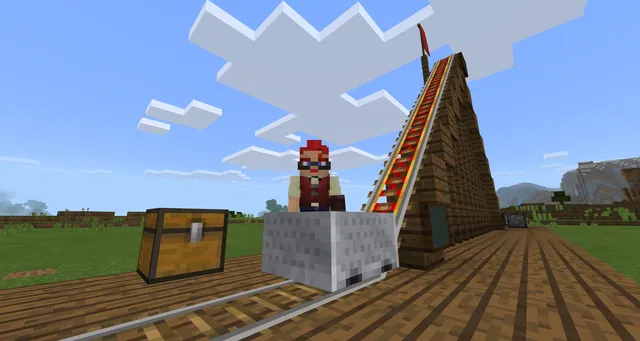
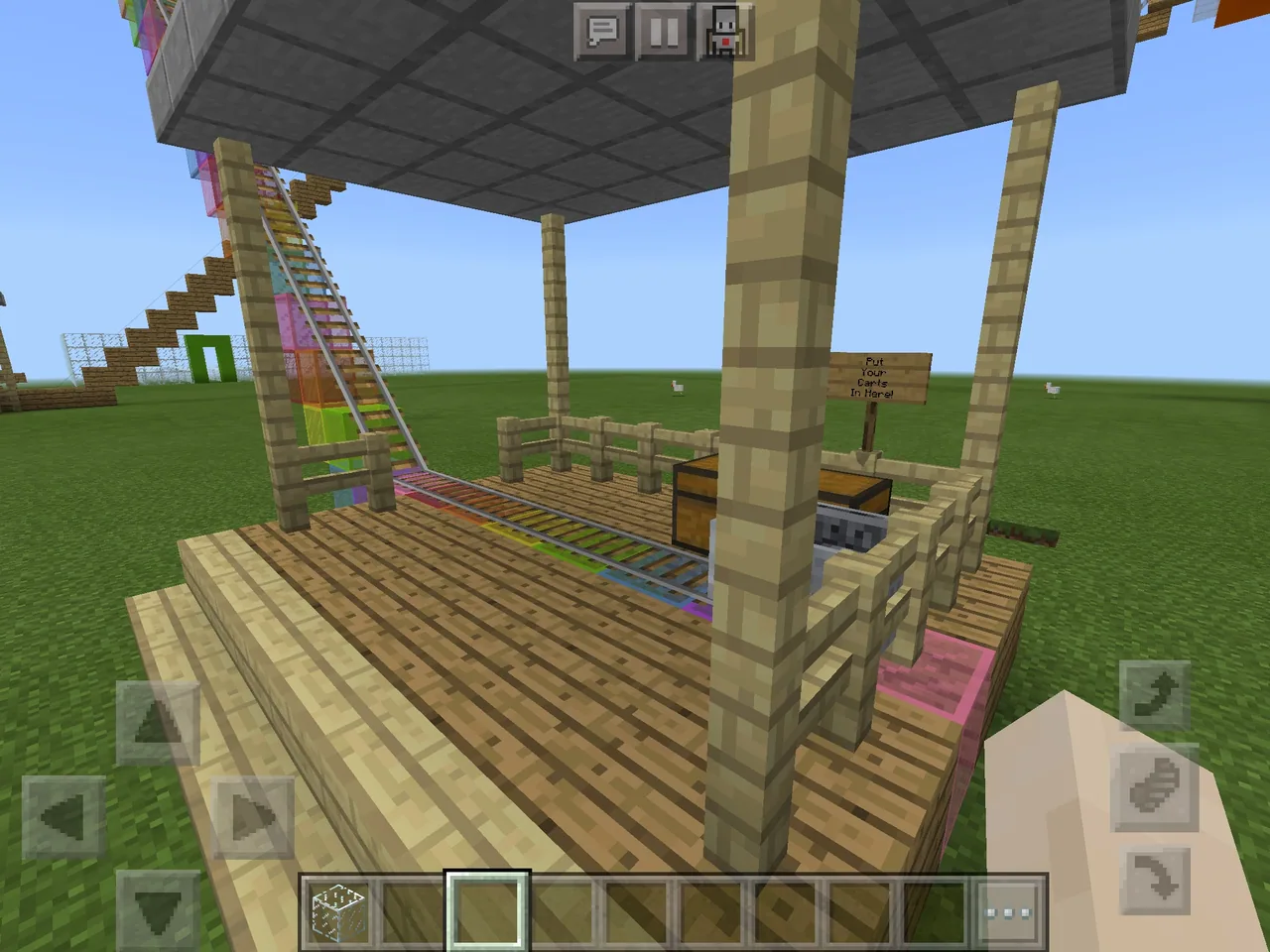
Using the Roller Coaster World, students experience track motion firsthand and record observations using the in-game camera and portfolio. By testing coaster behavior against guiding questions, learners collect visual evidence to justify how forces operate or differ within the Minecraft engine.
Learning objectives
By the end of this lesson students will be able to:
- Identify examples of forces such as gravity and friction acting within the Minecraft world.
- Explain the functional differences between gravity and friction on a roller coaster.
- Evaluate whether Newton's second law of motion applies accurately to the in-game coaster.
- Document evidence and observations using the in-game camera and portfolio.
Blocks and items used in this lesson


Key vocabulary
- Force
- A push or pull acting upon an object that can change its speed, direction, or shape.
- Gravity
- A force that pulls objects downward toward a surface or center of mass.
- Friction
- A resistive force that opposes the motion of surfaces sliding or moving across each other.
- Newton's Second Law of Motion
- A law of physics stating that the acceleration of an object depends on the net force acting on it and the object's mass.
Before class
Lesson sequence
Suggested timing: about 60 minutes in total.
- Warm-up Discussion10 min
Introduce the lesson topic using fill-in-the-blank prompts to solicit prior knowledge. Guide discussion on what forces are, whether forces exist in Minecraft, and the difference between gravity and friction.
- Roller Coaster Exploration20 min
Have students load the Roller Coaster World individually or in small groups. Instruct them to ride the coaster repeatedly, observing where the cart speeds up, slows down, and reacts to inclines and tracks.
- Evidence Collection15 min
Students use the in-game camera to photograph specific sections of the track that demonstrate forces. They compile these images into their portfolios with written explanations addressing the guiding questions and Newton's second law.
- Presentations and Extension15 min
Invite students to present their portfolio findings to the class. As an extension, allow learners to modify the existing roller coaster track or create new sections to test physical forces further.
Assessment: success criteria
- Student accurately identifies examples of gravity and friction acting on the coaster.
- Student explains the key differences between the effects of gravity and friction.
- Student uses camera photos and portfolio notes to justify whether Newton's second law applies to the world.
- Student communicates their scientific observations clearly in discussion or presentation.
Differentiation
Provide a structured checklist of specific track locations where students should stop to observe speed changes and label forces.
Have students modify the roller coaster track to test how changing slopes and track layouts affects the cart's motion.
Knowledge check
5 questions to check understanding after the lesson. Tap an answer to see if it is right; the score appears at the end.
1Which force pulls the roller coaster cart downward along drops and slopes?
Answer: B. Gravity is the attractive force that pulls objects downward toward the ground.
2How does friction primarily affect a roller coaster cart?
Answer: C. Friction acts as a resistive force opposing the motion between contacting surfaces.
3Which tools in Minecraft are students instructed to use to capture and present their observations?
Answer: A. The lesson directs students to use the camera and portfolio to document their findings.
4What physics principle are students asked to evaluate for accuracy in the Minecraft world?
Answer: C. The lesson specifically asks students to analyze whether Newton's second law of motion applies to the coaster.
5What is an extension activity suggested for this lesson?
Answer: D. The lesson suggests allowing students to add to the supplied world or build a new one as an extension.
Resources
- Lesson package (.zip)Everything the author attached to this lesson in one download.
- Roller Coaster WorldMinecraft mcworld file.
- Lesson worldOpens the world page in Minecraft Education (sign-in with a school account may be needed).
Part of the Physical Science curriculum
This is lesson 6 of 6 in Physical Science.
- Coaster-vation of Energy!
- Horizontal Projectile Motion
- Minecraft Micro Models
- Physics Coaster
- Physics Training Academy
- Physics:Roller Coaster World
Frequently Asked Questions
Can students work individually or must they be in groups?
The lesson can be conducted as an independent activity or in small groups depending on classroom structure, class size, and device availability.
What should students conclude about Newton's second law in Minecraft?
Students are asked to critically evaluate whether the in-game mechanics reflect the real-world law and explain why the simulation is or is not an accurate example of it.
Adapted from Physics:Roller Coaster World by Dean Garza on Minecraft Education, last updated Jul 21, 2025. This classroom version, the timings and the quiz were written by 9Minecraft Education.