- Type
- Lesson plan
- Topics
- Math & EconomicsScience
- Ages
- Ages 11-18
- Duration
- 1 hour
- Level
- Intermediate
How does starting height affect the conversion of potential energy into kinetic energy in a gravity-powered coaster?
Overview
Roller coasters rely on the direct transformation of gravitational potential energy into kinetic energy as cars navigate downhill slopes and flat track segments. In both real-world engineering and game simulations, physical resistance and track mechanics prevent 100% of stored energy from turning into kinetic motion, making efficiency a crucial metric.
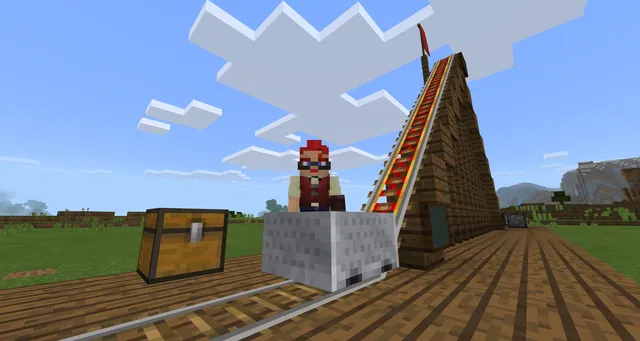
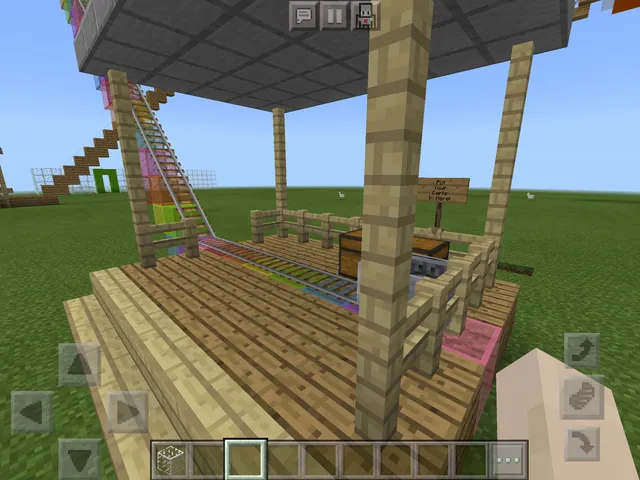
Using Minecraft Education, students treat each in-game block as one meter and test minecart rollouts from various heights using an assumed gravitational acceleration of 10 m/s^2. After recording data and computing velocity, energy, and efficiency values in a spreadsheet, learners take on an engineering challenge to construct an unpowered, gravity-fed coaster from a 50-meter-high platform.
Learning objectives
By the end of this lesson students will be able to:
- Calculate gravitational potential energy, kinetic energy, and initial velocity using collected track data.
- Determine the efficiency of energy conversion from minecart motion experiments.
- Design a gravity-powered roller coaster from a 50-meter height that maximizes travel distance without extra power sources.
- Explain how energy conversion efficiency relates to simulated physics and clean energy generation under SDG 7.
Blocks and items used in this lesson


Key vocabulary
- Gravitational Potential Energy
- Stored energy possessed by an object due to its height, calculated using mass, gravity, and elevation.
- Kinetic Energy
- The energy of an object in motion, calculated from half of its mass multiplied by its velocity squared.
- Energy Conversion Efficiency
- The proportion of input potential energy that is successfully converted into useful kinetic energy.
- Kinematic Equations
- A set of physics formulas linking displacement, time, initial velocity, final velocity, and acceleration.
Before class
Lesson sequence
Suggested timing: about 60 minutes in total.
- Classroom Review10 min
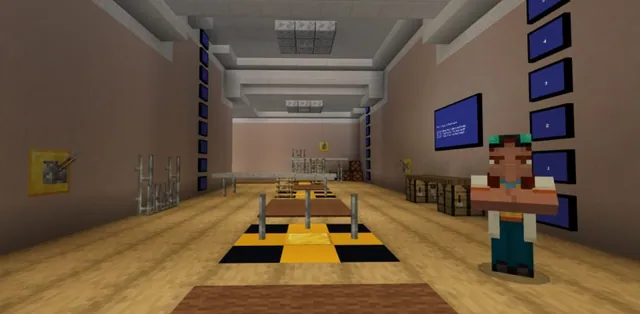
Gather students in the starting classroom to review kinetic energy, gravitational potential energy, and kinematic formulas. Clarify the lab conversion constants: one block equals one meter, cart mass is 1.0 kg, and gravitational acceleration is -10 m/s^2.
- Station A Lab Trials15 min
Students travel to Station A to test how release height changes distance and run time. Learners record stopwatch times and distance measurements across three trials per height setting, then calculate the average for each.
- Station B Analysis and SDG Reflection15 min
At Station B, students transfer trial averages into Microsoft Excel. They compute initial velocity, potential energy, kinetic energy, and conversion efficiency, followed by reflection on simulation friction and how generation efficiency connects to SDG 7 (Affordable & Clean Energy).
- Station C Engineering Challenge15 min
Students move to Station C to design an unpowered roller coaster starting on a platform 50.0 meters above the ground and ending at ground level. Track segments must fit within the Station C boundary and use only the single provided powered rail and button at launch.
- Recording and Review5 min
Learners record a video of their minecart completing the track ride. Completed runs are evaluated on rollout distance, design creativity, and adherence to track restrictions.
Assessment: success criteria
- Accurately recorded time, distance, and averaged values across three lab trials.
- Correct spreadsheet calculation of initial velocity, potential energy, kinetic energy, and conversion efficiency.
- Successful construction of a gravity-driven track from a 50-meter platform to ground level without unapproved power sources.
- Clear written or verbal reflection addressing why energy conversion falls below 100% and its connection to SDG 7.
Differentiation
Provide pre-entered spreadsheet formulas and pair students to share timing and recording duties.
Incorporate controlled track disconnects such as drops or jumps that maintain enough momentum to travel farther across ground level.
Knowledge check
5 questions to check understanding after the lesson. Tap an answer to see if it is right; the score appears at the end.
1What value must students assume for the mass of the minecart in this lab?
Answer: B. The guiding ideas instruct students to assume the minecart has a mass of 1.0 kg for all energy calculations.
2How high above the ground is the starting platform for the Station C coaster challenge?
Answer: A. The Station C guidelines state that the roller coaster must begin on a platform 50.0 meters above the ground.
3What value for acceleration due to gravity is assigned in the teacher prep notes?
Answer: C. The notes establish that acceleration due to gravity is given by a = -g = -10 m/s^2.
4Which track propulsion element is permitted during the Station C engineering challenge?
Answer: D. Builders are not allowed to use extra powered rails or redstone devices, except for the single powered rail and button provided at launch.
5Which United Nations Sustainable Development Goal is tied to the lesson's energy efficiency reflection?
Answer: B. The guiding ideas specifically link energy conversion efficiency to power plants and SDG 7 (Affordable & Clean Energy).
Resources
- Lesson package (.zip)Everything the author attached to this lesson in one download.
- Data Sheet Template - Coaster-vation of EnergyA sample Microsoft Excel spreadsheet for collecting data in this experiment.
Part of the Physical Science curriculum
This is lesson 1 of 6 in Physical Science.
- Coaster-vation of Energy!
- Horizontal Projectile Motion
- Minecraft Micro Models
- Physics Coaster
- Physics Training Academy
- Physics:Roller Coaster World
Frequently Asked Questions
Can this activity be completed in student groups?
Yes, teachers may assign the lab activity either individually or in groups, and multiplayer play is optional.
Are students allowed to leave gaps in their coaster rails?
Yes, track disconnects are allowed at specific points if students choose to create jumps or falling drops through obstacles.
What additional tools are required outside of Minecraft Education?
Students need stopwatches to time the trials and Microsoft Excel to use the provided data sheet template.
Adapted from Coaster-vation of Energy! by Jason Arias on Minecraft Education, last updated Jun 3, 2025. This classroom version, the timings and the quiz were written by 9Minecraft Education.