- Type
- Lesson plan
- Topics
- Math & EconomicsScience
- Ages
- Ages 14-18
- Duration
- 45 min
- Level
- Intermediate
How can kinematic equations and data averaging be used to predict projectile landing points and position launchers accurately in Minecraft?
Overview
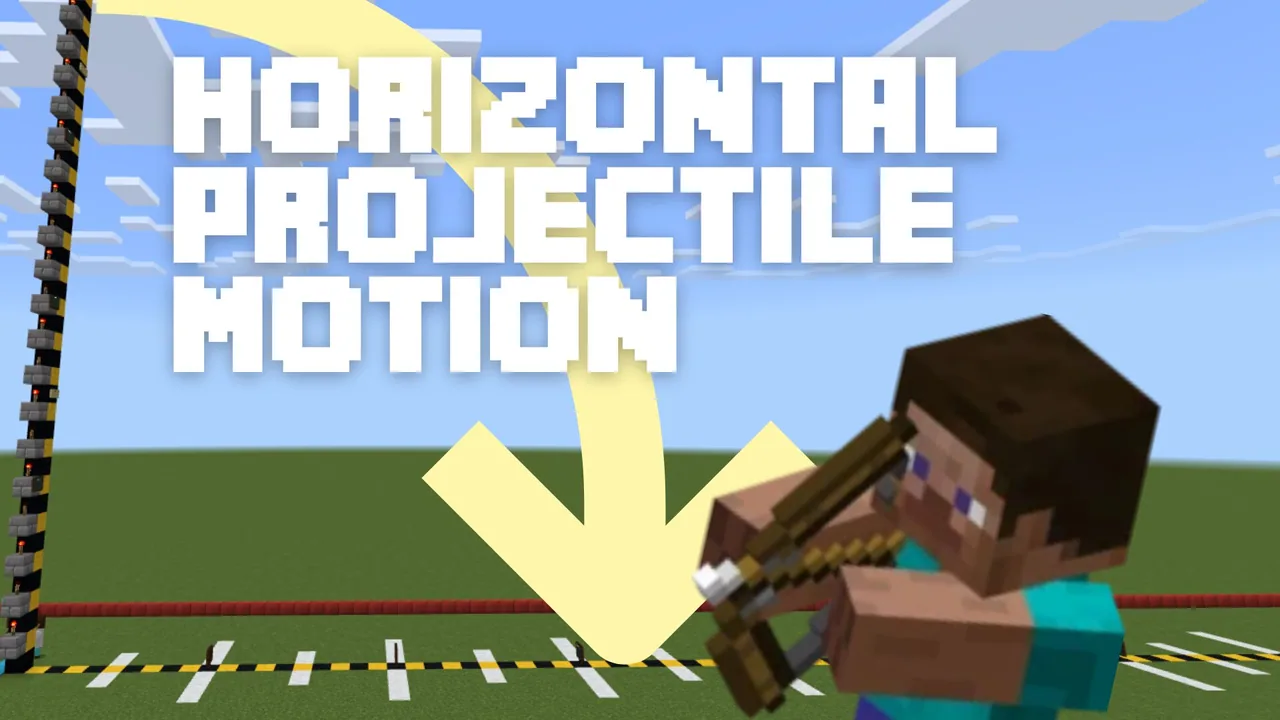
Projectile motion allows students to analyze and predict the flight path of objects by separating motion into horizontal and vertical components. By applying kinematic equations, learners connect abstract algebraic formulas to physical motion, calculating how initial horizontal velocity and gravitational acceleration dictate where an airborne projectile will land.
In this Minecraft Education lab, students observe simulated arrow trajectories using automated dispensers and landing markers. After averaging trial shots to overcome the game code randomizer, students determine arrow velocity and use redstone engineering to position a second launcher at the precise height required to strike a distant target hole.
Learning objectives
By the end of this lesson students will be able to:
- Calculate the initial velocity of an arrow launched horizontally using averaged trial data and kinematic formulas.
- Solve for the required dispenser launch height to hit a target hole placed at a known distance.
- Construct and test a redstone dispenser mechanism at the calculated height within the game world.
- Explain how game engine randomizers simulate real-world environmental inconsistencies in projectile flight.
Blocks and items used in this lesson

Key vocabulary
- Kinematic Equations
- A set of physics formulas relating displacement, initial velocity, final velocity, acceleration, and time.
- Horizontal Projectile Motion
- Motion where an object is launched horizontally and moves along a curved path influenced only by downward gravity.
- Initial Velocity
- The speed and direction of an object at the exact moment its motion begins.
- Range
- The total horizontal distance traveled by a projectile before striking the ground or target.
Before class
Lesson sequence
Suggested timing: about 45 minutes in total.
- Classroom Briefing and NPC Dialogue10 min
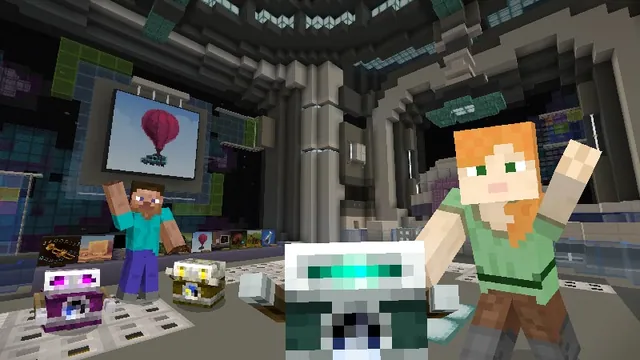
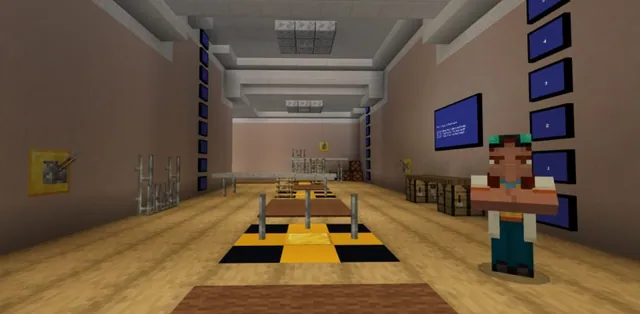
Students spawn inside an educational classroom and interact with non-player characters (NPCs) that introduce the kinematic equations and projectile motion rules. Review that the elapsed time is the identical variable linking horizontal motion and vertical fall, and establish the world parameters (1 block = 1 meter; gravity = -10 m/s^2).
- Station A Trials and Range Averaging15 min
Students travel to Station A, which features an arrow dispenser mounted 50 meters above ground level. After receiving marking torches from the lab technician NPC, students fire at least ten trial shots, place torches at the impact spots, measure each distance, and compute the average horizontal range.
- Calculating Initial Velocity10 min
Using the fall distance (50 meters), acceleration (-10 m/s^2), and their recorded average range, students solve the kinematic equations to isolate time of flight and calculate the initial horizontal velocity of the arrow.
- Station B Target Engineering and Testing10 min
Students proceed to Station B, locate the target hole 50 to 60 meters away, and calculate the height required to land an arrow inside it using their derived velocity. Students obtain redstone supplies from the nearby technician NPC, build the launcher at that calculated height, and fire test shots to verify their prediction.
Assessment: success criteria
- Student records at least ten launch trials and calculates an accurate mean horizontal range.
- Student applies kinematic equations correctly to compute the dispenser arrow initial velocity.
- Student calculates the required height for Station B and constructs a functional dispenser that strikes the target hole.
- Student explains why repeated trials are necessary when measuring projectile systems that incorporate randomization.
Differentiation
Provide a calculation template that outlines each algebraic step for finding fall time before solving for horizontal velocity.
Ask advanced students to calculate launch adjustments needed to hit a moving zombie with known velocity, or design an experiment to predict ranges for handheld bows.
Knowledge check
5 questions to check understanding after the lesson. Tap an answer to see if it is right; the score appears at the end.
1What distance does one in-game block represent in this lab activity?
Answer: B. The teacher prep notes establish that one block is assumed to equal one meter in length.
2What value is used for the acceleration due to gravity in this lesson?
Answer: A. The activity assumes an acceleration due to gravity of a = -g = -10 m/s^2.
3Why are students asked to fire at least ten test shots at Station A?
Answer: C. Minecraft code integrates a randomizer that makes individual arrow landing spots inconsistent, requiring an average of multiple shots.
4When analyzing the horizontal and vertical components of projectile motion, which quantity is identical for both?
Answer: D. Time is the shared scalar variable connecting the horizontal flight and the vertical descent of a projectile.
5At what height is the arrow dispenser installed at Station A?
Answer: A. Station A has an automatic arrow dispenser mounted exactly 50 blocks (meters) above the ground.
Part of the Physical Science curriculum
This is lesson 2 of 6 in Physical Science.
- Coaster-vation of Energy!
- Horizontal Projectile Motion
- Minecraft Micro Models
- Physics Coaster
- Physics Training Academy
- Physics:Roller Coaster World
Frequently Asked Questions
Why does the lab use -10 m/s^2 instead of -9.8 m/s^2 for gravity?
Using -10 m/s^2 simplifies the mental math and manual calculations, allowing students to focus on kinematic concepts and redstone placement rather than decimal arithmetic.
What item do students use to mark the landing spots of arrows?
Students talk to the lab technician NPC at Station A to collect torches, which they place on the ground where each arrow lands to record distances.
Adapted from Horizontal Projectile Motion by Jason Arias on Minecraft Education, last updated Jun 3, 2025. This classroom version, the timings and the quiz were written by 9Minecraft Education.