- Type
- Lesson plan
- Ages
- Ages 14-18
- Duration
- 30 min
- Level
- Beginner
How can network administrators use firewalls and access control systems to defend networks against unauthorized access and denial-of-service attacks?
Overview
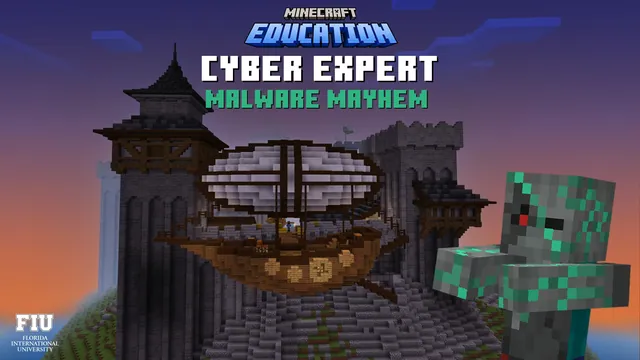
Cyber Expert: Daring Defense introduces upper secondary students to foundational network security principles. Developed in collaboration with Florida International University, this unit teaches learners how modern defenders safeguard digital infrastructure against denial-of-service threats and unauthorized intrusion through access control and filtering policies.Learning objectives
By the end of this lesson students will be able to:
- Define core academic vocabulary associated with network defense.
- Differentiate between Denial of Service (DoS) and Distributed Denial of Service (DDoS) attacks.
- Create a firewall using explicit allow and deny rules.
- Prevent unauthorized users from entering a network by implementing an access control system.
Blocks and items used in this lesson


Key vocabulary
- Firewall
- A security system that monitors and filters incoming and outgoing network traffic according to specific rules.
- DoS Attack
- A Denial of Service attack where an attacker floods a target system from a single source to disrupt its availability.
- DDoS Attack
- A Distributed Denial of Service attack where multiple compromised devices launch a coordinated flood against a target network.
- Access Control System
- A security framework that verifies identities and regulates permissions to protect resources from unauthorized users.
- Allow and Deny Rules
- Firewall configurations that explicitly specify which types of network traffic are permitted through and which are blocked.
Before class
Lesson sequence
Suggested timing: about 30 minutes in total.
- Concept Introduction & Vocabulary5 min
Introduce the scenario of defending a castle and village to frame cybersecurity defense. Review primary terms including firewalls, unauthorized access, and network traffic.
- DoS and DDoS Analysis8 min
Present the mechanics of denial-of-service disruptions. Guide students to examine how a single-source DoS attack differs from a distributed multi-source DDoS attack.
- Firewall Configuration in Minecraft10 min
Have students enter the Minecraft world to configure firewall defenses. Learners establish functional allow and deny rules to block malicious traffic while permitting safe requests.
- Implementing Access Control & Review7 min
Task students with deploying an access control system to bar unauthorized users from network grounds. Conclude by having students document their solutions in their workbooks.
Video
Assessment: success criteria
- Student accurately distinguishes between a DoS attack and a DDoS attack in discussion or writing.
- Student successfully configures working allow and deny firewall rules in the activity.
- Student correctly implements an access control system that blocks unauthorized network users.
- Student defines key unit terms accurately in their workbook.
Differentiation
Provide the Solutions Guide and pre-formulated allow and deny rule examples to assist students who struggle with configuring network rules.
Ask advanced learners to design multi-tiered access control policies capable of mitigating coordinated, high-volume DDoS attack scenarios.
Knowledge check
5 questions to check understanding after the lesson. Tap an answer to see if it is right; the score appears at the end.
1What is the primary operational difference between a DoS attack and a DDoS attack?
Answer: A. DoS attacks launch from a single machine, while DDoS attacks deploy multiple distributed devices simultaneously.
2What is the primary function of an access control system?
Answer: B. Access control systems manage authentication and permissions to ensure only approved users reach network assets.
3How does a firewall manage incoming and outgoing network traffic?
Answer: C. Firewalls evaluate traffic against allow and deny rules to decide which data packets are permitted or blocked.
4Which sequence correctly represents the three units of the Cyber Expert progression?
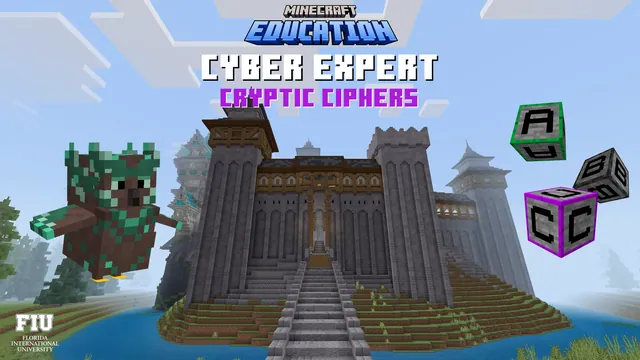
Answer: D. The Cyber Expert curriculum consists of Cryptic Ciphers, Daring Defense, and Malware Mayhem.
5Which educational institution partnered to develop the Cyber Expert curriculum?
Answer: B. The source explicitly states that the Cyber Expert units were developed in partnership with Florida International University.
Resources
- Lesson package (.zip)Everything the author attached to this lesson in one download.
- Educator GuideEducator Guide for all unit lessons and activities
- Presentation SlidesPowerPoint presentation to support instruction of Daring Defense
- Student WorkbookStudent workbook to guide learning, including formative assessments.
- Solutions GuideFind all lesson solutions for student activities
- Lesson worldOpens the world page in Minecraft Education (sign-in with a school account may be needed).
Frequently Asked Questions
What materials are available to help guide classroom instruction?
The unit includes an Educator Guide, Presentation Slides, a Student Workbook, and a Solutions Guide to accompany the downloadable Minecraft world.
Is prior cybersecurity experience necessary for high school students?
No, the unit is rated for beginners and teaches foundational concepts such as firewalls and access controls directly through guided tasks.
Adapted from Cyber Expert: Daring Defense (Unit 2) by Minecraft Education on Minecraft Education, last updated Oct 18, 2023. This classroom version, the timings and the quiz were written by 9Minecraft Education.