- Type
- Lesson plan
- Ages
- Ages 14-18
- Duration
- 30 min
- Level
- Beginner
How can encryption, message integrity, and awareness of social engineering protect systems and data from cyber attacks?
Overview
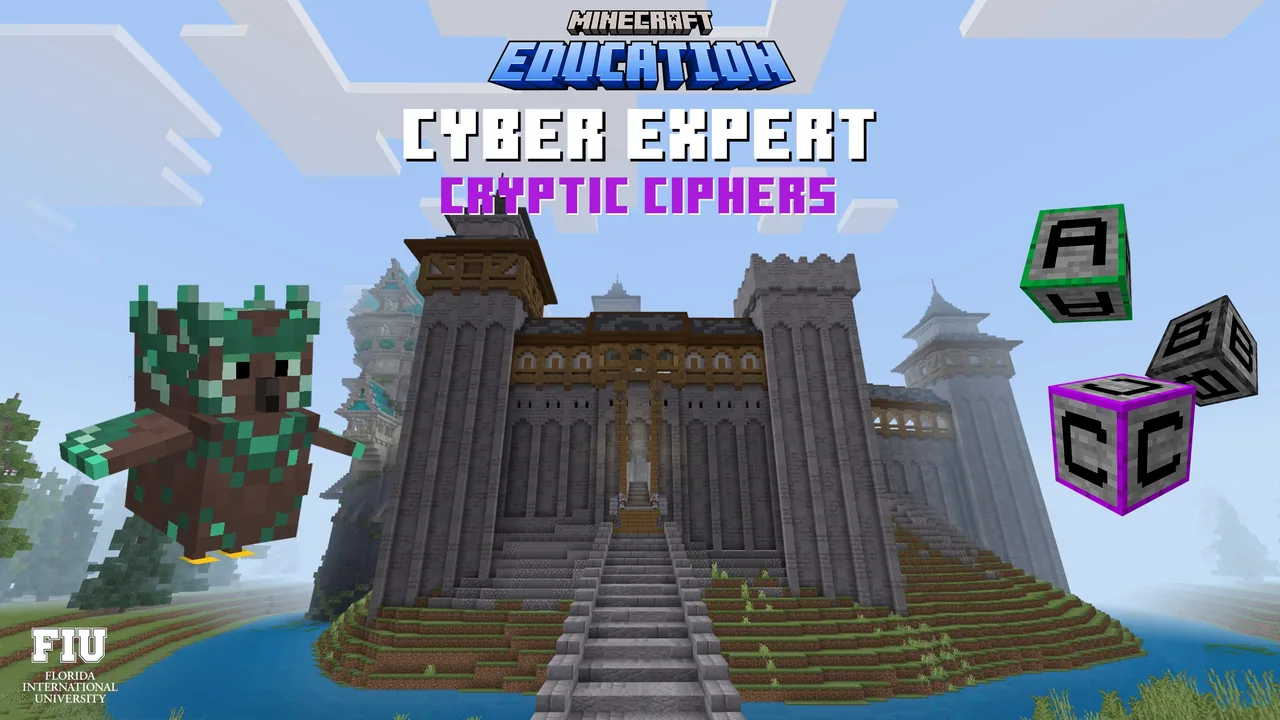
Cyber Expert: Cryptic Ciphers introduces foundational cybersecurity concepts to high school learners. Designed in partnership with Florida International University, this unit focuses on securing information through encryption, maintaining message integrity, and recognizing social engineering tactics.
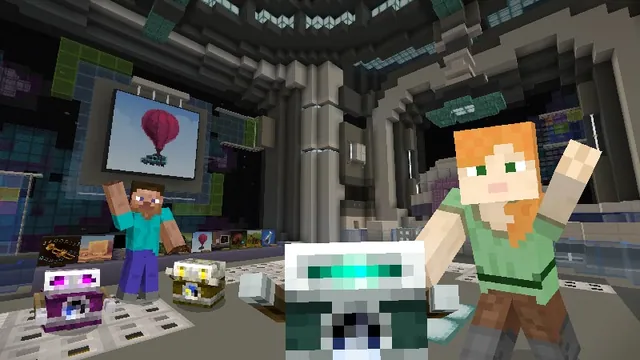
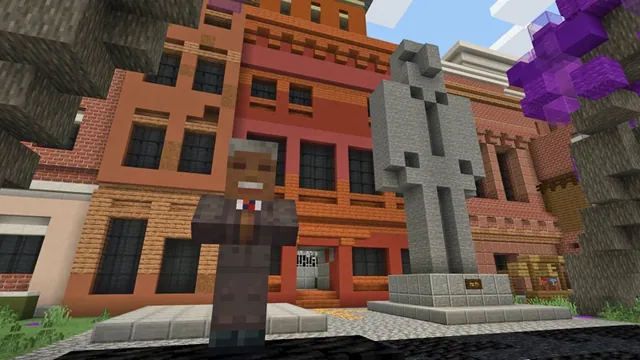
Students enter a Minecraft environment tasked with defending a castle and saving a village. By applying Caesar and Vigenere ciphers and examining how deceptive communication compromises security, learners connect abstract cryptographic principles to active problem-solving scenarios.
Learning objectives
By the end of this lesson students will be able to:
- Differentiate between the processes of encryption and decryption.
- Encrypt and decrypt messages using Caesar and Vigenere ciphers.
- Explain the importance of message integrity in digital communication.
- Describe social engineering tactics and explain methods to avoid falling victim to them.
Blocks and items used in this lesson


Key vocabulary
- Encryption
- The process of encoding data so that only authorized parties can read it.
- Decryption
- The process of converting scrambled or encrypted text back into readable plain text.
- Caesar Cipher
- A substitution cipher where letters are shifted a set number of places down the alphabet.
- Vigenere Cipher
- A method of encrypting text using a series of interwoven shifts determined by a keyword.
- Message Integrity
- Ensuring that data has remained accurate, unaltered, and trustworthy during transmission.
- Social Engineering
- Manipulating people into handing over confidential information or compromising security.
Before class
Lesson sequence
Suggested timing: about 30 minutes in total.
- Introduction to Ciphers and Terminology10 min
Present key cybersecurity terms using the provided slides. Discuss the difference between plain text, encryption, and decryption, and walk through a basic Caesar cipher shift as a group.
- In-World Defense and Cipher Solving12 min
Students load the downloadable Minecraft world to protect the castle and village. Working through the tasks, they decrypt messages with Caesar and Vigenere ciphers and verify message integrity using their student workbooks.
- Social Engineering Analysis and Debrief8 min
Examine scenarios of social engineering presented in the lesson. Guide a brief discussion on how manipulation techniques operate and what specific steps students can take to avoid being deceived.
Video
Assessment: success criteria
- Successfully encrypt and decrypt practice text using both Caesar and Vigenere ciphers.
- Clearly explain the difference between encryption and decryption.
- State what message integrity means and why it matters in secure communication.
- Identify at least two strategies for avoiding social engineering traps.
Differentiation
Provide an alphabet shift chart or reference guide from the workbook to assist with Caesar and Vigenere substitutions.
Have students write their own encrypted dispatch with a custom keyword and challenge a classmate to verify its integrity.
Knowledge check
5 questions to check understanding after the lesson. Tap an answer to see if it is right; the score appears at the end.
1Which two ciphers do students learn to encode and decode in this unit?
Answer: A. The unit explicitly lists Caesar and Vigenere ciphers as the two methods taught.
2What is the core difference between encryption and decryption?
Answer: B. Encryption transforms plain text into secret code, and decryption turns that code back into plain text.
3What does message integrity ensure in cybersecurity?
Answer: B. Integrity refers to keeping data authentic and preventing unauthorized modification.
4Which best describes the tactic of social engineering?
Answer: C. Social engineering targets human psychology to trick individuals rather than attacking system code directly.
5Which unit comes directly after Cryptic Ciphers in the Cyber Expert progression?
Answer: D. The source identifies the sequential unit order as Cryptic Ciphers, Daring Defense, and Malware Mayhem.
Resources
- Lesson package (.zip)Everything the author attached to this lesson in one download.
- Educator GuideCryptic Ciphers Educator Guide
- Presentation SlidesPowerPoint presentation to support instruction of Cryptic Ciphers
- Student WorkbookStudent workbook to guide learning, including formative assessments.
- Solutions GuideFind all lesson solutions for student activities
- Lesson worldOpens the world page in Minecraft Education (sign-in with a school account may be needed).
Frequently Asked Questions
What grade level is this lesson suited for?
This unit is designed for upper secondary students in grades 9 through 12, typically ages 14 to 18, with a beginner experience level.
What curriculum standards does this unit align with?
Developed in partnership with Florida International University, the units are built to support Cyber.org, CSTA, and ISTE cybersecurity and computer science standards.
What supplemental materials come with this lesson?
Teachers have access to an Educator Guide, Presentation Slides, a Student Workbook, and a Solutions Guide to support classroom implementation.
Adapted from Cyber Expert: Cryptic Ciphers (Unit 1) by Minecraft Education on Minecraft Education, last updated Oct 29, 2026. This classroom version, the timings and the quiz were written by 9Minecraft Education.