- Type
- Build challenge
- Subject
- Science
- Topics
- Science
- Duration
- about 60 min (suggested)
How can three-dimensional models help us understand and communicate the structure of things too small to see?
Overview
Scientific modeling allows researchers to visualize, examine, and explain concepts that are otherwise inaccessible. By translating unseen structures into tangible representations, scientists can test ideas, illustrate functional relationships, and communicate complex phenomena to a broader audience.
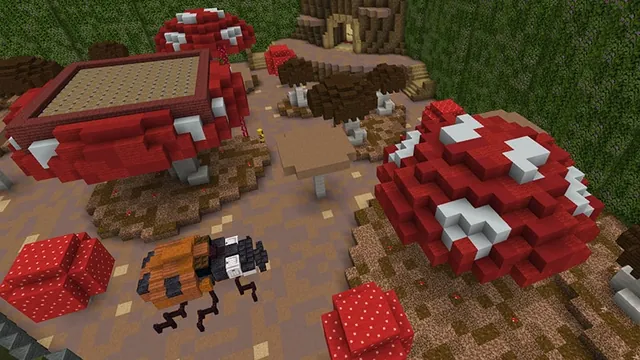
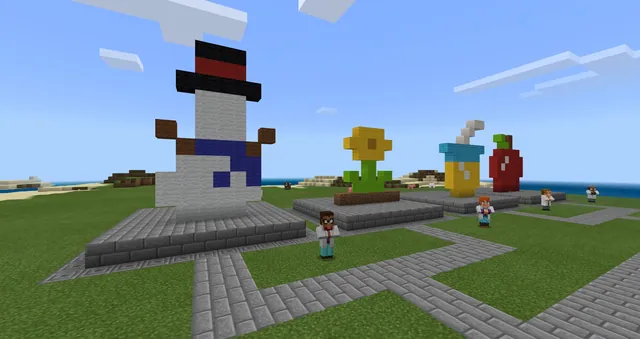
In this activity, students use Minecraft as a three-dimensional design space to reconstruct microscopic entities such as atoms, proteins, viruses, cells, or micro-animals. Building block by block requires learners to translate reference diagrams into spatial representations, emphasizing scale, structure, and scientific communication.
Learning objectives
By the end of this activity students will be able to:
- Research visual reference diagrams of structures or organisms invisible to the naked eye
- Construct an accurate three-dimensional scientific model within Minecraft
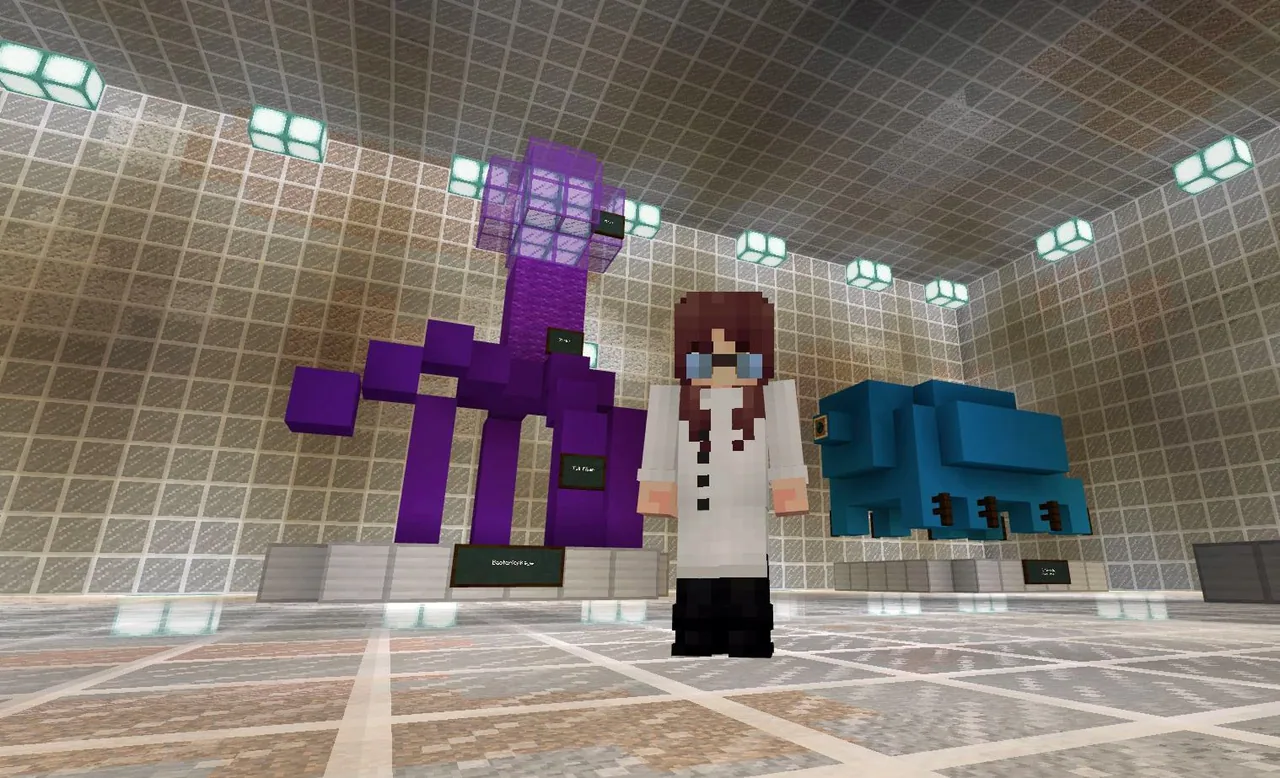
- Explain key structural features of a chosen microscopic subject using model annotations
Blocks and items used in this lesson


Key vocabulary
- Scientific Model
- A physical, digital, or conceptual representation used to explain ideas, processes, or structures.
- Microscopic
- Objects or organisms that are too small to be viewed directly by the human eye without magnification.
- Structure
- The specific arrangement and organization of parts within an organism, molecule, or object.
Before class
Lesson sequence
Suggested timing: about 60 minutes in total.
- Research and Subject Selection15 min
Introduce the role of modeling in scientific research. Students select a microscopic target such as an atom, protein, virus, cell, or micro-animal, then collect reference illustrations detailing its shapes, layers, and components.
- Model Construction30 min
Working in creative mode, students plan their scale and select block types to represent distinct anatomical or molecular parts. Learners translate their two-dimensional research diagrams into accurate three-dimensional builds.
- Documentation and Labeling15 min
Students add in-game text signs or slates to label major components of their model. Using the camera and portfolio tools, learners capture screenshots showing different angles and summarize the function of each labeled feature.
Assessment: success criteria
- The build represents an authentic microscopic subject, such as a cell, virus, protein, atom, or micro-animal.
- The three-dimensional model demonstrates accurate spatial relationships and recognizable structural features.
- The student clearly explains the components and purpose of their model using in-game documentation or presentation tools.
Differentiation
Provide simplified, labeled reference diagrams of plant or animal cells with clear color-coded boundaries for students to recreate.
Have students collaborate to assemble their individual models into a broader system, such as a human body system or the water cycle, or explore the Molcraft world.
Knowledge check
5 questions to check understanding after the lesson. Tap an answer to see if it is right; the score appears at the end.
1What is the primary scientific purpose of building models as described in this challenge?
Answer: B. Scientists use models to represent ideas, processes, and structures and to communicate information.
2Which category of subjects are students required to construct for this build challenge?
Answer: C. The prompt challenges learners to build something too small to be seen by the human eye.
3Which of the following is listed in the lesson as an appropriate subject for this project?
Answer: A. The lesson specifically lists atoms, proteins, viruses, cells, or micro-animals as suitable targets.
4Which in-game tools are recommended to record and document the finished model?
Answer: D. The lesson extensions advise students to use the camera and portfolio to document their work.
5What ready-made world is suggested as an extension for studying chemical compounds and proteins?
Answer: B. The source identifies the Molcraft lesson and world for exploring chemical compounds and proteins.
Resources
Part of the Physical Science curriculum
This is lesson 3 of 6 in Physical Science.
- Coaster-vation of Energy!
- Horizontal Projectile Motion
- Minecraft Micro Models
- Physics Coaster
- Physics Training Academy
- Physics:Roller Coaster World
Frequently Asked Questions
Do students need to follow a strictly realistic color scheme?
Scientific models of microscopic structures often use artificial colors to distinguish separate parts, so encourage students to choose contrasting block palettes that make individual organelles or molecular bonds easy to identify.
Can students work together on a single microscopic model?
Yes, students can collaborate on complex subjects or build complementary components that combine into a larger biological system, as suggested in the extension activities.
Adapted from Minecraft Micro Models by Minecraft Education on Minecraft Education, last updated Oct 21, 2026. This classroom version, the timings and the quiz were written by 9Minecraft Education.