- Type
- Lesson plan
- Ages
- Ages 8-18
- Duration
- 45 min
- Level
- Beginner
How can we identify accurate and up to date information in a world full of artificial intelligence?
Overview
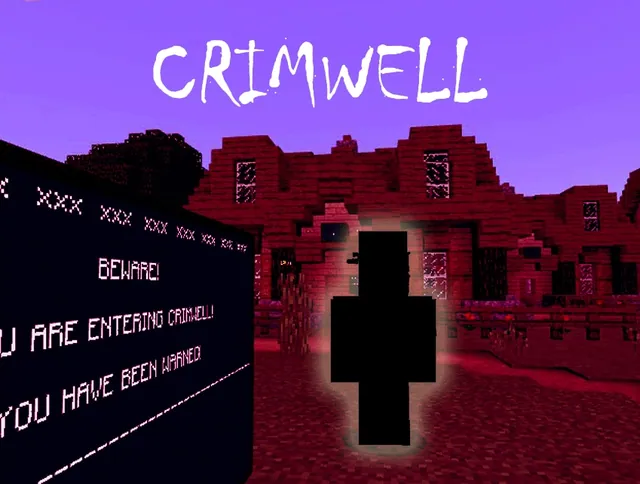
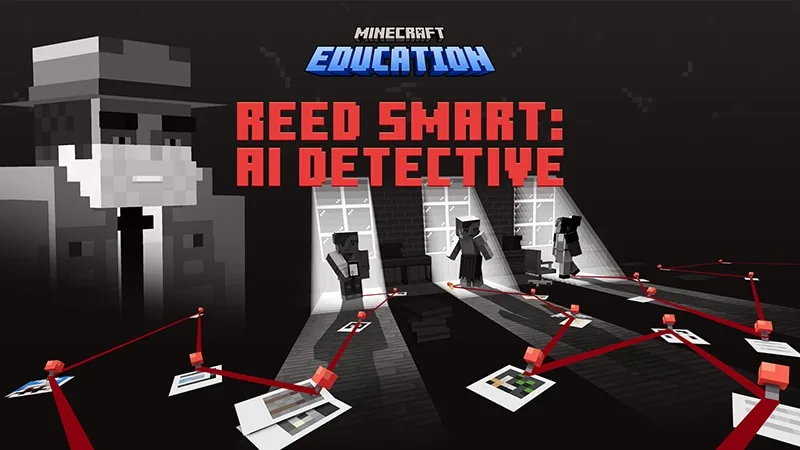
In an era where synthetic media and automated text blur the line between reality and fabrication, students must learn to question what they see online. This lesson frames media literacy through a noir-style mystery where learners partner with Detective Reed Smart to analyze claims, cross-examine evidence, and distinguish authentic content from computer-generated misinformation.
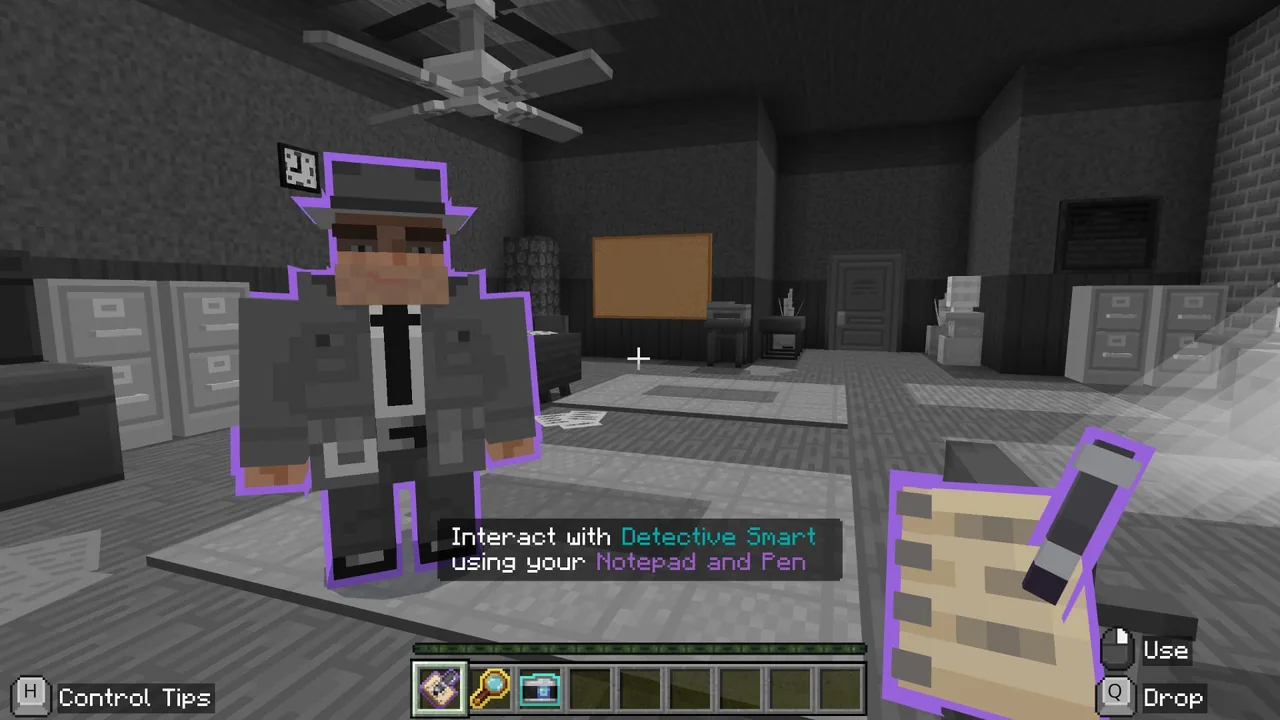
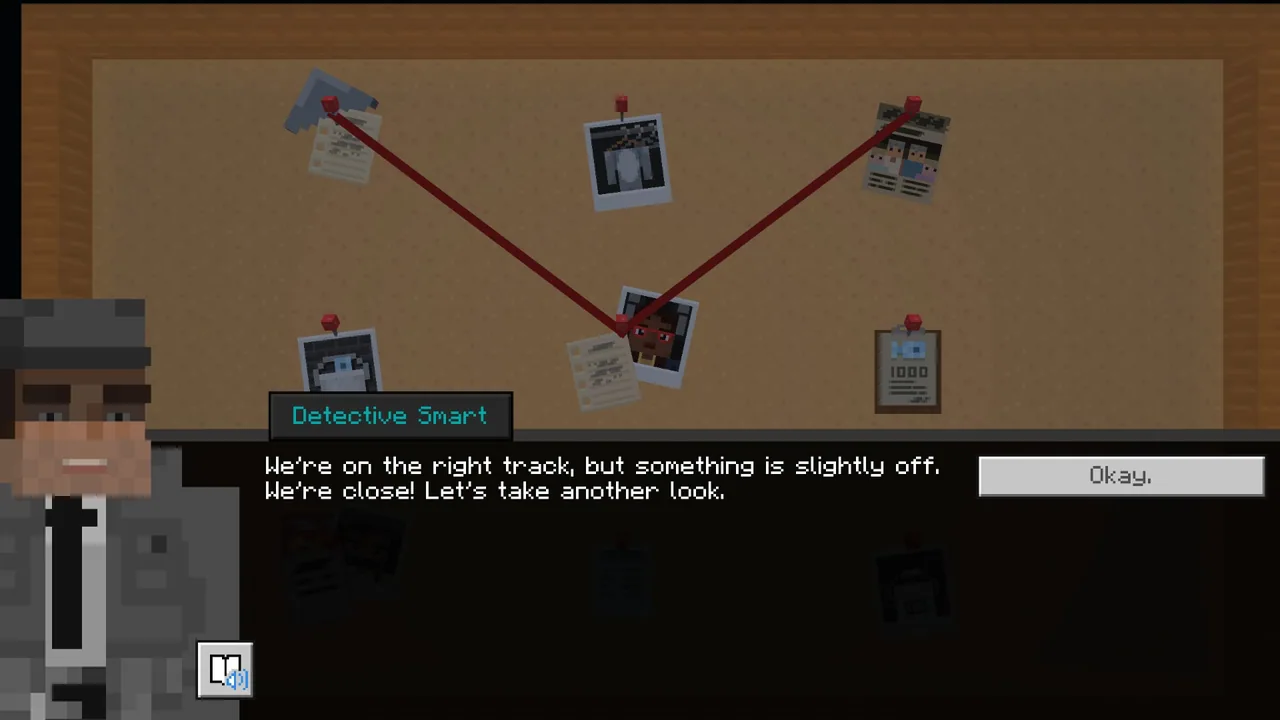
Using a downloadable Minecraft Education world, students explore interactive crime scenes equipped with specialized investigation tools like a magnifying glass, camera, and notebook. Learners interview witnesses, document suspicious clues, and map out connections on case boards, developing essential critical thinking habits such as lateral reading and source verification.
Learning objectives
By the end of this lesson students will be able to:
- Identify at least three distinct signs that digital media has been manipulated or generated by artificial intelligence.
- Practice lateral reading strategies by checking multiple independent sources before verifying information.
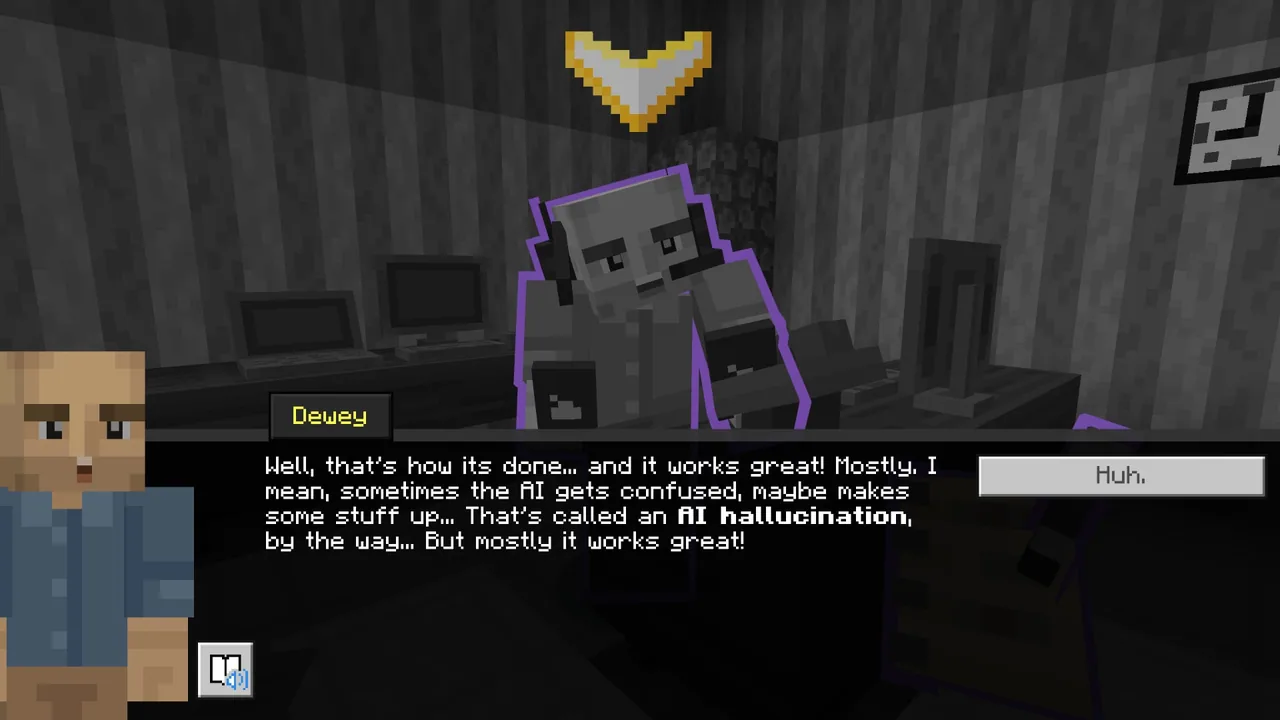
- Explain the differences between deepfakes, AI hallucinations, and genuine human-created content.
- Formulate evidence-based conclusions on a case board using clues gathered from interviews and environmental searches.
Key vocabulary
- Deepfake
- Synthetic digital media, such as video or audio, manipulated by artificial intelligence to replace a person's likeness or voice.
- AI Hallucination
- A confident response generated by an AI tool that presents incorrect, fabricated, or nonsensical information as fact.
- Lateral Reading
- The habit of evaluating the credibility of a source by opening separate browser tabs to research what outside sources say about it.
- Case Board
- A visual display used by investigators to pin evidence, photographs, and notes to find patterns and draw conclusions.
Before class
Lesson sequence
Suggested timing: about 75 minutes in total.
- Case Briefing and Concept Introduction15 min
Open the lesson using the presentation slides to introduce Detective Reed Smart and central concepts like deepfakes and AI hallucinations. Have students begin their workbook KWL chart by answering what they already know about AI and predicting whether AI can produce false information.
- In-Game Detective Investigation30 min
Students log into the world individually or in pairs to tackle one or more of the three cases (The Deepest Fake, An Ode to Deception, or Dine & Deceive). Learners use their hotbar tools: interviewing non-player characters with the Notepad & Pen, discovering hidden evidence using the Magnifying Glass, and recording visual clues with the Camera.
- Case Board Assembly and Evidence Reflection15 min
Learners transfer their findings to the in-game case board using the Hand/Inspect tool, organizing clues into relevant versus irrelevant information and connecting strings between facts. Students pause at designated reflection checkpoints in their workbooks to explain which clues matter most and how the evidence refutes or supports suspect claims.
- Debrief and Verification Strategies15 min
Reconvene the class to discuss solutions and address the essential question. Students compare how AI was misused across cases, discuss the limits of automated AI detection, and outline personal lateral reading rules for evaluating suspicious online media in daily life.
Video
Inside the lesson world
Assessment: success criteria
- Student accurately completes and solves at least one of the three in-game mystery cases.
- Student distinguishes relevant evidence from irrelevant distractors on the case board.
- Workbook reflections define key differences between deepfakes, AI hallucinations, and authentic material.
- Student demonstrates lateral reading principles by referencing multiple verification sources in class discussion.
Differentiation
Allow students to work in pairs and use the educator guide's case walkthrough prompts to navigate complex evidence boards.
Challenge students to evaluate the limitations of automated AI detectors in Case 2 and propose human-centered evaluation rules for creative schoolwork.
Knowledge check
5 questions to check understanding after the lesson. Tap an answer to see if it is right; the score appears at the end.
1What is the primary function of lateral reading when examining online content?
Answer: B. Lateral reading involves looking outside the original source across multiple tabs or references to confirm whether the information is trustworthy.
2Which in-game hotbar tool is specifically designed to uncover hidden clues in the environment?
Answer: B. The magnifying glass tool highlights hidden environmental clues and evidence when equipped by the player.
3In Case 2 ('An Ode to Deception'), why was the student poet disqualified from the contest?
Answer: C. Case 2 focuses on a poet who was falsely accused of utilizing AI, highlighting the limitations and biases of AI detection software.
4What term describes an instance where an artificial intelligence tool produces false or fabricated details as fact?
Answer: D. An AI hallucination occurs when an AI system generates incorrect information and presents it as true.
5What visual shift in the game serves as a metaphor for developing nuanced, balanced thinking about AI?
Answer: A. The visual shift from black-and-white to color mirrors the progression from simple binary views to nuanced cognitive evaluation of AI.
Resources
- Lesson package (.zip)Everything the author attached to this lesson in one download.
- Educator GuideProvides detailed instructions for implementing the lesson, including step-by-step walkthroughs of all three cases and curriculum connections.
- Presentation SlidesStudent-facing slides to guide and facilitate the experience, providing visual support for introducing key concepts, vocabulary, and discussion.
- Student WorkbookThis student workbook serves as a companion guide, creating an integrated learning and assessment system for teaching AI literacy.
- AI Foundations Curriculum OverviewAI Foundations is Minecraft Education’s comprehensive curriculum designed to build AI literacy through 17 immersive, standards-aligned lessons.
- Lesson worldOpens the world page in Minecraft Education (sign-in with a school account may be needed).
Part of the AI Foundations curriculum
This is lesson 18 of 18 in AI Foundations.
- AI-1: Who Is That Ocelot?
- AI-2: Mapping Terrain
- AI-3: Sustainable Farming
- AI-4: Ocean Observations
- AI-5: Water Quality
- Unit 9: AI
- AI Adventurers
- AI Wildlife Park
- CyberSafe AI: Dig Deeper
- Fantastic Fairgrounds
- Hour of AI: Field Agent
- Hour of AI: Generation AI
- Hour of AI: The First Night
- Hour of Code: AI for Good
- Hour of Code: Generation AI
- Mini Agent Mission
- Peter Is Here: AI for Cultural Heritage
- Reed Smart: AI Detective
Frequently Asked Questions
Do students need to finish all three mystery cases in a single class period?
No. Each case is structured to function as a standalone class period or as part of a multi-day unit, allowing teachers to spread the three investigations across several days.
What materials are provided with this lesson resource?
The package includes a downloadable Minecraft Education world, an educator guide with case walkthroughs, presentation slides for class discussions, and a student workbook featuring a KWL chart and reflection prompts.
What are the four tools students use in their hotbar during the mystery?
Players rely on the Notepad & Pen for witness interviews, the Magnifying Glass for spotting hidden clues, the Camera for documenting evidence, and the Hand/Inspect tool for arranging clues on the case board.
Adapted from Reed Smart: AI Detective by Minecraft Education on Minecraft Education, last updated Jul 6, 2026. This classroom version, the timings and the quiz were written by 9Minecraft Education.