How did walking speed shape the journey along the Oregon Trail, and how does that pace compare to modern travel?
Overview
During the westward migration, emigrants faced the grueling challenge of traveling over a thousand miles across North America. While wagons carried their food, tools, and household belongings, most pioneers walked alongside their teams for entire days, averaging roughly fifteen miles from morning until evening.
In this lesson, students explore the physical realities of this historic route through practical rate and distance calculations. By analyzing daily schedules, total mileage from Missouri to Oregon, and modern vehicle speeds, learners develop a concrete appreciation of how time and speed defined pioneer life.
Learning objectives
By the end of this lesson students will be able to:
- Calculate the pioneer walking rate based on daily active travel hours.
- Determine the total days needed to travel eighteen hundred miles without delays.
- Compare the time required to complete the trail using modern transportation speeds.
- Justify mathematical calculations using clear reasoning and work.
Blocks and items used in this lesson


Key vocabulary
- Emigrant
- A person who moves from one region to settle permanently in another.
- Rate of speed
- The measurement of how fast an object or person moves over a specific distance during a set period.
- Oregon Trail
- A historic overland route of roughly 1,800 miles traveled by pioneers between Missouri and Oregon.
Before class
Lesson sequence
Suggested timing: about 65 minutes in total.
- Warm-up and Personal Reflection10 min
Ask students about the farthest distance they have ever walked, such as to a park or a friend's house. Introduce the reality of the Oregon Trail, explaining that emigrants walked beside loaded supply wagons across thousands of miles.
- Calculating Pioneer Walking Rate15 min
Present the pioneer daily schedule: walking begins at 7 a.m., includes a one-hour lunch break, and ends at 5 p.m., covering fifteen miles total. Have students calculate the active walking hours and the resulting hourly rate of speed, showing their steps.
- Total Journey Duration15 min
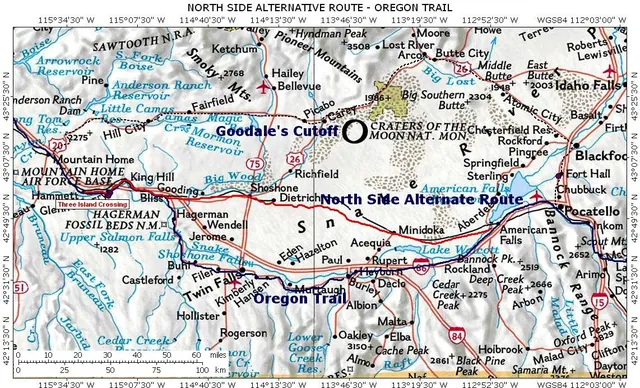
Provide the total distance from Independence, Missouri to the Willamette Valley in Oregon (just over 1,800 miles). Have students divide this distance by fifteen miles per day to determine the minimum number of travel days needed without any delays.
- Modern Speed Comparisons15 min
Challenge students to calculate how many hours the 1,800-mile journey would take using modern methods:
- A bicycle traveling at 12 miles per hour
- A car traveling at 40 miles per hour
- A car traveling at 70 miles per hour
- An airplane flying at 600 miles per hour
- Discussion and Justification10 min
Have students share their answers and explain the reasoning behind their calculations. Discuss how these dramatic differences in travel time alter our perception of distance and geography.
Assessment: success criteria
- Correctly calculates the daily walking hours and hourly rate of speed from the given schedule.
- Accurately solves the total number of days needed to complete the 1,800-mile trail.
- Computes travel times for bicycles, cars, and airplanes across the same total distance.
- Shows clear mathematical reasoning and written justification for every solution.
Differentiation
Provide a structured calculation table with pre-written formulas for rate, distance, and time.
Have students calculate how many hours would be spent traveling per day if a bicycle or car followed the pioneers' nine-hour daily schedule.
Knowledge check
5 questions to check understanding after the lesson. Tap an answer to see if it is right; the score appears at the end.
1Why did most emigrants on the Oregon Trail walk instead of riding in wagons?
Answer: B. The source notes that wagons were used for transporting supplies, so travelers typically walked beside them.
2How many hours of walking did travelers complete each day between 7 a.m. and 5 p.m. with a one-hour lunch break?
Answer: A. From 7 a.m. to 5 p.m. is ten hours total, and subtracting the one-hour lunch break leaves nine hours of walking.
3On average, how many miles did Oregon Trail travelers cover in a single day?
Answer: C. The source states that emigrants averaged 15 miles of travel each day.
4At a steady pace of 15 miles per day without delays, how many days would it take to travel 1,800 miles?
Answer: D. Dividing 1,800 total miles by 15 miles per day results in 120 days.
5What speed does the lesson use to model traveling the route by airplane?
Answer: A. The activity specifies an airplane traveling at an average speed of 600 miles per hour.
Part of the The Oregon Trail curriculum
This is lesson 6 of 14 in The Oregon Trail.
- An Artist’s Perspective
- Barlow Road
- Build a Fort
- Cross, Float, or Hire
- Everlasting Bubbles
- How fast can you go?
- Make Your Mark
- Map the Journey
- Public Service Announcement
- Run, pony, Run!
- Supply and Demand
- Take it or leave it?
- Travel Guide
- Which Month Will You Leave?
Frequently Asked Questions
Does this lesson require a specific Minecraft Education downloadable world?
No downloadable world file is required for this lesson. Teachers can use the prompt as a classroom math and geography investigation or integrate it into existing historical frontier builds.
What grade levels are best suited for this lesson?
While listed for all ages, the calculations involve multi-step word problems, division, and rates of speed, making it ideal for upper elementary and middle school students.
Adapted from How fast can you go? by Minecraft Education on Minecraft Education, last updated Aug 27, 2025. This classroom version, the timings and the quiz were written by 9Minecraft Education.