- Type
- Lesson plan
- Subject
- Science
- Topics
- Science
- Grade
- Early years (Pre-K to Grade 2)Primary (Grades 3-5)Middle school (Grades 6-8)High school (Grades 9-12)
- Ages
- All ages
- Duration
- about 70 min (suggested)
- Skills
- Critical thinking
How can testing buoyancy help us choose the safest way to cross a river?
Overview
Students investigate the physical principles of buoyancy and learn what causes objects to float or sink in water. By conducting hands-on water experiments, learners observe how material shape and added weight affect flotation, connecting fundamental science concepts to real-world transportation challenges.Learning objectives
By the end of this lesson students will be able to:
- Investigate the physical properties that enable objects to float or sink in water.
- Construct and test miniature flotation devices using aluminum foil and paperclips.
- Evaluate experimental data and prior weight estimates to choose a river crossing strategy.
- Determine which supplies should be kept or discarded to maintain wagon safety.
Blocks and items used in this lesson


Key vocabulary
- Buoyancy
- The upward force that water exerts on an object, allowing it to float.
- Caulk
- To seal seams and joints so that water cannot leak inside, turning a wagon into a raft.
- Ford
- To cross a body of water by driving animals and wagons directly through shallow depths.
- Ferry
- A hired boat or service used to carry passengers and cargo across deep water.
Before class
Lesson sequence
Suggested timing: about 70 minutes in total.
- Introduce the River Dilemma10 min
Present the river crossing challenge: travelers must decide whether to ford with oxen, caulk their wagon into a floating raft, or pay for a ferry. Introduce buoyancy and ask students how they might test if a wagon will float.
- Hands-on Buoyancy Testing20 min
Provide aluminum foil, paperclips, and water basins. Have students shape foil hulls and incrementally add paperclips to observe how much cargo weight their designs can support before sinking.
- Data Analysis and Strategy15 min
Guide students to compare their foil test results with their earlier wagon weight estimates. Ask them to determine whether caulking is a realistic option, or if the load requires fording or hiring a ferry.
- In-Game River Crossing15 min
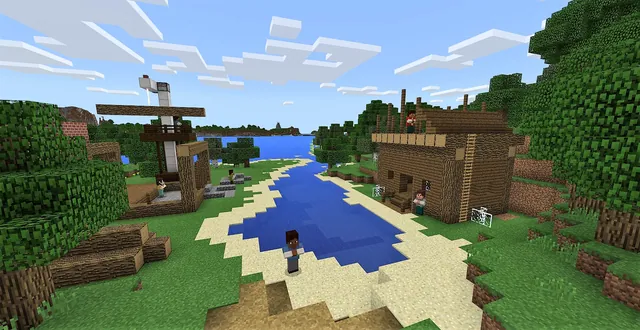
Students log into Minecraft, navigate to the riverbank, and carry out their crossing strategy. Students decide which inventory items to keep or unload based on their weight and buoyancy findings.
- Reflection and Discussion10 min
Conclude with a class debrief focusing on why certain designs floated, which materials sank, and how scientific testing informed their choices along the trail.
Assessment: success criteria
- Student can describe the physical properties that allow an object to float.
- Student accurately identifies which experimental setups floated and which sank.
- Student justifies their river crossing choice using buoyancy test observations and wagon weight data.
- Student explains which cargo items should be kept or removed to ensure safe passage.
Differentiation
Provide pre-shaped foil boat templates and assist with counting paperclips to simplify the data collection process.
Challenge students to redesign their foil hulls to maximize paperclip capacity and calculate the maximum weight allowance for their caulked wagon.
Knowledge check
5 questions to check understanding after the lesson. Tap an answer to see if it is right; the score appears at the end.
1What scientific force allows an object to float on the surface of water?
Answer: B. Buoyancy is the upward force exerted by a fluid that allows objects to float.
2Which materials are used to run the physical flotation test in this lesson?
Answer: C. The activity uses aluminum foil, paperclips, and a sink or bucket of water to test buoyancy.
3What does caulking a wagon mean in the context of crossing a river?
Answer: A. Caulking seals the cracks of the wagon box so it stays watertight and acts as a raft.
4How do students decide whether caulking their wagon is a viable choice?
Answer: D. Students compare their hands-on test data with their previous weight calculations to see if the wagon can safely float.
5Which option is NOT one of the three river crossing methods evaluated in the lesson?
Answer: C. The lesson specifically focuses on three methods: fording, caulking, or hiring a ferry.
Part of the The Oregon Trail curriculum
This is lesson 4 of 14 in The Oregon Trail.
- An Artist’s Perspective
- Barlow Road
- Build a Fort
- Cross, Float, or Hire
- Everlasting Bubbles
- How fast can you go?
- Make Your Mark
- Map the Journey
- Public Service Announcement
- Run, pony, Run!
- Supply and Demand
- Take it or leave it?
- Travel Guide
- Which Month Will You Leave?
Frequently Asked Questions
Do I need a downloadable Minecraft world file for this lesson?
No special world download is required. Any standard world featuring a river between two land areas is suitable for students to practice their crossing decisions.
What previous information do students need before starting this activity?
Students should have an estimated weight for their wagon and its cargo calculated from an earlier activity so they can evaluate whether caulking is practical.
Adapted from Cross, Float, or Hire by Minecraft Education on Minecraft Education, last updated Aug 27, 2025. This classroom version, the timings and the quiz were written by 9Minecraft Education.