- Type
- Lesson plan
- Subject
- History & Social Studies
- Topics
- History
- Grade
- Early years (Pre-K to Grade 2)Primary (Grades 3-5)Middle school (Grades 6-8)High school (Grades 9-12)
- Ages
- All ages
- Duration
- 30 min
- Level
- Beginner
- Skills
- Creativity
How can role-play and dialogue with historical characters help us understand Ancient Roman society and governance?
Overview
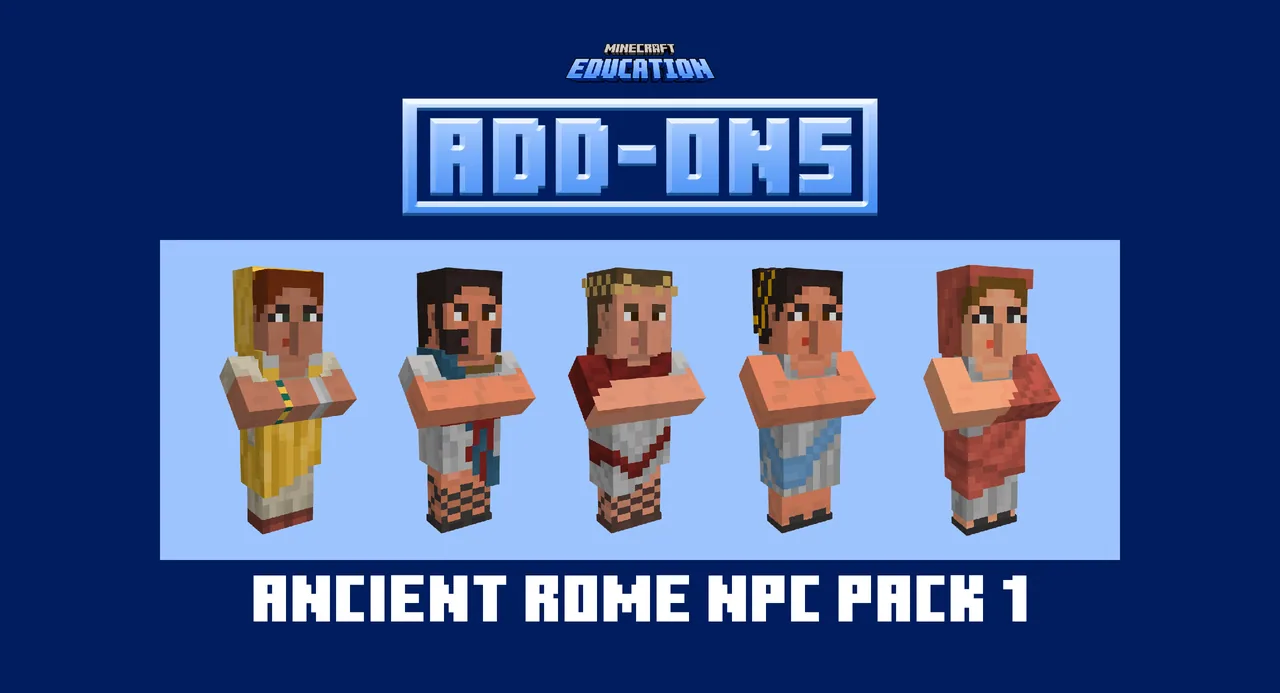
This history lesson introduces learners to Ancient Rome through storytelling and creative role-play. Using custom non-player character styles, students explore how historical figures communicate ideas about governance, daily routines, and Roman engineering.
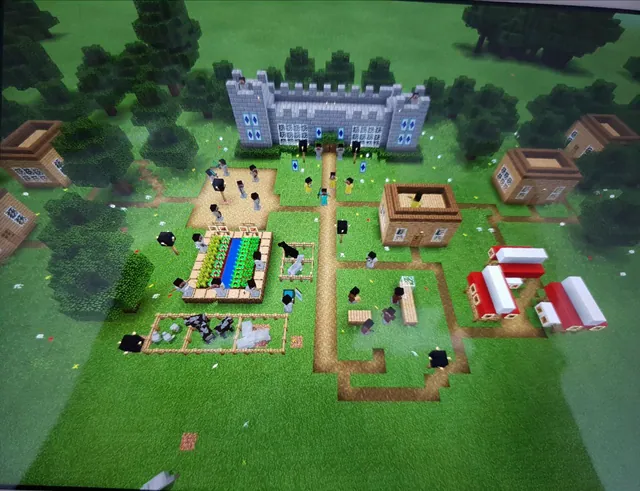
Students work in Minecraft Education using the Roman NPC Pack Add-On to stage historical scenes. By assigning dialogue and perspectives to era-appropriate characters, learners bring historical scenarios and debates to life directly inside their virtual spaces.
Learning objectives
By the end of this lesson students will be able to:
- Configure non-player characters with Ancient Roman appearances and custom dialogue.
- Stage a Senate debate that presents multiple viewpoints supported by historical evidence.
- Investigate Roman daily life, government, or engineering by conducting character interviews.
Blocks and items used in this lesson

Key vocabulary
- NPC
- Non-player character; a computer-controlled figure in Minecraft used to share information and dialogue.
- Add-On
- A package that changes or adds new appearances and behaviors in Minecraft.
- Senate
- The governing council in Ancient Rome where officials debated public matters and gave speeches.
Before class
Lesson sequence
Suggested timing: about 30 minutes in total.
- Introduction and Setup5 min
Introduce the lesson topic and demonstrate how to spawn NPCs using the Ancient Roman styles provided by the add-on. Explain that students will use these figures to represent historical voices.
- Research and Dialogue Drafting10 min
Direct students to choose an activity focus: staging a scenario, preparing a Senate debate, or conducting an interview. Students gather facts regarding Roman daily life, government, or engineering to write into their character scripts.
- Staging and Role-Play10 min
Students place their Roman NPCs into their Minecraft worlds, entering custom speeches and dialogue lines. For debate tasks, students program different NPCs to express opposing viewpoints backed by evidence.
- Class Sharing and Review5 min
Learners tour each other's setups, interact with the configured Roman characters, and read through the dialogues to compare different aspects of Roman society.
Assessment: success criteria
- NPCs are placed and customized with era-appropriate Roman visual styles.
- Character dialogue accurately represents historical topics such as daily life, engineering, or government.
- Senate debate speeches include evidence representing more than one historical viewpoint.
Differentiation
Provide pre-written dialogue prompts or fact sheets about Roman engineering and government for students to insert into their NPCs.
Have students build a multi-character Senate scenario with complex, opposing speeches that require evidence-based counterarguments.
Knowledge check
5 questions to check understanding after the lesson. Tap an answer to see if it is right; the score appears at the end.
1What does the Roman NPC Pack Add-On add to Minecraft Education?
Answer: B. The add-on specifically provides Ancient Roman styles for non-player characters to support role-play.
2Which activity idea from the lesson focuses on presenting multiple viewpoints using evidence?
Answer: A. The source outlines conducting a Senate debate where students gather evidence and give speeches showing multiple viewpoints.
3Which three topics can students explore by interviewing Roman NPCs?
Answer: B. The lesson lists daily life, government, and engineering as the interview focus topics.
4Which primary skill is highlighted in the lesson information?
Answer: C. The source document identifies Creativity as the key skill developed in this activity.
5Does this resource come with a downloadable pre-built Minecraft world?
Answer: C. The source explicitly states 'Has a downloadable world: no'.
Resources
- Lesson package (.zip)Everything the author attached to this lesson in one download.
- Teachers GuideTeacher's guide to help you get started using Add-Ons in the classroom.
- Ancient Rome NPC PackUnzip and open the mcaddon in Minecraft Education to add the Ancient Rome NPC Pack.
Part of the Add-ons in the Classroom curriculum
This is lesson 10 of 12 in Add-ons in the Classroom.
- Dice Add‑on (Tool Pack) Add-On
- Egyptian NPC Pack (NPC Pack) Add-On
- Greek NPC Pack (NPC Pack) Add-On
- Greek Skin Pack (Skin Pack) Add-On
- Math Chests Division (Tool Pack) Add-On
- Math Chests Multiplication (Tool Pack) Add-On
- Non-transitive Dice (Tool Pack) Add-On
- Number Blocks (Block Pack) Add-On
- Number Shape Blocks (Block Pack) Add-On
- Roman (NPC Pack) Add-On
- Roman Architecture (Structure Pack) Add-On
- Roman Skin Pack (Skin Pack) Add-On
Frequently Asked Questions
Do I need an existing Minecraft world to use this pack?
Yes. The add-on does not include a downloadable world, so you can apply the NPC pack to any new or existing world you choose to use in class.
What materials are available to help me prepare this lesson?
Educators can download the Teachers Guide and watch the how-to video referenced in the resource before introducing the pack to students.
What grade levels can participate in this activity?
The resource is designed for all ages at a beginner experience level, making it flexible for any class studying Ancient Rome.
Adapted from Roman (NPC Pack) Add-On by Minecraft Education on Minecraft Education, last updated Apr 9, 2026. This classroom version, the timings and the quiz were written by 9Minecraft Education.