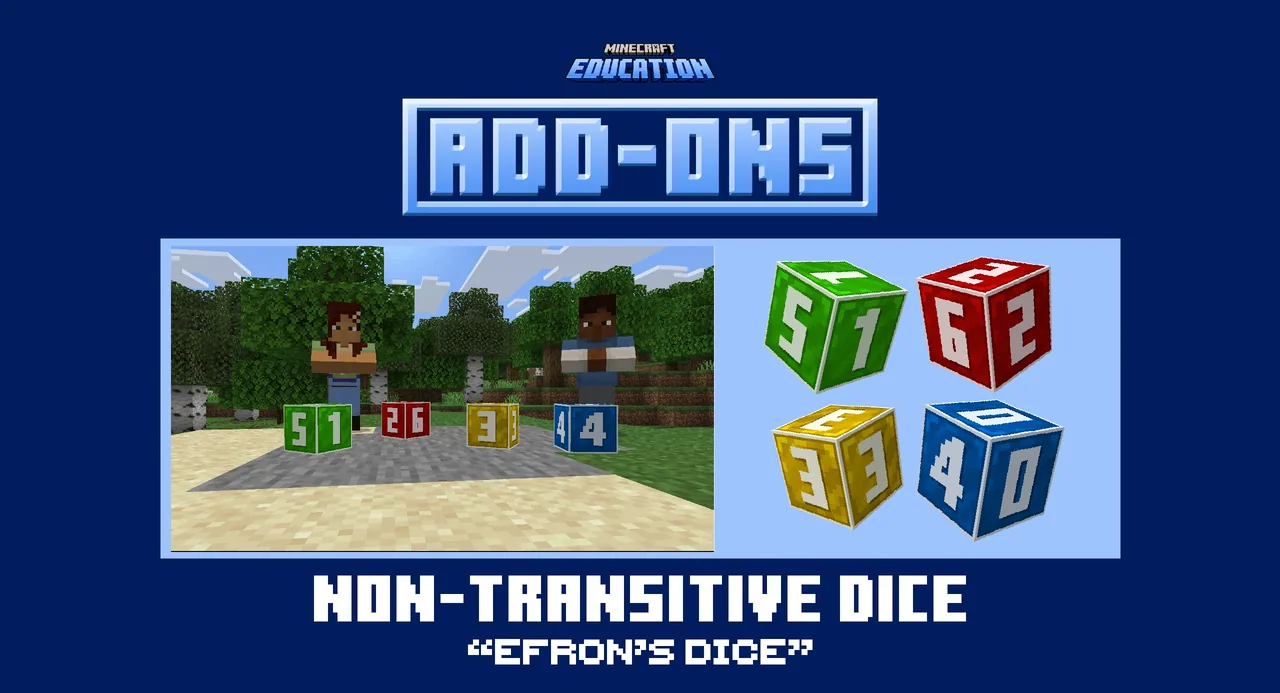
- Type
- Lesson plan
- Subject
- Math
- Topics
- Math & Economics
- Grade
- Early years (Pre-K to Grade 2)Primary (Grades 3-5)Middle school (Grades 6-8)High school (Grades 9-12)
- Ages
- All ages
- Duration
- 30 min
- Level
- Beginner
- Skills
- Creativity
How can a game be designed so that every choice has an advantage over another, but no single choice is unbeatable?
Overview
Non-transitive dice challenge standard assumptions about probability and fairness in competitive games. In conventional transitive relationships, if option A defeats option B, and option B defeats option C, then option A is expected to defeat option C. Non-transitive dice break this pattern by creating a cyclical relationship where each colored die has a statistical advantage over another, ensuring that no single die is universally best.
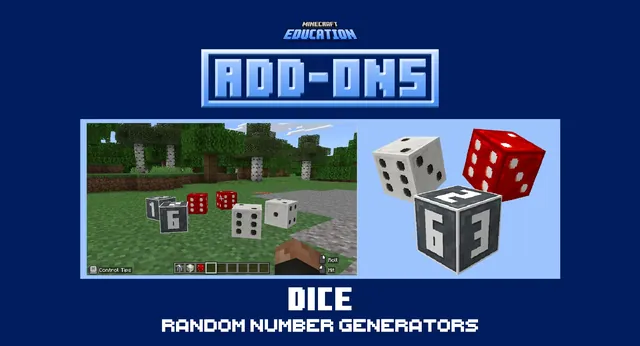
By importing the Non-transitive Dice tool pack into Minecraft Education, students explore this statistical paradox through hands-on simulation. Learners test paired dice matchups, run repeated trials, record outcome data, and evaluate how cyclical probability influences strategy and economic game theory.
Learning objectives
By the end of this lesson students will be able to:
- Test paired matchups between colored non-transitive dice through repeated trials.
- Record and organize outcome data to identify winning percentages and patterns.
- Design a structured experiment plan that specifies variables, trial counts, and recording methods.
- Explain how non-transitive probability affects fairness, competitive advantage, and player strategy.
Blocks and items used in this lesson


Key vocabulary
- Non-transitive dice
- A set of dice where no single die is consistently best, because each die beats another in a circular chain.
- Probability
- The mathematical chance or likelihood of a specific outcome happening.
- Trial
- A single test or roll comparison between dice within an experiment.
- Fairness
- A state in game design where rules and probabilities provide balanced opportunities or balanced counters.
Before class
Lesson sequence
Suggested timing: about 30 minutes in total.
- Introduction5 min
Introduce cyclical advantage using the analogy of rock-paper-scissors, where each option defeats one choice but loses to another. Explain that the add-on provides colored dice that mirror this non-transitive behavior through specific statistical face values.
- Experiment Design5 min
Have student pairs create a brief experiment plan. Students must identify the pairs to test (such as A vs B, B vs C, C vs D, and D vs A), decide on a target number of trials, and agree on a data recording method.
- Simulation and Data Collection15 min
Students use the tool pack in Minecraft to execute their trials. Working together, learners roll paired dice repeatedly, tallying wins and losses on their recording sheets to uncover which die holds the statistical advantage in each matchup.
- Class Analysis and Reflection5 min
Gather the class to compare results across groups. Guide a discussion on fairness, strategy, and why picking second in this dice game gives a player a clear mathematical advantage.
Assessment: success criteria
- Student creates an experiment plan identifying test pairs, trial numbers, and recording methods.
- Student accurately tallies and summarizes win-loss outcomes from repeated dice rolls.
- Student clearly explains the circular relationship where A beats B, B beats C, C beats D, and D beats A.
Differentiation
Provide a pre-printed data table with labeled matchups so students can concentrate solely on rolling and tallying.
Ask students to analyze how picking first versus picking second impacts game strategy and player advantage.
Knowledge check
5 questions to check understanding after the lesson. Tap an answer to see if it is right; the score appears at the end.
1What defines the relationship between the dice in Efron's dice game?
Answer: B. Efron's dice form a cyclical non-transitive loop where each die has a specific advantage over another.
2Why do students run repeated trials when testing the dice?
Answer: B. Conducting multiple trials provides enough data to confirm mathematical advantages rather than single random outcomes.
3If a game uses non-transitive dice, which player holds the strategic advantage?
Answer: A. Because every die is beaten by another in a circular chain, the second player can always choose the die that counters the first player's choice.
4What should students establish when designing their experiment plan?
Answer: A. A scientific test plan requires defining variables, setting the number of trials, and preparing a tracking method.
5Which curriculum areas does this tool pack primarily connect?
Answer: C. The source identifies Math & Economics as the primary subjects for this probability and decision-making lesson.
Resources
- Lesson package (.zip)Everything the author attached to this lesson in one download.
- Teachers GuideTeacher's guide to help you get started using Add-Ons in the classroom.
- Non-transitive Dice (Tool Pack) Add-OnUnzip and open the mcaddon in Minecraft Education to add the Non-transitive Dice (Tool Pack) Add-On
Part of the Add-ons in the Classroom curriculum
This is lesson 7 of 12 in Add-ons in the Classroom.
- Dice Add‑on (Tool Pack) Add-On
- Egyptian NPC Pack (NPC Pack) Add-On
- Greek NPC Pack (NPC Pack) Add-On
- Greek Skin Pack (Skin Pack) Add-On
- Math Chests Division (Tool Pack) Add-On
- Math Chests Multiplication (Tool Pack) Add-On
- Non-transitive Dice (Tool Pack) Add-On
- Number Blocks (Block Pack) Add-On
- Number Shape Blocks (Block Pack) Add-On
- Roman (NPC Pack) Add-On
- Roman Architecture (Structure Pack) Add-On
- Roman Skin Pack (Skin Pack) Add-On
Frequently Asked Questions
Does this lesson require a specific downloadable world?
No, this resource is a tool pack add-on rather than a standalone world, allowing you to import and use the dice inside any Minecraft Education world.
How does non-transitive probability relate to economics?
It illustrates principles of game theory and competitive strategy, showing how the value or success of an option depends directly on the decisions made by competing participants.
Adapted from Non-transitive Dice (Tool Pack) Add-On by Minecraft Education on Minecraft Education, last updated Mar 16, 2026. This classroom version, the timings and the quiz were written by 9Minecraft Education.