- Type
- Lesson plan
- Ages
- Ages 8-13
- Duration
- 1 hour
- Level
- Beginner
How do treehoppers and stingless bees help each other survive, and what happens when their ecosystem changes?
Overview
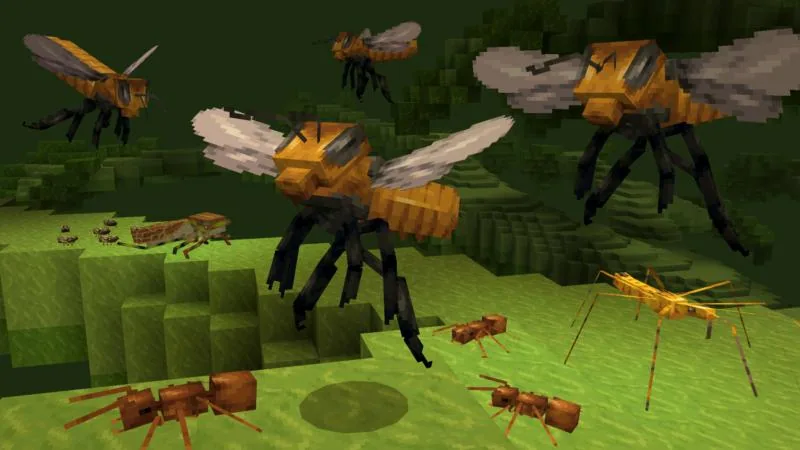
In nature, organisms often rely on each other to survive. This lesson investigates the mutualistic partnership between the treehopper (Aetalion reticulatum) and stingless bees native to the Amazon rainforest in Ecuador. While treehoppers provide bees with sweet honeydew, stingless bees actively shield defenseless treehopper nymphs from predatory threats such as assassin bugs.
Using both tactile unplugged demonstrations and Minecraft gameplay, learners explore how insects communicate and cooperate. Inside Minecraft, students step directly into the roles of a mother treehopper guiding nymphs and a stingless bee patrolling branches to repel predators, cementing their understanding of ecosystem interdependence.
Learning objectives
By the end of this lesson students will be able to:
- Define mutualism and explain how both treehoppers and stingless bees benefit from their relationship.
- Demonstrate how treehoppers communicate distress to their nymphs using vibrations.
- Describe the role stingless bees play in defending treehopper young against predators.
- Analyze how environmental disturbances such as deforestation could disrupt species partnerships.
Blocks and items used in this lesson
 Bee
 Honey Bottle
 Jungle Leaves
 Jungle Log
 Vines
Key vocabulary
- Mutualism
- A cooperative relationship between two different species where both organisms receive benefits.
- Nymph
- The young, immature form of an insect, such as a baby treehopper.
- Honeydew
- A sugary liquid excreted by treehoppers that serves as a food source for stingless bees.
- Distress Signal
- A warning sent through vibrations or other cues to alert young or allies of immediate danger.
- Ecosystem
- A community of interacting living organisms and their physical environment.
Before class
Lesson sequence
Suggested timing: about 60 minutes in total.
- Introduction & Concept Hook10 min
Open by asking students to identify relationships in their daily lives where both parties benefit, such as parents and children or pets and owners. Introduce the term mutualism and show Ecuador on a world map to introduce the Amazonian treehopper (Aetalion reticulatum) and the stingless bee.
- Unplugged Vibration Lab15 min
Demonstrate vibrational communication. Distribute balloons tied with rubber bands containing small objects and connected to a length of string. Have students hold the string taut and gently tap the balloon, observing how vibrational distress signals travel along the line just as treehoppers signal their nymphs.
- Predator Roleplay Activity10 min
Assign students roles using cards: baby treehoppers, protective stingless bees, and a small group of predatory assassin bugs. Run a 3- to 5-minute timed game where bees work to shield treehoppers while assassin bugs attempt to tag them, demonstrating the protective side of mutualism.
- Minecraft In-Game Simulation15 min
Launch the Minecraft world. Students play two distinct roles: first as a treehopper mother moving nymphs between feeding zones and knocking away predators, and second as a stingless bee defending nymphs across the canopy in exchange for honeydew rewards.
- Discussion & Ecosystem Reflection10 min
Regroup to debrief the game and Minecraft experiences. Discuss what strategies bees used to protect treehoppers and prompt students to consider how threats like deforestation could reduce feeding sites and destabilize both populations.
Assessment: success criteria
- Student accurately identifies the exchange of goods and services: honeydew for the bee, defense for the treehopper.
- Student describes how vibrations serve as a communication method between parent treehoppers and nymphs.
- Student completes both in-game roles (treehopper mother and stingless bee protector) according to the task rules.
- Student explains at least one consequence of habitat loss on the treehopper-bee relationship.
Differentiation
Provide visual diagrams of the treehopper life cycle and pre-assign clear buddy pairs during the physical roleplay and Minecraft phases.
Ask advanced learners to write a brief prediction about how the loss of stingless bees would alter the population numbers of assassin bugs and treehoppers over time.
Knowledge check
5 questions to check understanding after the lesson. Tap an answer to see if it is right; the score appears at the end.
1What food source do stingless bees obtain from treehoppers?
Answer: A. Stingless bees consume the sugary honeydew produced by treehoppers.
2How do treehoppers primarily send distress warnings to their young nymphs?
Answer: C. Treehoppers communicate with their nymphs by sending vibrations along plant surfaces.
3Which predator threatens treehopper nymphs during the roleplay activity?
Answer: B. Assassin bugs act as the primary predators trying to catch treehopper young.
4What major benefit do treehoppers receive from having stingless bees nearby?
Answer: B. Stingless bees guard and defend treehoppers and their nymphs from attacking predators.
5How does deforestation threaten the mutualistic relationship between treehoppers and stingless bees?
Answer: D. Habitat destruction limits feeding areas, which can cause population declines and break their cooperative relationship.
Resources
- Lesson package (.zip)Everything the author attached to this lesson in one download.
- Treehoppers and Stingless Bees PPTTreehoppers and Stingless Bees Classroom Presentation
- The Stingless Bee FactsThe Stingless Bee Fact Sheet
- The Treehopper Fact SheetThe Treehopper Fact Sheet
- Lesson worldOpens the world page in Minecraft Education (sign-in with a school account may be needed).
Part of the Planet Earth III curriculum
This is lesson 4 of 5 in Planet Earth III.
- An Ecosystem Jigsaw
- Fur Seal-Great White Shark Showdown
- Lily-trotter Nest Challenge
- Mutualistic Vibes
- The Arctic Wolf – Musk Ox Challenge
Frequently Asked Questions
Do stingless bees sting players or predators in this lesson?
Stingless bees do not have functional stingers, but they defend treehoppers from predators using active physical deterrence and protective movements.
What supplies are needed if balloons are unavailable for the vibration activity?
Any setup that lets students feel physical movement through a taut line, such as cups connected by string or tapping directly on a shared desk, can demonstrate vibrational signals.
Adapted from Mutualistic Vibes by Minecraft Education on Minecraft Education, last updated Jan 16, 2024. This classroom version, the timings and the quiz were written by 9Minecraft Education.