- Type
- Lesson plan
- Ages
- Ages 8-13
- Duration
- 1 hour
- Level
- Beginner
How do solitary great white sharks and social Cape fur seals interact within their shared marine ecosystem?
Overview
At the Robberg Nature Reserve in South Africa, recovering Cape fur seal colonies share coastal waters with hunting great white sharks. This lesson explores the delicate balance between predators and prey, examining how solitary hunters stalk their meals and how social marine mammals rely on group defense and rocky coastal terrain to protect their pups and territory.
Students begin with a map activity and an active physical simulation before launching into Minecraft. In the digital environment, students take on both perspectives: dodging danger and rallying the colony as a Cape fur seal, then tracking scent trails to secure a meal as a great white shark.
Learning objectives
By the end of this lesson students will be able to:
- Describe how Cape fur seals use social grouping and rocky terrain to protect their territory and pups.
- Explain the hunting strategies and challenges faced by solitary great white sharks.
- Simulate predator-prey interactions through both a physical boundary game and Minecraft tasks.
- Discuss how historical human hunting and modern conservation affect coastal marine ecosystems.
Blocks and items used in this lesson


Key vocabulary
- Solitary hunter
- A predator that hunts on its own rather than cooperating in a pack or group.
- Shoal
- A large group of fish swimming together.
- Explosive acceleration
- A sudden, rapid burst of speed used to attack prey or escape danger.
- Mobbing
- A defensive behavior where prey animals band together in large numbers to deter a predator.
Before class
Lesson sequence
Suggested timing: about 60 minutes in total.
- Introduction and Habitat Mapping10 min
Display images of the Cape fur seal and great white shark. Ask learners to identify each animal and share their reasoning. Explain that both live off the Robberg Peninsula at the Robberg Nature Reserve in South Africa. Direct students to find and color this location on their maps, then read the species fact sheets.
Inform the class that seals recently recolonized this area after earlier unregulated hunting wiped them out, which in turn attracted unprecedented numbers of great white sharks. Prompt students to predict how seals protect themselves.
- Unplugged Showdown Game20 min
Move to an open gym or field marked with boundary cones representing the seal territory and the sea. Divide students into two teams: Cape fur seals (wearing ribbons or scarves) and great white sharks (wearing wristbands or headbands).
- Seals aim to remain inside their territory and protect the colony.
- Sharks must infiltrate the area and tag five seals (representing failed and successful hunting attempts) to earn a single meal before leaving the play area.
- Run a 5-minute timed round, then hold a debrief about shark stealth versus seal mobbing tactics.
- Minecraft Animal Perspectives20 min
Direct students to launch the lesson world to experience both ecological roles:
- Cape Fur Seal: Catch a set number of fish while evading the shark. If the predator gets close, gather other seals into a mob to drive it away.
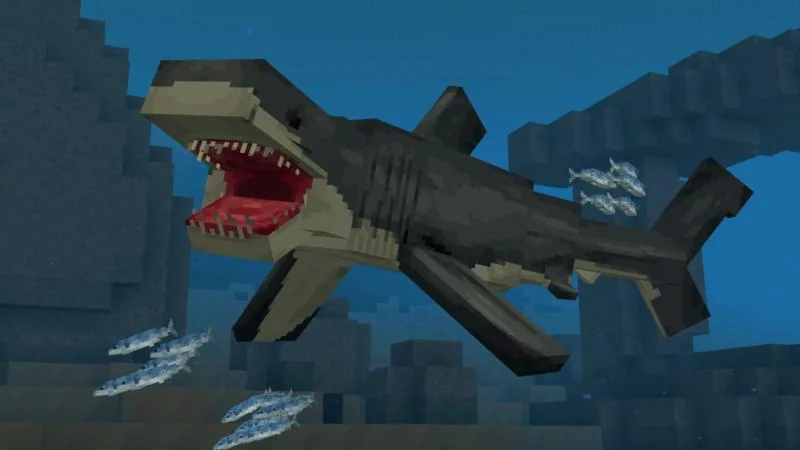
- Great White Shark: Follow the scent trail of the seals through the water and attempt a successful catch before energy runs out.
- Debrief and Creative Extension10 min
Lead a think-pair-share discussion on the energy costs of hunting, asking what happens to a shark that is repeatedly driven away without catching food. For an optional creative extension, use the Ocean Biome world to have students design an ecotourism plan for the rocky coastline that brings visitors in without disturbing the seal colony or harming the marine ecosystem.
Assessment: success criteria
- Identify Cape fur seals and great white sharks and accurately mark the Robberg Peninsula on a regional map.
- Articulate how seal groups use mobbing behaviors and underwater rocks to deter solitary sharks.
- Explain why solitary hunting can be difficult and energy-draining for great white sharks.
- Successfully complete both the seal gathering and shark tracking objectives in the Minecraft world.
Differentiation
Pair students during map research and let them complete the Minecraft food-gathering and mobbing challenges as collaborative partners.
Develop an ecotourism and conservation proposal in the Ocean Biome world balancing human coastal development with seal and shark preservation.
Knowledge check
5 questions to check understanding after the lesson. Tap an answer to see if it is right; the score appears at the end.
1Where is the protected marine area highlighted in this lesson located?
Answer: A. The lesson specifically focuses on Cape fur seals and great white sharks interacting at the Robberg Nature Reserve in South Africa.
2What strategy do Cape fur seals use to defend themselves against hunting great white sharks?
Answer: B. Fur seals use sheer force of numbers in mobs and use rocks to make it difficult for sharks to reach them.
3In the physical showdown game, why must a shark tag five seals before earning a meal?
Answer: C. The game rules state that tagging five times represents repeated hunting attempts because sharks frequently miss catches in nature.
4What action must a player take as a Cape fur seal in Minecraft when a shark comes near?
Answer: B. In the Minecraft activity, the seal player must rally other seals in time to mob and deter the nearby shark.
5Why had Cape fur seals previously disappeared from the Robberg area before recently returning?
Answer: D. The teacher notes explain that humans hunted the fur seals without rules or limitations until they were wiped out locally.
Resources
- Lesson package (.zip)Everything the author attached to this lesson in one download.
- Cape Fur Seal FactsThe Cape Fur Seal Fact Sheet v1.0
- Great White Shark FactsThe Great White Shark Fact Sheet v1.0
- Seals and Sharks PPTCape Fur Seals and Great White Sharks classroom presentation
- Lesson worldOpens the world page in Minecraft Education (sign-in with a school account may be needed).
Part of the Planet Earth III curriculum
This is lesson 2 of 5 in Planet Earth III.
- An Ecosystem Jigsaw
- Fur Seal-Great White Shark Showdown
- Lily-trotter Nest Challenge
- Mutualistic Vibes
- The Arctic Wolf – Musk Ox Challenge
Frequently Asked Questions
What equipment is required for the physical showdown activity?
You need an open area such as a gymnasium or sports field, boundary cones, a timer, colored ribbons or scarves for the seals, and colored headbands or wristbands for the sharks.
How does the optional creative extension connect to human impact?
The optional extension challenges students to design responsible ecotourism around coastal rocks in the Ocean Biome world, encouraging visitors without disturbing recovering seal colonies or the sharks that hunt nearby.
Adapted from Fur Seal-Great White Shark Showdown by Minecraft Education on Minecraft Education, last updated Jan 16, 2024. This classroom version, the timings and the quiz were written by 9Minecraft Education.